What Does Cash To Close Mean And How Much Do I Need To Buy A Home

Buying a home around Austin is exciting. It is also one of the biggest financial decisions most people will ever make. One of the most common questions I hear from buyers is simple, honest, and incredibly important: what does cash to close mean and how much do I need to buy a home? That question sits right at the heart of preparing for a successful purchase.
Howdy, I'm Robbie English, Broker, REALTOR with Uncommon Realty. I help buyers all across Austin and Central Texas understand the numbers behind buying a home so they can move forward with confidence. When someone understands what their cash to close looks like, the entire process becomes smoother, clearer, and a whole lot less stressful.
Many buyers assume the only money they need is a down payment. That is only part of the story. Cash to close includes multiple costs that come together near the finish line of a transaction. These costs include lender fees, title costs, prepaid expenses, insurance, and several other items that appear on the closing disclosure. When you add everything together, the total number becomes the amount you must bring to the closing table.
Over the years I have guided buyers through this process across neighborhoods like Northwest Austin, Great Hills, Cedar Park, Round Rock, Leander, Georgetown, and Lakeway. Every buyer arrives with different goals, different financial situations, and different questions about the numbers. My role is to help translate those numbers into a clear path forward.
Understanding what does cash to close mean and how much do I need to buy a home is not about memorizing a formula. It is about understanding the pieces that make up the total and knowing how to plan ahead. When you know the numbers early, you gain control over the process instead of reacting to it.
That is exactly where experience matters. I have spent decades helping buyers navigate the details of real estate transactions. I also teach real estate professionals across the country as a national real estate instructor and speaker. I spend my time mastering the details so my clients can focus on finding the right home.
If you are thinking about buying a home anywhere around Austin, this guide will walk you through the numbers step by step so you know exactly what to expect.

TLDR (Too Long; Didn't Read): What Does Cash To Close Mean And How Much Do I Need To Buy A Home
- Cash to close represents the total amount of money you must bring to the closing table to complete your home purchase.
- Your total usually includes the down payment, closing costs, prepaid expenses, and adjustments.
- Down payments may range from zero percent to twenty percent depending on the loan program.
- Earnest money and option money are early deposits that later apply toward your closing costs and down payment.
- Planning your finances early with a trusted lender and REALTOR helps you approach the purchase with clarity and confidence.
Understanding What Cash To Close Really Means
Let's start with the core concept. When people ask what does cash to close mean and how much do I need to buy a home, they are asking about the final amount of money required to complete the purchase of the property.
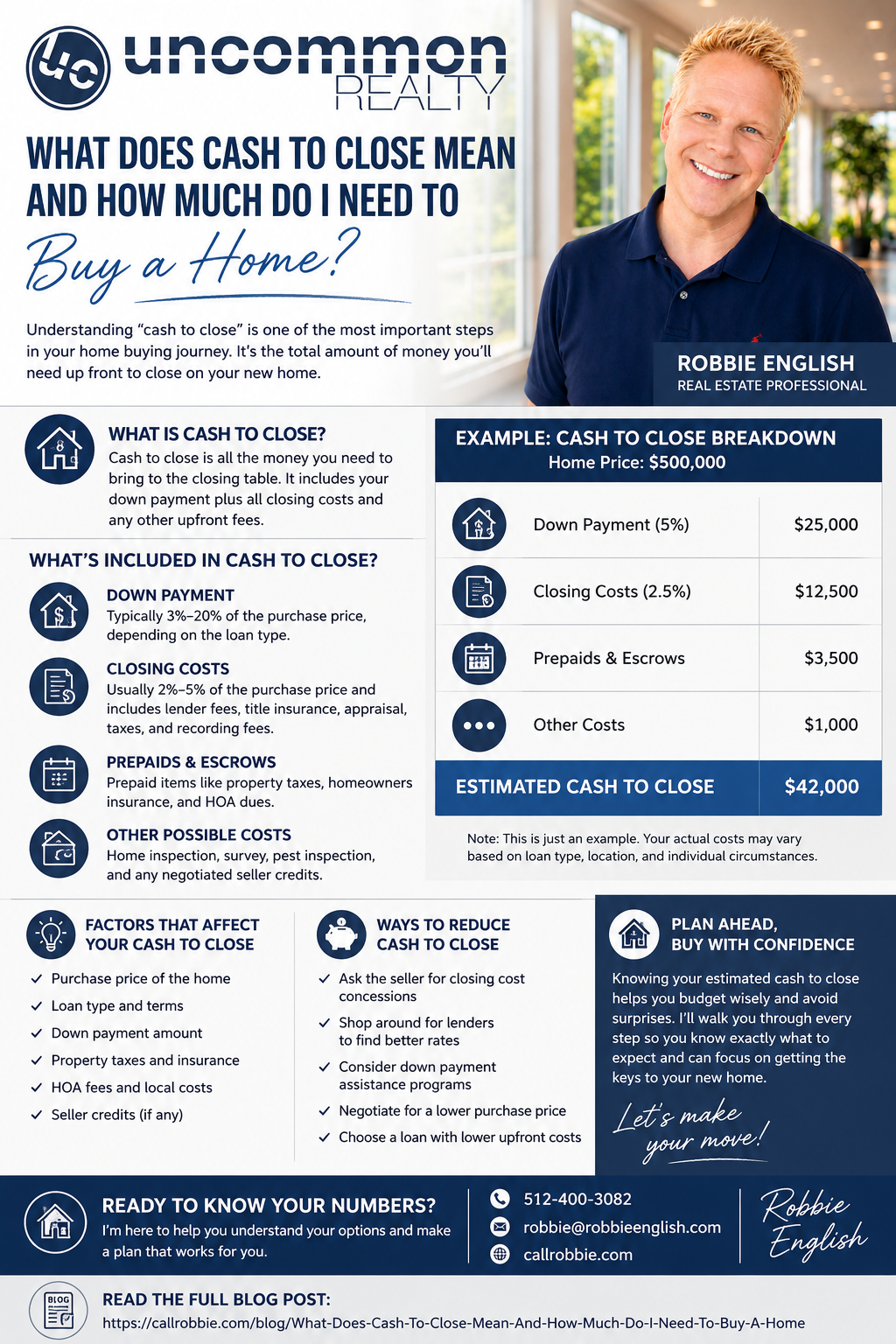
Cash to close represents your total out of pocket expense at the end of the transaction. It combines your down payment with the various closing costs and prepaid expenses required by your lender and the title company. Think of it as the complete financial snapshot of your purchase. It shows the total funds needed to move ownership of the home into your name.
These funds typically include loan origination fees, appraisal costs, credit report fees, title insurance fees, title company closing fees, recording fees, transfer fees, insurance premiums, and prepaid items such as property taxes and mortgage interest. Homeowners association fees may also appear if the property sits within a neighborhood governed by an association. In areas like Northwest Austin, Circle C Ranch, Steiner Ranch, or Teravista in Round Rock, HOA fees are quite common and often appear as prorated costs at closing.
Once all these items come together, the total becomes your cash to close.
When buyers understand this concept early in the process, they avoid surprises. That is one of the biggest advantages of working with an experienced REALTOR who walks through the numbers ahead of time.
The Difference Between Cash To Close And Closing Costs
Many buyers confuse two important terms. Cash to close and closing costs are not the same thing.
Closing costs represent the fees and expenses associated with completing the transaction. These include lender fees, title services, recording fees, and administrative costs required to finalize the transfer of ownership.
Cash to close includes those closing costs, but it also includes your down payment and prepaid expenses. In other words, closing costs are one part of the bigger number.
For most buyers around Austin, closing costs typically fall somewhere between 2%-5% of the purchase price. That percentage can shift depending on the loan program, lender fees, and other transaction details.
Prepaid items and escrows often add another 1%-3% to the total. These items usually include property taxes, insurance premiums, and prepaid mortgage interest that must be collected ahead of time.
Once these amounts combine with your down payment, the result becomes the amount you must bring to closing. Understanding that difference helps buyers plan their finances accurately.
How Down Payment Fits Into The Equation
The down payment is the portion of the home price you pay upfront when purchasing the property. It represents your initial equity in the home.
Many buyers believe they must put down 20%. That used to be a common expectation, but today buyers have far more options available.
Some loan programs allow buyers to purchase with 0% down. Others may require 3%-5%, or somewhere in between. Conventional loans often allow down payments between 3%-20% depending on the borrower's financial profile.
The important point is that your down payment becomes a major part of your total cash to close.
For example, a buyer purchasing a home in Cedar Park or Leander might choose a five percent down payment. That amount becomes part of the total funds needed at closing.
Every buyer's situation is different. This is why the conversation with a lender early in the process becomes so important.
Why Speaking With A Lender Early Changes Everything
One of the most important steps a buyer can take happens before touring homes. That step is speaking with a mortgage professional and getting preapproved.
Too many buyers start by browsing homes online and falling in love with properties before they understand their financial numbers. That approach creates stress later.
Instead, I encourage my clients to lead with the approval.
Meeting with a lender early allows you to discuss loan options, understand interest rate impacts, and determine a price range that fits comfortably within your financial goals. You gain clarity about the down payment, closing costs, and estimated cash to close.
A good lender also reviews credit, income, and financial history so any necessary adjustments can happen early.
When buyers start with this conversation, the entire home search becomes more focused. You are not guessing. You are making informed decisions.
Earnest Money And How It Works In Texas
Earnest money plays an important role in Texas real estate contracts. It demonstrates to the seller that the buyer is serious about completing the purchase.
In many Austin area transactions, earnest money typically ranges between 1%-3% of the purchase price. The exact amount often depends on market conditions and the negotiation between the buyer and seller. Once the contract becomes effective, the earnest money must be delivered to the title company within the timeline specified in the agreement.
In Texas, earnest money and option money are generally due three days after the effective date of the contract. The day the contract becomes effective counts as day zero. The following day becomes day one.
If the final day to deliver these funds falls on a Saturday, Sunday, or legal holiday, the deadline extends to the next day that is not a weekend or holiday.
This timeline matters greatly because failing to deliver the funds on time can affect the contract rights of the buyer.
What Happens To Earnest Money At Closing
Many buyers worry that earnest money is an extra cost. In reality, it usually becomes part of the funds applied toward your purchase.
When the transaction moves forward successfully, the earnest money deposit gets credited toward your down payment and closing costs at the closing table. In other words, it becomes part of your total cash to close rather than an additional expense.
Earnest money also interacts with contract contingencies. If a contingency such as financing approval, property inspection, or appraisal cannot be satisfied, the earnest money is often refundable.
However, once those contingencies are cleared and the transaction proceeds toward closing, the earnest money typically becomes non refundable. Understanding these rules helps buyers navigate the contract process with confidence.
The Role Of Option Money And The Option Period
Texas real estate contracts include something unique called the option period. This period gives the buyer the unrestricted right to terminate the contract within a certain number of days.
To receive that right, the buyer provides option money to the seller. The amount is negotiated between the parties and often ranges from a small amount to a few hundred dollars or more depending on the situation. Just like earnest money, option funds must be delivered within the contract timeline.
If the option money is not delivered on time, the buyer loses the unrestricted right to terminate the contract during the option period. That right is extremely valuable because it allows the buyer to investigate the property thoroughly before fully committing.
Because of this importance, I always guide my clients carefully through the delivery process.
Inspections And Why They Are Worth Every Dollar
During the option period, buyers typically schedule property inspections. These inspections help identify potential issues with the home before the purchase becomes final. A general home inspection often forms the foundation of this review. Depending on the property, buyers may also choose additional inspections such as foundation evaluations, plumbing reviews, or roof inspections.
These inspections involve costs paid by the buyer. However, they provide valuable insight into the condition of the property.
I often remind buyers that inspection costs represent an investment in protecting their future. Discovering a major issue early allows a buyer to renegotiate repairs, request concessions, or terminate the contract if necessary.
Walking away from a problematic property during the option period can save thousands of dollars and countless headaches later.
Wiring Funds And Why Timing Matters
When it comes time to deliver earnest money, option money, or final closing funds, buyers often wire money to the title company. This process requires careful attention. The funds must be received by the title company before the deadline, not simply sent before the deadline.
There is a big difference between funds being sent and funds being received. Wire transfers can take time to process depending on the bank and the time of day the wire is initiated. Because of that delay, buyers should never wait until the final moment to send funds.
Title companies also provide detailed wiring instructions to prevent fraud. Buyers should always confirm these instructions directly with the title company before sending any money.
Handling wires correctly protects both the buyer and the transaction.
How Local Experience Helps Buyers Navigate These Details
Buying a home involves many moving parts. Contracts, inspections, lender coordination, title deadlines, and financial planning all work together throughout the process.
That is where experience becomes a real advantage.
Again, I am Robbie English, Broker, REALTOR with Uncommon Realty, I have spent decades helping buyers across Central Texas navigate the journey of homeownership. I guide clients through neighborhoods all across the region including Northwest Austin, Brushy Creek, Round Rock, Georgetown, Lakeway, Leander, and Cedar Park.
My clients benefit from more than local experience. I also serve as a national real estate instructor and speaker, teaching agents across the country the mechanics of real estate transactions. That perspective gives my clients an advantage because I stay deeply connected to the technical side of the industry.
When someone asks what does cash to close mean and how much do I need to buy a home, they deserve an answer that comes from real experience, not guesswork.
My goal is always to provide clarity. I want buyers to understand the numbers, understand the timeline, and move forward with confidence.
Planning Ahead Creates A Smoother Closing
When buyers prepare early, the closing process becomes far more predictable.
Understanding the total cash to close allows you to organize your finances ahead of time. It helps you decide how much you want to invest in the purchase and how the monthly payment fits into your long term goals.
Preparation also helps buyers avoid last minute stress. When funds are already positioned and timelines are understood, closing day becomes an exciting milestone instead of a scramble.
Austin continues to attract people who appreciate its vibrant culture, outdoor spaces, and growing economy. From the hills of West Austin to the tech corridors of North Austin and the expanding communities in Williamson County, buyers have many options when choosing a place to call home.
Each of those areas comes with its own pricing trends and property types. Having a guide who understands those nuances makes the entire process smoother.
Why Choosing The Right REALTOR Matters
Real estate transactions involve far more than paperwork. They require strategy, negotiation, and careful attention to details that many buyers never see behind the scenes.
I have spent years strategically working to master real estate so my clients benefit from that knowledge. Every transaction adds another layer of experience that helps the next buyer succeed.
My team at Uncommon Realty focuses on providing expert guidance throughout the entire process. From the first conversation about finances to the moment the keys land in your hand, we help navigate the details that shape the experience.
Understanding what does cash to close mean and how much do I need to buy a home represents just one part of the journey. When buyers understand the numbers and work with the right professionals, the path to homeownership becomes far more achievable.
If you are considering buying a home anywhere around Austin or Central Texas, I would be honored to help guide you through the process.
Again, I'm Robbie English, Broker, REALTOR with Uncommon Realty. Helping buyers understand the numbers behind their purchase is one of the ways I help them move forward with confidence. When the numbers make sense and the plan is clear, that is when the excitement of finding the right home truly begins.
Categories
- All Blogs (851)
- !!! (14)
- !x (576)
- Austin Real Estate (91)
- Bee Cave Real Estate (1)
- Building A Home (6)
- Buying A Home (120)
- Cedar Park Real Estate (56)
- Central Austin Real Estate (75)
- Downsizing (3)
- Downtown Austin Real Estate (5)
- Dripping Springs Real Estate (60)
- East Austin Real Estate (3)
- Financing and Mortgage (13)
- first-time homebuying (96)
- Georgetown Real Estate (5)
- Hill Country Real Estate (1)
- HOA (1)
- Home Appraisals (3)
- Home For Rent (1)
- Home Inspections (3)
- Home Pricing (1)
- Home Values (6)
- Homeownership (1)
- Homes For Rent (1)
- Homes For Sale (146)
- Hutto Real Estate (1)
- Lakeway Real Estate (32)
- Leander Real Estate (58)
- LGBT+ Real Estate (8)
- Luxury Homes For Sale (4)
- Luxury Real Estate (18)
- Market Conditions (9)
- Moving to Texas (3)
- Negotiations (2)
- Neighborhoods (8)
- Northwest Austin Real Estate (93)
- Off Market Listings (6)
- Pflugerville Real Estate (6)
- Private Listings (2)
- Property Management (42)
- Real Estate (11)
- Reddit Question Answered (73)
- redwrite (63)
- Renting (4)
- Representation (32)
- Round Rock Real Estate (55)
- Selling Your Home (38)
- Westlake Real Estate (2)
Recent Posts