
4 Signs You Might Want To Walk Away After The Home Inspection

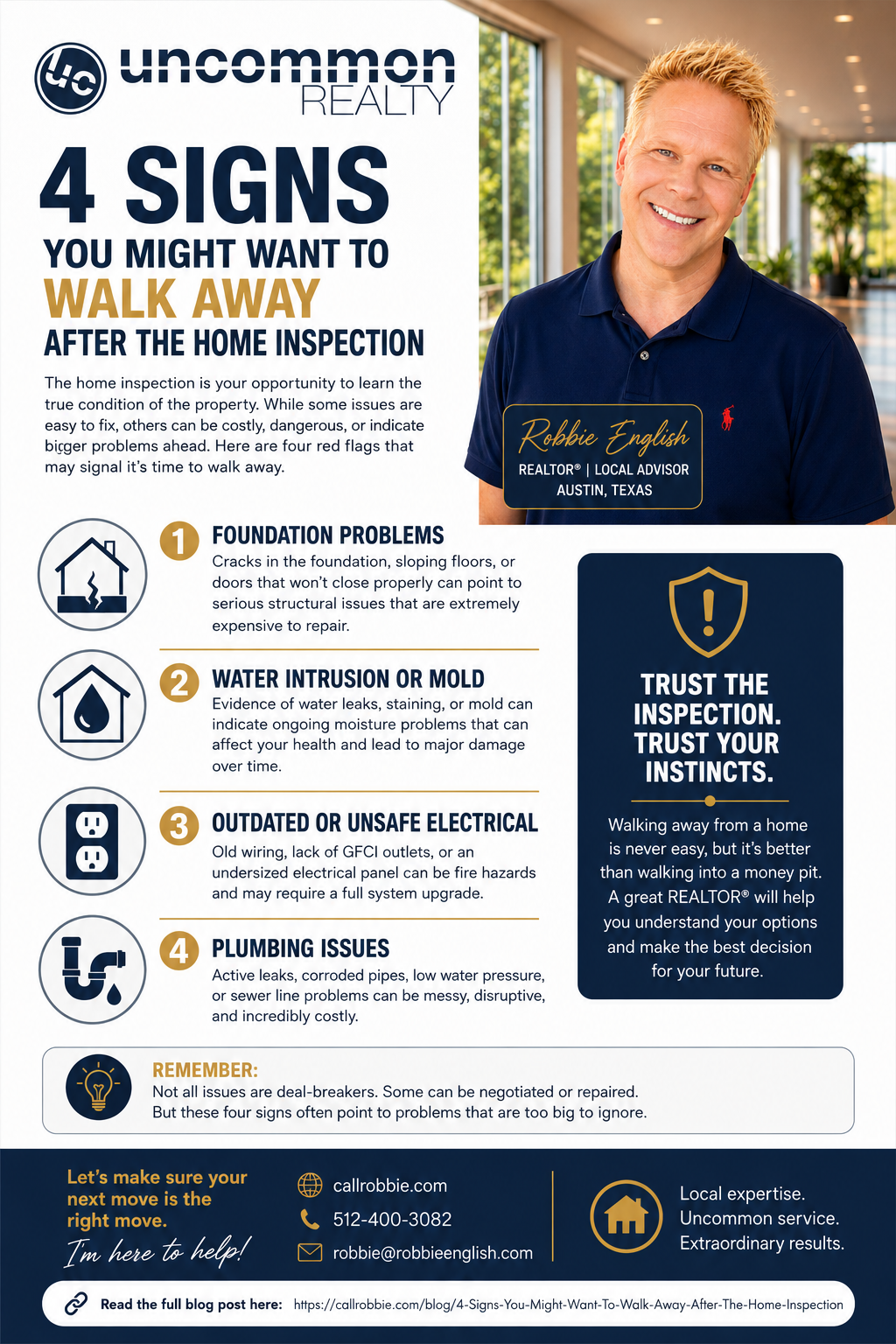
So, a home inspection genuinely uncovers something on nearly every property, and most of those findings are genuinely negotiable, a repair credit, a modest price adjustment, or simply items to address later after closing. But a handful of specific findings are serious enough that walking away, using your Texas option period while you still can, is often the smarter move than trying to negotiate through them. This guide covers four real categories of findings worth taking seriously, and how to think through the decision when you're facing one.
I am Robbie English, Broker, REALTOR at Uncommon Realty, and I've guided buyers through inspection decisions across Austin for years. My goal here is to help you tell the difference between a normal negotiation point and a genuine reason to walk.

Sign One: Significant, Active Foundation Movement
Central Texas's genuinely expansive clay soils mean some foundation-related findings are entirely common and manageable, minor settling cracks, doors that stick seasonally. What's genuinely different is evidence of significant, active movement: substantial stair-step cracking in brick or block, multiple doors and windows that won't close properly throughout the home, visibly sloping floors, or a foundation engineer's report recommending structural repair rather than simple monitoring.
Foundation repair costs can genuinely run into five figures depending on the specific severity and repair method required, and the underlying cause isn't always fully or permanently resolved even after the repair work itself is complete. If your inspection reveals signs genuinely serious enough to warrant a specialized foundation engineer's evaluation, get that evaluation promptly during your option period before deciding whether to move forward, negotiate a specific remedy, or walk away entirely.
Sign Two: Active Water Intrusion Or Widespread Mold
A single, clearly resolved past leak with visible, professional repair work is a genuinely normal, common finding worth noting but not necessarily worrying about. Active water intrusion, wet insulation, current moisture readings inside walls, or mold visible in multiple areas of a home is a different category of problem entirely. Mold remediation can be genuinely expensive depending on scope, and more importantly, active water intrusion signals an ongoing source that hasn't been identified or fixed, meaning the problem will likely continue and potentially worsen after you close.
If your inspector recommends a specialized mold assessment or moisture-mapping evaluation, get it during your option period. A seller unwilling to identify and fully address an active water source before closing is asking you to inherit an unresolved, potentially worsening problem.
Sign Three: Electrical Or Structural Issues Beyond Simple Repair
Some electrical findings are genuinely routine, an outdated panel, a handful of ungrounded outlets, and are relatively inexpensive to bring fully up to current standard. Others are more serious: knob-and-tube or aluminum wiring throughout an older home, a panel with active fire risk, or evidence of amateur electrical work that doesn't meet code, particularly in wet areas like kitchens and bathrooms. These findings sometimes mean a full rewire is genuinely necessary, a substantial cost most buyers haven't budgeted for.
Structural findings beyond the foundation itself, a visibly sagging roofline, evidence of a removed load-bearing wall without proper engineered support, or significant termite damage to key structural members, fall into that same serious category. These aren't cosmetic fixes; they're findings that can fundamentally change the true cost and timeline of owning the home safely.
Sign Four: A Seller Unwilling To Negotiate In Good Faith
Sometimes the finding itself is genuinely negotiable, but the seller's response to it reveals something worth paying attention to. A seller who refuses to provide any credit or concession for a legitimate, documented safety issue, who becomes evasive about a finding's history, or who reveals through their response that they knew about a serious issue and didn't disclose it, is signaling something beyond just the specific repair item on the table.
Texas's Seller's Disclosure Notice requires sellers to disclose known material defects, and a seller's reaction to your inspection findings sometimes reveals whether that disclosure was made honestly and completely. If you have real reason to believe a seller knowingly concealed a significant issue, that's a genuine trust problem, well beyond a simple repair-cost problem, and it's worth weighing heavily in your decision to move forward.
Getting The Right Specialist For A Serious Finding
A general home inspector is trained to identify potential red flags and recommend further evaluation, not to definitively diagnose a foundation or structural issue's severity or exact repair cost. When your inspection turns up something in these serious categories, bringing in the right specialist matters more than getting a second general opinion. A structural or foundation engineer can give you an actual professional assessment of severity and likely repair scope; a licensed electrician can assess whether wiring findings require a full rewire or targeted repairs; a certified mold assessor can determine whether visible growth reflects a contained, resolved issue or an active, spreading one.
These specialist evaluations cost money and take some coordination during an already time-pressured option period, but they're genuinely worth it relative to the alternative: making a five- or six-figure decision based on a general inspector's necessarily limited assessment of a specialized problem.
Documenting Everything As You Go
Keep thorough, organized records throughout this entire process: the original inspection report, any specialist evaluations, repair estimates you personally gather, and all communication with the seller and their agent about the specific findings in question. This documentation matters for your own decision-making, but it also matters if a negotiation breaks down and you need clear records of what was found, what was requested, and how the seller responded.
If you do ultimately walk away, this documentation is also useful for your own future reference, both to explain your decision to anyone involved in your search and to help you evaluate the next property you consider more efficiently, since you'll have a clearer sense of what specific red flags to watch for going forward.
What A Normal, Negotiable Finding Looks Like By Contrast
Most inspection findings don't belong in the categories above. An aging but currently functional HVAC system, a roof with some remaining life left but approaching replacement, minor plumbing fixture issues, or cosmetic wear are all genuinely normal parts of buying an existing home, especially one with any real age to it. These are appropriately handled through a repair credit, a price adjustment, or simply factored into your own post-closing budget, not treated as reasons to walk away from an otherwise good home.
The distinction that matters is scope and safety: is this a defined, bounded cost you can reasonably estimate and budget for, or is it an open-ended, potentially worsening problem with real safety implications and an unclear true cost? The first category is negotiable; the second deserves serious consideration of walking away.
How To Use Your Option Period Effectively
Texas's option period gives you a negotiated window to inspect the home and terminate the contract for any reason in exchange for a modest fee paid to the seller, and it's specifically designed to protect you through exactly this kind of decision. Schedule your inspection as early in that window as possible, so you have genuine time remaining to order follow-up evaluations, foundation engineer, mold specialist, licensed electrician, if your general inspector's findings warrant one.
Don't let time pressure push you into a decision before you've gotten the specialized evaluation a serious finding actually requires. If your option period is genuinely too short to complete that follow-up diligence, it's worth asking the seller for a brief extension rather than deciding on incomplete information; a reasonable seller with nothing to hide will often grant it.
Negotiating Versus Walking Away: How To Decide
When a finding falls into a gray area, weigh the true, complete cost of the fix against the home's overall value and how much you specifically want this particular property. A serious finding on a home you can easily walk away from and find comparable to elsewhere is a much easier decision than the same finding on a genuinely unique property in a location you couldn't easily replace.
Get real, specific repair estimates from qualified professionals before you decide, not general assumptions or rough guesses, since actual costs sometimes differ significantly, in either direction, from what you might reasonably assume based on the inspection report's language alone. A repair that sounds alarming in an inspector's cautious, liability-conscious phrasing can sometimes turn out to be more modest in actual cost once a specialist provides a real quote. A seller may also be willing to address the issue directly before closing, provide a credit large enough to cover it, or reduce price meaningfully, any of which can turn a walk-away finding into a manageable one depending on the specific numbers.
The Emotional Side Of This Decision
Walking away from a home you've genuinely fallen in love with, even when the inspection findings clearly warrant it, is emotionally difficult, and it's worth acknowledging that directly rather than pretending the decision is purely rational. Buyers sometimes talk themselves into accepting a serious risk specifically because they've become emotionally invested in a particular home, its location, its layout, the vision they'd already built for living there.
It helps to separate the emotional attachment from the actual facts on the table before you decide. Ask yourself honestly whether you'd make the same decision about this specific finding if it were a different, less emotionally compelling house, since that comparison often reveals whether you're evaluating the finding objectively or rationalizing around it.
Considering Your Own Risk Tolerance And Resources
Two buyers can reasonably reach different conclusions about the same inspection finding based on their own genuine risk tolerance and financial resources. A buyer with substantial reserves and genuine appetite for a renovation project might reasonably take on a serious foundation issue at a meaningfully reduced price, while a buyer stretching their budget to the maximum on this purchase should weigh that same finding far more conservatively, since they have less financial cushion to absorb an unexpected cost overrun.
Neither approach is wrong; what matters is being honest with yourself about which situation actually describes you, rather than assuming you can handle a risk simply because you want the home badly enough.
When A Seller's Prior Disclosure Matters
Compare what your inspection reveals against what the seller's disclosure notice actually stated. If a serious finding was disclosed upfront and priced into your original offer, that's a meaningfully different situation than discovering something the seller's disclosure didn't mention at all. An undisclosed serious issue is worth discussing directly with your agent, since it may affect your negotiating position on this specific transaction and potentially raise real questions about what else might not have been disclosed accurately.
This isn't about assuming bad faith from every seller, most disclosures are made honestly and most sellers genuinely don't know about issues an inspection uncovers. But when a disclosure gap does show up on something serious, it's a data point worth weighing alongside the finding itself.
What Happens If You Do Walk Away
If you terminate during your option period, you're generally entitled to your full earnest money deposit back, provided the termination happens within the option period's terms, and you forfeit only the modest option fee itself. This is precisely why the option period is such valuable protection: it lets you walk away from a genuinely serious finding without major financial consequence, provided you act within the window rather than after it closes.
Once your option period has expired, terminating the contract becomes considerably more complicated and can put your earnest money at real risk depending on how your specific contract is structured and what grounds you have for terminating. This is exactly why moving efficiently through your specialist evaluations and decision-making within the option window matters as much as the substance of the findings themselves; even a genuinely serious issue is far easier to walk away from cleanly while your option period is still open than after it has passed.
Bringing It All Together
Most inspection findings are entirely normal, negotiable parts of buying an existing home, but significant, active foundation movement, active water intrusion or widespread mold, serious electrical or structural issues, and a seller genuinely unwilling to negotiate honestly are four real categories worth taking seriously as legitimate reasons to walk away rather than push forward. Using your option period fully, getting specialized follow-up evaluations when warranted, and grounding your decision in real repair estimates rather than assumptions is what protects you either way.
Whether you're facing a specific finding right now or simply want to understand this process before you're under contract, I'm glad to help you think through it and determine whether it's a genuine negotiating point or a real reason to walk away entirely. You can browse current Austin listings on my website or through my app.
Written for buyers and sellers in the Greater Austin, Texas area by Robbie English, REALTOR, Broker at Uncommon Realty.
Categories
- All Blogs (978)
- !!! (59)
- !x (621)
- Austin Real Estate (113)
- Bee Cave Real Estate (1)
- Building A Home (14)
- Buying A Home (145)
- Buying Land (1)
- Cedar Park Real Estate (58)
- Central Austin Real Estate (75)
- Down Payment Assistance Programs (1)
- Downsizing (4)
- Downtown Austin Real Estate (5)
- Dripping Springs Real Estate (62)
- East Austin Real Estate (3)
- Financing and Mortgage (24)
- first-time homebuying (109)
- Georgetown Real Estate (9)
- Hill Country Real Estate (1)
- HOA (3)
- Home Appraisals (13)
- Home For Rent (1)
- Home Inspections (6)
- Home Pricing (6)
- Home Staging (1)
- Home Values (12)
- Home Warranties (1)
- Homeownership (1)
- Homes For Rent (1)
- Homes For Sale (147)
- Hutto Real Estate (5)
- Insurance (1)
- Investing (6)
- Investment Properties (4)
- Lakeway Real Estate (33)
- Leander Real Estate (59)
- LGBT+ Real Estate (8)
- Luxury Homes For Sale (5)
- Luxury Real Estate (19)
- Market Conditions (17)
- Moving to Austin (2)
- Moving to Texas (4)
- Negotiations (3)
- Neighborhoods (8)
- Northwest Austin Real Estate (94)
- Off Market Listings (7)
- Pflugerville Real Estate (11)
- Private Listings (2)
- Property Management (42)
- Property Tax (5)
- Real Estate (18)
- Reddit Question Answered (80)
- redwrite (63)
- Relocation (2)
- Renting (6)
- Representation (34)
- Round Rock Real Estate (59)
- Selling Your Home (62)
- South Austin Real Estate (1)
- Westlake Real Estate (3)
Recent Posts