
8 Financial Benefits Of Homeownership For First-time Buyers

Buying your first home is about more than choosing a neighborhood, picking a floor plan, or finally having a place where you can paint the walls any color you please. It can also be one of the most important financial decisions you make.
Now, I am not going to sit here on the front porch and tell y’all that owning a home is automatically the right choice for every person in every season of life. Homeownership comes with responsibilities, expenses, and risks that deserve careful consideration. However, when a first-time buyer purchases thoughtfully, stays within a comfortable budget, and plans to remain in the home long enough, ownership can provide meaningful financial benefits that renting generally does not.
I am Robbie English, Broker, REALTOR with Uncommon Realty. I have spent more than 40 years in real estate and also serve as a national real estate instructor. My goal is not to pressure you into buying. My goal is to help you understand how homeownership works so you can make a clear, educated decision that supports your financial future.

TLDR: The Financial Benefits at a Glance
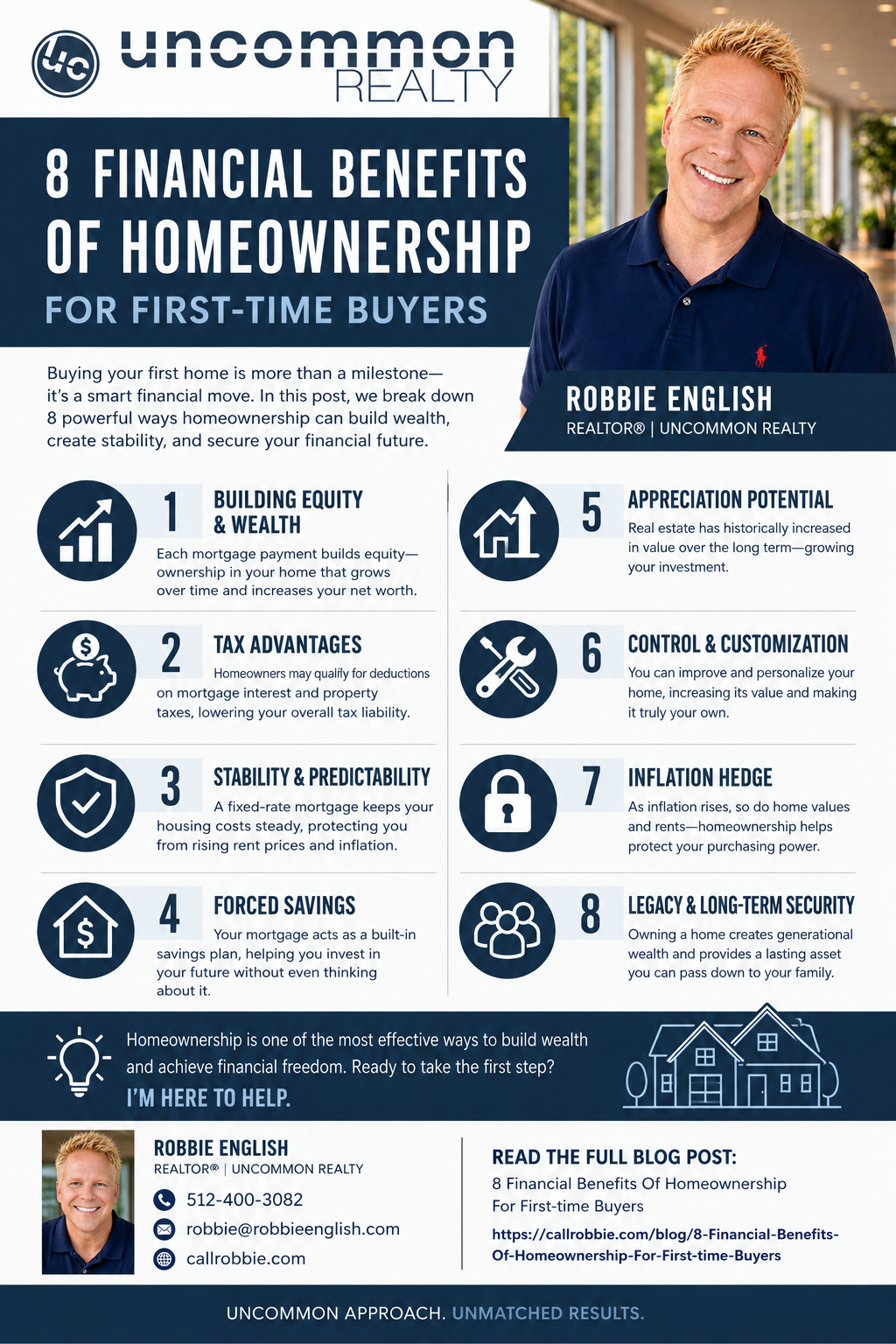
- Each mortgage payment may help you build ownership equity instead of paying only for temporary housing.
- A fixed-rate mortgage can provide more predictable principal and interest payments than a lease that may increase over time.
- Homeowners may benefit from appreciation when property values rise, although appreciation is never guaranteed.
- Certain mortgage interest and property tax expenses may provide tax benefits, depending on current law and your personal tax situation.
- Homeownership can encourage long-term saving, financial stability, and greater control over housing expenses.
1. Your Mortgage Payments Can Help Build Equity
One of the biggest financial differences between renting and owning is the opportunity to build equity. Equity is the portion of the property that you own financially. It is generally calculated by subtracting the amount you still owe on the mortgage from the home’s current value.
When you make a mortgage payment, part of that payment may reduce the principal balance of your loan. During the early years of a traditional mortgage, a larger portion of the payment typically goes toward interest. Over time, more of the payment generally begins reducing principal.
That principal reduction can gradually increase your equity. Rent payments, on the other hand, usually provide housing for the month but do not create an ownership interest in the property.
Equity should not be treated like a guaranteed savings account. Property values can rise or fall, and selling costs can reduce the amount you receive. Still, purchasing the right home at a responsible price can give first-time buyers an opportunity to build wealth through steady loan repayment.
2. Homeownership May Provide Long-Term Appreciation
Appreciation is the increase in a property’s value over time. Many homeowners have benefited when their homes became more valuable, but buyers should understand that appreciation is not automatic, predictable, or guaranteed.
A home’s future value can be influenced by its location, condition, nearby development, school boundaries, employment growth, property taxes, insurance costs, transportation access, and the balance between housing supply and buyer demand.
For a first-time buyer, the smartest approach is not to purchase based on the hope of making a quick profit. Instead, focus on buying a home that meets your needs, fits your budget, and could remain useful to you for several years.
Long-term ownership can give the property time to move through normal market cycles. It can also help spread your initial purchasing and future selling costs across a longer period. That is one reason I encourage buyers to think beyond what they need today and consider how well the home could serve them three, five, or even ten years from now.
3. A Fixed-Rate Mortgage Can Make Housing Costs More Predictable
Renters often face uncertainty when a lease comes up for renewal. The landlord may increase the rent, change lease terms, sell the property, or decide not to renew the lease at all.
With a fixed-rate mortgage, the principal and interest portion of the payment generally remains the same throughout the loan term. This can make long-range budgeting more predictable.
That does not mean the total monthly housing expense will never change. Property taxes, homeowners insurance, homeowners association dues, maintenance, and utility costs can increase. Buyers should plan for those adjustments rather than assuming their entire monthly expense will remain frozen.
Even so, having a stable principal and interest payment can create a dependable foundation for a household budget. First-time buyers who understand the complete monthly cost of ownership may be better positioned to plan for retirement contributions, emergency savings, education expenses, and other financial goals.
4. Homeownership Can Act as a Form of Forced Saving
Most of us know we should save more money, but saving consistently can be difficult. Homeownership may create a form of disciplined saving because a portion of each mortgage payment can reduce the loan balance.
This is sometimes called forced saving. You are not placing that money into a traditional savings account, and home equity is not immediately liquid. However, regular principal reduction may help build an asset over time.
For example, a homeowner who remains in a property for many years may eventually have substantial equity because of both principal repayment and any increase in value. That equity may later become available through a sale, refinance, or home equity product, subject to lending requirements and financial risks.
I always caution homeowners against treating home equity like an unlimited checking account. Borrowing against a home places the property at risk if payments cannot be made. Equity is most powerful when it is managed thoughtfully as part of a broader financial plan.
5. Some Homeownership Expenses May Offer Tax Advantages
Certain homeowners may qualify to deduct eligible mortgage interest or property taxes when filing federal income taxes. The actual benefit depends on current tax laws, deduction limits, whether the homeowner itemizes deductions, and the homeowner’s individual financial circumstances.
Not every first-time buyer will receive a meaningful tax benefit from owning a home. Tax rules can change, and online calculators often oversimplify the answer. Before purchasing based on an expected deduction, speak with a qualified tax professional who can evaluate your specific situation.
Homeowners may also encounter tax considerations when selling. In some situations, a homeowner may qualify to exclude a portion of the gain from the sale of a primary residence, provided ownership and occupancy requirements are satisfied. Again, this is an area where professional tax advice matters.
The responsible takeaway is that homeownership may provide tax advantages, but those advantages should be viewed as a possible benefit rather than the main reason to purchase.
6. Ownership Gives You Greater Control Over the Property
Financial value is not limited to dollars deposited into an account. Control over your housing can also have economic benefits.
As a homeowner, you may be able to improve the property, increase its usefulness, make energy-saving upgrades, create a home office, install storage, update landscaping, or remodel areas that no longer meet your needs. Any project must still comply with local regulations, deed restrictions, permits, and homeowners association rules.
Some improvements may increase marketability or future resale value. Others may simply improve your daily life. Buyers should not assume every dollar spent on renovations will be recovered when the property is sold.
Before making a major improvement, consider the quality of the work, neighborhood expectations, comparable properties, and whether the project is likely to appeal to future buyers. Thoughtful improvements usually perform better than highly personalized changes that reduce the home’s broader appeal.
7. Homeownership Can Create Greater Financial Stability
Stable housing can make other parts of your financial life easier to organize. When you own a home with a manageable payment, you may have greater confidence about where you will live, what your major monthly obligation will be, and how long you can remain in the property.
This stability may help families plan for work, education, childcare, retirement, or long-term community involvement. It may also reduce the expenses and disruption associated with frequent moves.
Moving from one rental to another can involve application fees, deposits, movers, utility transfers, time away from work, and new furnishing expenses. Homeowners still incur maintenance and repair costs, but they may avoid repeated relocation expenses when they remain in the same property for an extended period.
The key phrase here is manageable payment. Homeownership creates stability only when the buyer maintains sufficient savings and avoids stretching the budget too far. A home that consumes every available dollar can create stress rather than security.
8. A Home May Become a Flexible Long-Term Asset
A first home does not always have to be a forever home to provide lasting financial value. Depending on the property, financing, local regulations, and future circumstances, it may eventually become a resale asset, a rental property, or a stepping stone toward another home.
Some buyers later sell and use available equity toward the purchase of their next property. Others keep the home and explore rental possibilities. Anyone considering becoming a landlord should carefully evaluate cash flow, repairs, vacancies, insurance, taxes, tenant laws, and professional property management.
A property that works well as both a residence and a possible future investment may provide added flexibility. However, buyers should never assume a home will automatically generate profit as a rental. The numbers must work after accounting for realistic expenses.
First-time buyers who want to consider future investment potential can review educational resources about investing before making a purchase decision.
Renting and Owning: A Financial Comparison
| Financial Consideration | Renting | Homeownership |
|---|---|---|
| Monthly payment | May increase when the lease renews | Principal and interest may remain stable with a fixed-rate loan |
| Equity | Rent payments do not create ownership equity | Principal repayment may help build equity |
| Maintenance | Landlord is generally responsible for many repairs | Owner is responsible for repairs and maintenance |
| Appreciation | Tenant does not financially benefit from an increase in property value | Owner may benefit if the property appreciates |
| Flexibility | Often easier to relocate after the lease ends | Selling can require time, preparation, and transaction costs |
| Tax considerations | Generally fewer housing-related tax benefits | Certain expenses may qualify for tax benefits |
Common Financial Mistakes First-Time Buyers Should Avoid
The first mistake is focusing only on the mortgage payment. Your complete housing cost may also include property taxes, homeowners insurance, mortgage insurance, association dues, utilities, maintenance, and repairs.
The second mistake is spending every available dollar on the down payment and closing costs. Homeowners need an emergency fund because roofs leak, appliances fail, and air-conditioning systems rarely ask permission before needing repair.
The third mistake is making large purchases or opening new credit accounts before closing. Financing approval can be affected by changes in debt, employment, income, credit, or available funds. Keep your financial picture steady and follow your lender’s instructions until the transaction is complete.
The fourth mistake is assuming every home will appreciate quickly. A home should make sense for your life and budget even if its value remains relatively flat for a period.
The fifth mistake is skipping professional inspections or failing to investigate taxes, insurance availability, flood risk, utility costs, and homeowners association documents. A low purchase price does not automatically mean the home is affordable to own.
How First-Time Buyers Can Prepare Financially
- Review your complete budget. Determine what payment leaves room for savings, repairs, travel, healthcare, retirement, and everyday life.
- Check your credit early. Correcting errors and reducing debt may take time.
- Build emergency savings. Keep money available after closing rather than exhausting every account.
- Speak with a qualified lender. Learn about loan options, estimated closing costs, and how different down payments may affect the monthly expense.
- Get preapproved before shopping seriously. You can begin the process through the get preapproved page.
- Research the total cost of each property. Compare taxes, insurance, utilities, maintenance, and association expenses.
- Work with an experienced representative. A knowledgeable buyer representative can help you evaluate price, condition, terms, risk, and resale considerations.
You can also learn more about the purchase process through my buying a home resources and use the mortgage calculator to explore possible payments.
Frequently Asked Questions About the Financial Benefits of Homeownership
Is buying a home always financially better than renting?
No. The better option depends on your budget, lifestyle, local housing costs, expected length of stay, financing, and willingness to maintain a property. Renting can make more sense for someone who expects to relocate soon or needs greater flexibility.
How long should a first-time buyer plan to stay in a home?
There is no universal minimum, but buyers should consider whether they are likely to stay long enough to offset purchasing and selling expenses. The longer ownership period may provide more opportunity for principal reduction and possible appreciation.
Does every mortgage payment build equity?
A portion of a traditional amortizing mortgage payment generally reduces principal, although the amount may be small during the early years. Taxes, insurance, interest, mortgage insurance, and association dues do not build equity.
Should I use all my savings for a larger down payment?
Usually, it is wise to retain emergency reserves after closing. The appropriate down payment depends on your loan, payment goals, mortgage insurance, savings, and overall financial plan.
Can I buy a home with less than 20 percent down?
Yes. Some financing programs permit lower down payments for qualified borrowers. A smaller down payment may affect mortgage insurance, interest costs, reserves, and the total monthly payment.
Are home repairs tax deductible?
Routine repairs on a primary residence are generally not deductible, although certain improvements, energy-related upgrades, home office expenses, or medically necessary modifications may receive different treatment. Consult a qualified tax professional.
Can my first home become a rental later?
Possibly. Review loan occupancy requirements, local regulations, association restrictions, insurance, taxes, expected rent, maintenance, vacancies, and management expenses before making that decision.
Let’s Decide Whether Homeownership Fits Your Financial Goals
Again, I am Robbie English, and I believe a first-time buyer should understand both the rewards and the responsibilities of ownership before signing a contract. Homeownership may help you build equity, create greater payment stability, benefit from appreciation, and establish a long-term financial asset. It also requires savings, maintenance, patience, and a realistic understanding of risk.
The right decision begins with education, not pressure. When you are ready to explore your options, I would be glad to help you compare homes, evaluate ownership costs, and understand the purchasing process one step at a time.
Start by reviewing my homebuyer resources, explore available properties through the home search, or contact me to discuss your goals.
Categories
- All Blogs (978)
- !!! (59)
- !x (621)
- Austin Real Estate (113)
- Bee Cave Real Estate (1)
- Building A Home (14)
- Buying A Home (145)
- Buying Land (1)
- Cedar Park Real Estate (58)
- Central Austin Real Estate (75)
- Down Payment Assistance Programs (1)
- Downsizing (4)
- Downtown Austin Real Estate (5)
- Dripping Springs Real Estate (62)
- East Austin Real Estate (3)
- Financing and Mortgage (24)
- first-time homebuying (109)
- Georgetown Real Estate (9)
- Hill Country Real Estate (1)
- HOA (3)
- Home Appraisals (13)
- Home For Rent (1)
- Home Inspections (6)
- Home Pricing (6)
- Home Staging (1)
- Home Values (12)
- Home Warranties (1)
- Homeownership (1)
- Homes For Rent (1)
- Homes For Sale (147)
- Hutto Real Estate (5)
- Insurance (1)
- Investing (6)
- Investment Properties (4)
- Lakeway Real Estate (33)
- Leander Real Estate (59)
- LGBT+ Real Estate (8)
- Luxury Homes For Sale (5)
- Luxury Real Estate (19)
- Market Conditions (17)
- Moving to Austin (2)
- Moving to Texas (4)
- Negotiations (3)
- Neighborhoods (8)
- Northwest Austin Real Estate (94)
- Off Market Listings (7)
- Pflugerville Real Estate (11)
- Private Listings (2)
- Property Management (42)
- Property Tax (5)
- Real Estate (18)
- Reddit Question Answered (80)
- redwrite (63)
- Relocation (2)
- Renting (6)
- Representation (34)
- Round Rock Real Estate (59)
- Selling Your Home (62)
- South Austin Real Estate (1)
- Westlake Real Estate (3)
Recent Posts