
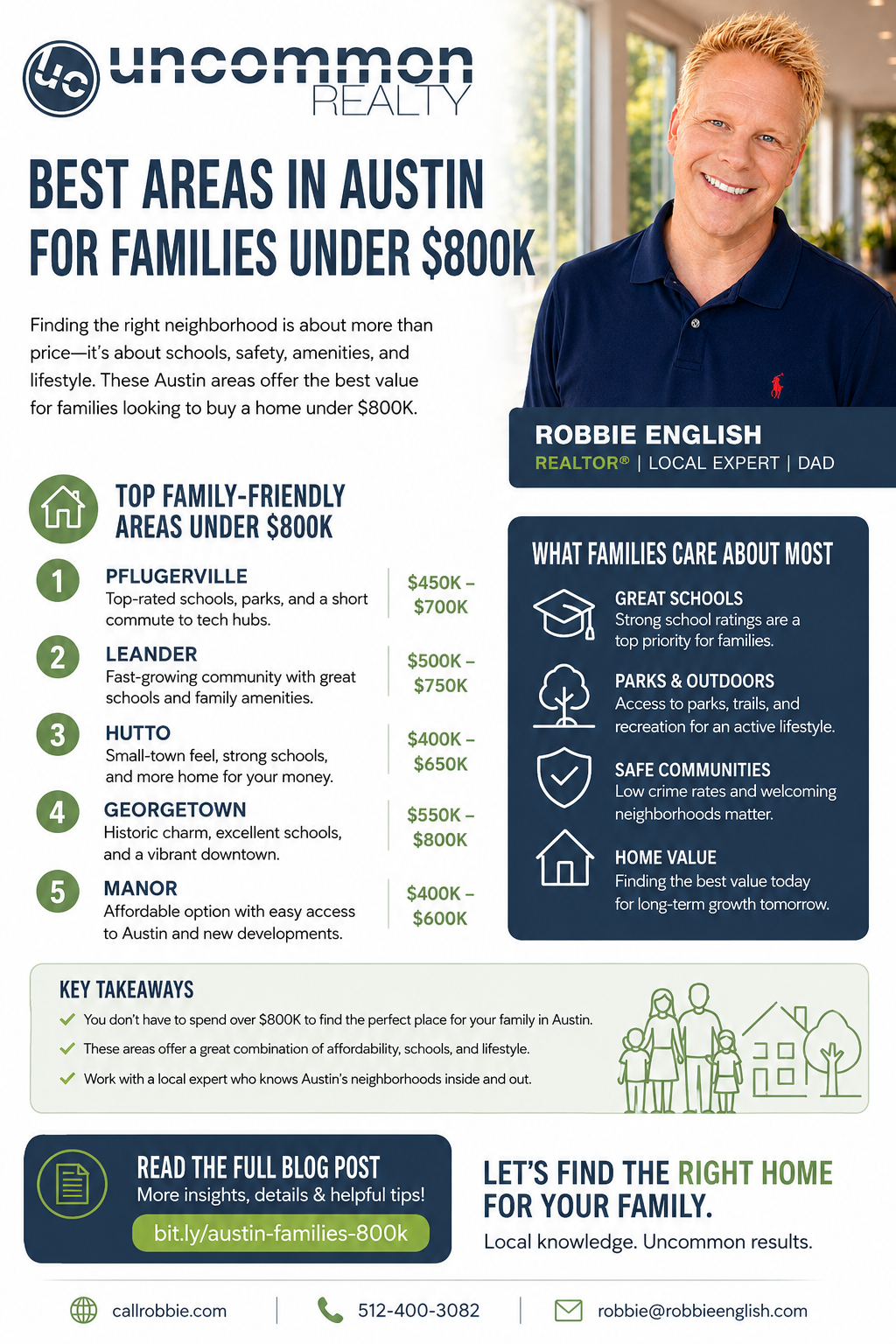
Best Areas In Austin For Families Under $800K

When buyers ask me about the best areas in Austin for families under $800K, they are usually asking two things at once: where can a growing family get real space and good schools, and where does that budget still stretch comfortably in 2026? Those are fair questions, and the honest answer has changed over the last few years. Prices have cooled from the 2022 peak, inventory has loosened, and $800K now buys meaningfully more in the right submarkets than it did at the top of the market.
I am Robbie English, Broker, REALTOR at Uncommon Realty, and I have spent years helping families weigh these exact tradeoffs across the Greater Austin area. What follows is a practical map of where an $800K ceiling works well for families, where it gets tight, and how to think about schools, space, and timing so the home you choose still fits five years from now.
There is no single "best" area. The right choice depends on your commute, the ages of your kids, how much yard you want, and how much house versus how much location you are willing to trade. Let's walk through the real options.

What "Best For Families" Actually Means Under $800K
For most families, "best" comes down to a short list of things that matter every day: schools you feel good about, a floor plan that fits your routine, a yard or park nearby, a reasonable commute, and a neighborhood that holds its value. Under an $800K budget in the Austin metro, you can hit all of those, but the balance shifts depending on where you look.
In the suburbs north and northwest of the city, $800K buys space, newer construction, and highly rated schools with room to spare. Closer to central Austin, the same budget buys location and walkability but far less square footage and often an older home that needs work. Neither is wrong. The point is to match the tradeoff to your family's priorities rather than chasing a single "best" zip code.
The Honest Truth About $800K In Austin Right Now
The 2026 market gives families more leverage than they had a few years ago. The Austin metro median sits in the mid-$400s, well off the May 2022 peak, with several months of inventory and homes routinely selling at or below asking price after longer days on market. That matters because an $800K budget no longer forces you into bidding wars in most family submarkets.
What it means in practice: in the northern and northwestern suburbs, $800K is comfortably above the local median, so you have genuine choice and negotiating room. In central and south Austin's most established family neighborhoods, $800K is closer to the entry point, so the same number buys less and moves faster. Knowing which side of that line a neighborhood falls on is the single most useful thing to understand before you start touring.
Northwest Austin: The Value Sweet Spot
Northwest Austin is where I send a lot of families who want strong schools without paying central-Austin prices. Milwood is a standout: a well-established neighborhood with a recent median sale price in the mid-$400s, which leaves real room under an $800K ceiling for an updated or larger home. Depending on the exact address, Milwood feeds into Round Rock ISD schools like Jollyville Elementary and Canyon Vista Middle, with many homes zoned to Westwood High School, which posted a roughly 97% graduation rate for 2025-2026 and is consistently among the top-rated high schools in Round Rock ISD.
Neighboring Anderson Mill offers a similar profile: mature trees, established value, an extensive trail and park network, and access to the same well-regarded Round Rock ISD campuses in many sections. For families, this corner of Austin is one of the few places where you can stay inside the city, land top-tier public schools, and still keep the purchase price well under budget. Because school attendance zones cut through these neighborhoods block by block, the one rule here is to confirm the exact campus assignment for a specific address before you fall in love with a house.
Cedar Park And Leander: Space, Newer Homes, Strong Schools
Cedar Park and Leander are where families go when they want newer construction, more square footage, and master-planned amenities. Cedar Park's citywide median list price sat around $505K in mid-2026, so $800K opens up larger homes and premium sections.
Avery Ranch is the premium end of this market, with a recent median around $667K and strong year-over-year appreciation. It offers golf, pools, and a well-connected layout that families love, and it comes in under budget with room for a bigger or updated home. Buttercup Creek is a more established, wooded option at a lower price point. One important note on Cedar Park: most of the city is served by Leander ISD, but sections of Avery Ranch are zoned to Round Rock ISD, so this is another area where the district follows the address, not the city line.
In Leander proper, master-planned communities like Bryson and Palmera Ridge deliver newer homes, resort-style amenities, and Leander ISD schools, most of it well under $800K. If you want the deeper breakdown of family-focused Leander communities, I cover them in detail in my guide to the best family neighborhoods in Leander. The tradeoff in Leander is commute: you are farther out, so drive time to central-Austin job centers is the main thing to test before committing.
Round Rock And Georgetown: The Most Home For The Money
If your top priority is getting the most house and yard for the budget, Round Rock and Georgetown are hard to beat. In Teravista, the twelve-month median has run around $459K, with most single-family homes falling between roughly $450K and $600K. It is zoned to Round Rock ISD schools, including Teravista Elementary, Hopewell Middle, and Stony Point High, and it offers golf, pools, and greenbelt trails. That leaves a large cushion under $800K for a bigger home or upgraded section. Paloma Lake is a similar family-oriented option with a lake amenity and a median in the low-$500s.
For broader Round Rock context, I break down neighborhoods for buyers just getting started in my guide to the best Round Rock neighborhoods for first-time buyers, and many of those same communities work well for growing families at this budget.
In Georgetown, Rancho Sienna is a strong pick, with resale homes generally ranging from the mid-$300s into the high-$600s and its own on-site elementary. One detail that surprises buyers: despite the Georgetown mailing address, Rancho Sienna is zoned to Liberty Hill ISD, so verify the district if a specific school is part of your decision. Across both cities, the theme is the same: your $800K goes further here than almost anywhere else in the metro, at the cost of a longer commute to central Austin.
South And Central Austin: Where $800K Gets Tight
Closer in, an $800K budget for a family home is real but tighter. Circle C Ranch in southwest Austin is the standout family community here, with top-rated Austin ISD schools like Kiker Elementary feeding into Bowie High School, parks, trails, and a genuine master-planned feel. Recent medians have run anywhere from the low-$700s to the high-$700s depending on the reporting period, so Circle C is doable under $800K but you are shopping near the top of the range, and the best-priced homes move quickly. Nearby Shady Hollow offers larger lots and a more established feel at a similar price point.
In central Austin, family-friendly Mueller is walkable and amenity-rich, but under $800K you are typically looking at row homes, smaller lots, or condos rather than large single-family houses. The broader lesson for central and south Austin is straightforward: the closer you get to the core, the more you trade square footage and yard for location and walkability. For some families that trade is worth it. For others, the same money in the suburbs buys twice the house.
How To Compare Schools The Right Way
Schools drive more family home decisions than any other single factor, and they are also the most commonly misunderstood. The mistake I see most often is shopping by district reputation instead of by the specific campus a home is zoned to. Round Rock ISD, Leander ISD, and Austin ISD all contain both top-tier and average campuses, and attendance zones can change block to block.
Before you commit to a house, confirm the exact elementary, middle, and high school assignments for that address, and look at recent accountability ratings, graduation rates, and program offerings rather than a single star score. If you have a younger child, also ask how fast the area is growing, because rapid enrollment growth can trigger boundary changes that move your kids to a different campus later. This is exactly the kind of detail that separates a good buy from a regret, and it is worth doing carefully.
Space, Layout, And What Actually Matters For Families
Square footage is easy to fixate on, but layout usually matters more for how a home actually lives. A well-designed 2,400-square-foot house with a smart floor plan often works better for a family than a poorly laid-out 3,000-square-foot one. Think about the things you will use daily: a downstairs bedroom or flex room, a real mudroom or drop zone, storage, a functional kitchen that opens to where the kids will be, and a yard that fits how your family spends time outside.
Under $800K in the suburbs, you can usually get all of that plus a game room or dedicated office. Closer in, you may need to prioritize. I encourage families to write down their true must-haves versus nice-to-haves before touring, because it is far easier to compare homes against a clear list than to react emotionally to whichever house you saw most recently.
Inventory And Timing In The 2026 Market
The current market rewards patience and preparation. With several months of inventory across most family submarkets and homes sitting longer than they did during the frenzy, buyers have room to negotiate on price, closing costs, repairs, and rate buydowns. Well-priced, move-in-ready homes in the strongest school zones still attract competition, but the blanket bidding wars of a few years ago are the exception now, not the rule.
Timing your search around the school calendar helps too. Many families want to be settled before the fall, which concentrates demand in late spring and early summer. Shopping in the fall or winter often means less competition and more motivated sellers. Either way, being fully pre-approved and ready to move decisively when the right home appears is worth more than trying to perfectly time the market.
How To Approach The Search
The most effective family searches start with the numbers and the non-negotiables, then narrow to areas, then to homes. Get a full pre-approval so you know your true comfortable monthly payment, rather than the maximum loan amount a lender will approve. Remember that the sticker price is only part of the cost: property taxes across the northern suburbs generally run higher than in Travis County, and many master-planned communities carry HOA dues and sometimes MUD taxes on top of the base rate. Build those into your real budget before you set a price ceiling, because a home that looks affordable on price alone can strain the monthly numbers once taxes and dues are added in.
Decide on your commute limits and your school priorities next. Then let those filters point you to two or three areas rather than trying to watch the entire metro at once. Families who try to keep tabs on every neighborhood at the same time tend to burn out and second-guess themselves; families who narrow to a short list make faster, more confident decisions when the right home appears.
From there, you can track listings efficiently. You can browse and save homes on my website or through my app, which lets you set up alerts for the exact neighborhoods, price range, and school zones that fit your family so you see the right homes first. The goal is to spend your energy on the handful of homes that actually match your criteria, not on scrolling through everything.
Bringing It All Together
Under $800K, families have genuinely good options across the Austin metro in 2026, and the right one depends on which tradeoff fits your life. If you want top schools at the best value inside the city, Northwest Austin's Milwood and Anderson Mill are hard to beat. If you want newer homes and space with strong schools, Cedar Park and Leander deliver. If you want the most house and yard for the money, Round Rock and Georgetown lead. And if location and walkability matter most, Circle C and central Austin are worth the tighter budget.
The best next step is to get clear on your priorities and your true budget, then let those decisions narrow the map. When you are ready to compare specific homes and school zones side by side, I am glad to help you sort through the tradeoffs and find the area that fits your family for the long run.
Written for buyers and sellers in the Greater Austin, Texas area by Robbie English, REALTOR, Broker at Uncommon Realty.
Categories
- All Blogs (970)
- !!! (59)
- !x (621)
- Austin Real Estate (113)
- Bee Cave Real Estate (1)
- Building A Home (14)
- Buying A Home (143)
- Buying Land (1)
- Cedar Park Real Estate (58)
- Central Austin Real Estate (75)
- Down Payment Assistance Programs (1)
- Downsizing (4)
- Downtown Austin Real Estate (5)
- Dripping Springs Real Estate (62)
- East Austin Real Estate (3)
- Financing and Mortgage (24)
- first-time homebuying (109)
- Georgetown Real Estate (9)
- Hill Country Real Estate (1)
- HOA (2)
- Home Appraisals (13)
- Home For Rent (1)
- Home Inspections (6)
- Home Pricing (6)
- Home Staging (1)
- Home Values (12)
- Homeownership (1)
- Homes For Rent (1)
- Homes For Sale (147)
- Hutto Real Estate (5)
- Investing (6)
- Investment Properties (4)
- Lakeway Real Estate (33)
- Leander Real Estate (59)
- LGBT+ Real Estate (8)
- Luxury Homes For Sale (5)
- Luxury Real Estate (19)
- Market Conditions (17)
- Moving to Austin (2)
- Moving to Texas (4)
- Negotiations (3)
- Neighborhoods (8)
- Northwest Austin Real Estate (94)
- Off Market Listings (7)
- Pflugerville Real Estate (10)
- Private Listings (2)
- Property Management (42)
- Property Tax (3)
- Real Estate (18)
- Reddit Question Answered (80)
- redwrite (63)
- Relocation (2)
- Renting (6)
- Representation (34)
- Round Rock Real Estate (59)
- Selling Your Home (62)
- South Austin Real Estate (1)
- Westlake Real Estate (3)
Recent Posts