
Best Property Management in Austin

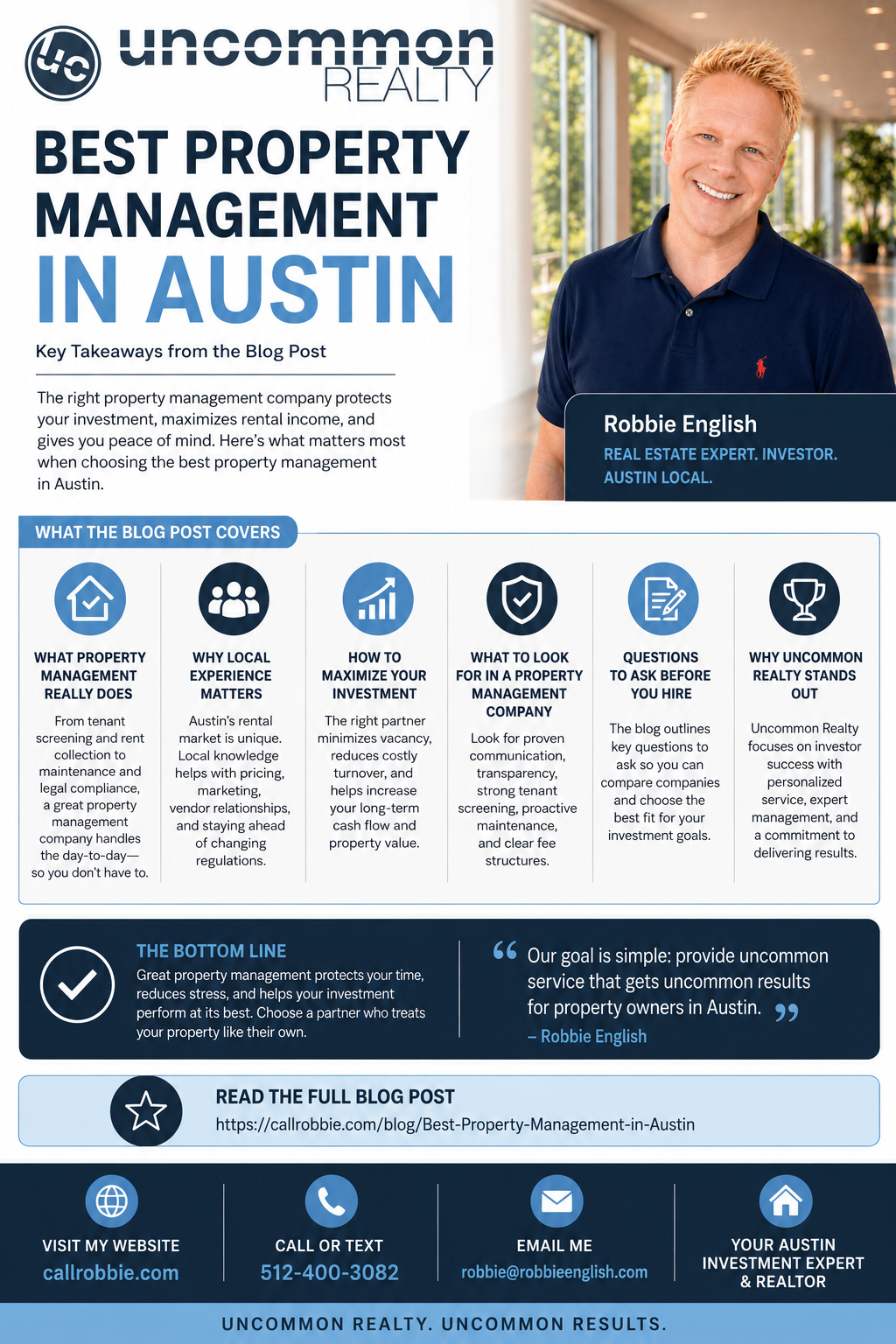
Finding the best property management in Austin is not simply a matter of comparing monthly fees and choosing the company with the slickest website. A good property manager becomes the daily steward of your rental property, your tenant relationships, your maintenance decisions, and a meaningful part of your long-term investment strategy.
I have spent more than 40 years working in real estate, and one lesson has remained true through every kind of market: good management protects value, while poor management quietly drains it. Missed maintenance, weak screening, incomplete documentation, poor communication, and careless leasing decisions can cost an owner far more than the management fee they were trying to save.
Again, I am Robbie English, Broker, REALTOR with Uncommon Realty, as well as a national real estate instructor. My approach is straightforward: educate owners, explain the risks, and help them make decisions based on sound judgment rather than sales pressure.

TLDR: What You Need to Know
- The best manager is not always the cheapest. Look at service quality, communication, experience, documentation, and decision-making.
- Local knowledge matters. Austin rental homes perform differently depending on location, property condition, competing inventory, tenant demand, and commuting patterns.
- Tenant screening should be consistent and documented. A manager should use written standards while complying with fair housing requirements.
- Maintenance procedures deserve close attention. Ask who approves repairs, how emergencies are handled, and whether the manager adds fees to vendor invoices.
- Review the agreement before signing. Understand management fees, leasing charges, renewal fees, cancellation provisions, maintenance authority, and services that cost extra.
What Does the Best Property Management in Austin Actually Mean?
The word “best” depends on what you own and what kind of help you need. An owner with one updated condominium near Downtown Austin may need a different management plan than an investor with several single-family homes across Northwest Austin, Cedar Park, and Leander.
For most owners, the best property manager is the company that consistently handles five important responsibilities: protecting the property, finding qualified tenants, collecting and accounting for funds, communicating clearly, and addressing problems before they become expensive.
A dependable manager should also know when a decision requires an attorney, accountant, insurance professional, contractor, or other qualified specialist. Experience is not pretending to know everything. Experience is knowing which questions to ask, which records to keep, and when additional professional guidance is appropriate.
Services an Austin Property Manager Should Provide
Before comparing companies, ask each manager to identify exactly what is included in the standard management fee. The phrase “full service” can mean very different things from one company to another.
| Management Service | What Owners Should Expect | Questions to Ask |
|---|---|---|
| Rental evaluation | A property-specific assessment based on condition, features, location, competition, and likely tenant demand | Will you inspect the property before recommending a rental price? |
| Marketing and leasing | Professional advertising, inquiry response, showing coordination, application processing, and lease preparation | Where will the property be advertised, and who conducts the showings? |
| Tenant screening | Consistent written criteria covering income, credit, rental history, and other lawful qualifications | Can I review your written rental qualification standards? |
| Rent collection | Online payment options, accurate records, owner distributions, and procedures for late payments | When are owner funds distributed, and how are late payments handled? |
| Maintenance | Repair coordination, emergency response, documentation, and reasonable oversight of vendors | Do you add a markup or coordination fee to maintenance invoices? |
| Inspections | Documented property reviews at agreed intervals, subject to the lease and applicable law | How often do you inspect, and is there an additional charge? |
| Accounting | Monthly statements, income and expense reporting, invoice records, and year-end documentation | Can I see a sample owner statement before signing? |
You can learn more about our approach to Property management, leasing, tenant communication, and rental oversight before deciding whether professional management fits your situation.
Local Austin Knowledge Makes a Difference
Austin is not one uniform rental market. Neighborhood atmosphere, housing style, nearby employment, transportation access, school assignments, entertainment, parks, and competing inventory can all affect how tenants view a property.
A home near The Domain may appeal to tenants who value access to major employers, restaurants, shopping, and North Austin conveniences. A property in Milwood, Scofield Farms, or Avery Ranch may attract renters looking for a more residential atmosphere and access to everyday services.
Properties in South Austin may offer proximity to restaurants, parks, entertainment, and established neighborhoods. Homes in Garrison Park, Westgate, and Cherry Creek can differ significantly in age, upgrades, lot characteristics, and tenant expectations.
A local manager should understand those differences without making promises about rental income, occupancy, school quality, appreciation, or future results. Good advice is property-specific and supported by current information, not a generic rental estimate generated without seeing the home.
Neighborhood Atmosphere, Walkability, Restaurants, and Parks
Tenants often choose a rental based on lifestyle as much as square footage. That makes neighborhood positioning an important part of marketing.
Some Austin neighborhoods offer sidewalks, nearby restaurants, entertainment, trails, and daily conveniences within a relatively short distance. Other communities are primarily vehicle-oriented and appeal to tenants who prefer larger homes, yards, garages, neighborhood amenities, or a quieter residential environment.
A property manager should describe these characteristics accurately. Calling a home “walkable” when basic errands require a car can create disappointed prospects. Likewise, failing to mention access to greenbelts, community parks, recreation facilities, major roadways, or nearby dining can cause a good property to be overlooked.
The goal is not to exaggerate. The goal is to help qualified tenants understand how the home and surrounding area may fit their daily routines.
Home Styles, Property Condition, and Leasing Appeal
Austin rental inventory includes older bungalows, mid-century homes, suburban houses, condominiums, townhomes, duplexes, and newer construction. Every property type brings its own management considerations.
Older homes may have charm and established landscaping, but they can also require closer attention to plumbing, electrical components, drainage, roofing, foundations, insulation, and aging mechanical systems. Newer homes may offer modern layouts and energy-efficient features, but owners still need to plan for warranties, routine service, landscaping, appliances, and eventual wear.
Condition often matters more than decorative trends. Cleanliness, working systems, reliable locks, safe stairs, functional lighting, maintained landscaping, and completed repairs establish trust before a tenant ever signs a lease.
The best manager will tell you which improvements are likely to improve leasing appeal and which projects may not produce a meaningful return. Not every rental needs luxury finishes. It does need to be safe, functional, clean, properly maintained, and positioned honestly.
Pricing a Rental Property Responsibly
Rental pricing should not begin with the amount an owner wants to receive. It should begin with an evaluation of the property and its competition.
A manager should consider location, floor plan, bedroom and bathroom count, garage configuration, yard, updates, maintenance condition, pet policies, lease terms, included services, and competing rental choices. The highest advertised rental is not necessarily the most relevant comparison, especially when it has been sitting vacant. Overpricing can lead to additional vacancy, repeated reductions, and a listing that begins to look stale. Underpricing may reduce income and can create questions about why the property appears cheaper than competing homes.
A sound pricing recommendation balances income goals with realistic leasing conditions. Owners should receive an explanation, not merely a number.
Schools and Fair Housing Considerations
Prospective tenants frequently ask about schools, but managers must be careful about how they answer. School assignments can change, and subjective descriptions such as “best,” “good,” or “family-friendly” can create fair housing concerns.
A responsible manager should direct applicants to official school district resources so they can verify attendance boundaries and evaluate schools according to their own priorities. The manager should provide factual property and location information rather than steering tenants toward or away from a neighborhood.
The same principle applies to discussions of neighborhood demographics, religion, disability, national origin, familial status, race, color, sex, and other protected characteristics. Professional management requires consistent standards and careful communication.
Commuting and Tenant Demand
Commuting patterns influence tenant decisions, but travel times vary based on traffic, construction, weather, destination, and time of day. A manager should avoid guaranteeing a particular commute. Instead, marketing can identify nearby transportation corridors and employment areas. Properties near Dell, major technology campuses, medical facilities, universities, government offices, or retail centers may appeal to renters who want practical access to work.
A good manager also asks how the property competes with homes located closer to those destinations. A longer commute may be acceptable when a property provides additional space, a yard, neighborhood amenities, or a more favorable overall housing arrangement.
Which Owners Benefit Most From Professional Management?
Professional management can be particularly useful for owners who live outside the Austin area, have demanding careers, own multiple rentals, lack reliable maintenance contacts, or simply do not want to manage tenant communication and documentation personally.
It may also help an owner who plans to keep a former residence as an Investor property. Turning a personal home into a rental involves more than placing an advertisement. The owner must consider insurance, taxes, lender requirements, property condition, leasing documents, accounting, maintenance reserves, and the emotional adjustment of allowing someone else to occupy the home.
Owners who enjoy managing repairs, understand Texas leasing practices, maintain detailed records, and are available for tenant needs may choose to self-manage. The important thing is to make that decision with a realistic understanding of the workload and risk.
Comparing Property Management Fees
| Possible Charge | What It May Cover | What Owners Should Clarify |
|---|---|---|
| Monthly management fee | Ongoing administration, communication, rent collection, and coordination | Is it based on rent collected, rent due, or a flat amount? |
| Leasing fee | Marketing, showing, screening, documentation, and move-in coordination | Is the fee owed if an existing tenant renews? |
| Renewal fee | Lease review, negotiation, documentation, and execution | Is it a flat fee or a percentage of rent? |
| Maintenance fee | Repair coordination or vendor administration | Is it charged per repair, hourly, or as a vendor markup? |
| Inspection fee | Scheduled property condition reviews | How detailed is the report, and are photographs included? |
| Cancellation fee | Administrative costs when ending the agreement | Can the agreement be terminated for poor performance? |
Do not evaluate these charges in isolation. A low monthly fee paired with leasing charges, maintenance markups, renewal fees, inspection costs, and restrictive cancellation terms may not be the better value.
Long-Term Appreciation and Property Preservation
No property manager can guarantee appreciation. Future value depends on many factors outside the manager’s control, including location, property condition, land use, infrastructure, buyer demand, financing conditions, insurance costs, taxes, and broader economic trends. However, management can influence how well the physical asset is preserved. Prompt maintenance, accurate documentation, routine observation, responsible tenant selection, and thoughtful turnover preparation may help prevent avoidable deterioration.
The manager should also distinguish between maintenance and improvement. Replacing a failed water heater preserves function. Renovating an entire kitchen is an investment decision that should be evaluated based on cost, remaining useful life, rental positioning, ownership plans, and possible resale strategy.
Common Mistakes Owners Make
- Choosing solely by price. The least expensive service may not provide the communication, oversight, or expertise your property requires.
- Failing to read the agreement. Owners sometimes discover cancellation fees, repair authority, or additional charges only after a disagreement occurs.
- Overpricing the property. Emotional attachment and mortgage obligations do not determine what a tenant will pay.
- Deferring necessary maintenance. Small problems can become larger expenses and may affect tenant satisfaction or safety.
- Making inconsistent screening exceptions. Written rental criteria should be applied consistently and in compliance with fair housing requirements.
- Keeping inadequate reserves. Rental homes require repairs, replacements, turnover work, and occasional periods without income.
- Expecting the manager to guarantee results. Ethical managers explain risks and options rather than promising occupancy, income, or appreciation.
Questions to Ask Before Hiring an Austin Property Manager
- Who will be my primary point of contact?
- How many properties does each manager oversee?
- How are after-hours emergencies handled?
- What written tenant qualification criteria do you use?
- How do you document property condition before and after a tenancy?
- What maintenance expenses can you approve without contacting me?
- Do you receive vendor rebates, markups, or referral compensation?
- How frequently will I receive accounting statements?
- What happens if a tenant does not pay or violates the lease?
- How may either party terminate the management agreement?
Listen carefully to how those questions are answered. Clear explanations are a good sign. Vague assurances, pressure to sign immediately, and reluctance to provide written terms deserve closer examination.
Frequently Asked Questions About Austin Property Management
How do I choose the best property management company in Austin?
Compare experience, services, communication procedures, tenant screening, maintenance oversight, accounting, contract terms, and local knowledge. Request a sample management agreement and owner statement before making your decision.
Is the cheapest Austin property manager the best value?
Not necessarily. Compare the total cost of management, including leasing, renewal, inspection, maintenance, cancellation, and administrative charges. Service quality and risk management may matter more than a small difference in the monthly fee.
Should an Austin property manager inspect my rental?
Documented property reviews can help identify maintenance concerns and verify general condition. The frequency, purpose, notice requirements, cost, and scope should be explained in the management agreement and handled in accordance with the lease and applicable law.
Can a property manager guarantee rental income or appreciation?
No responsible manager should guarantee occupancy, rental income, tenant performance, or future appreciation. A manager can provide analysis, recommendations, oversight, and documented procedures, but real estate ownership always involves risk.
What should I prepare before renting my Austin home?
Owners should review insurance, lender requirements, property condition, safety items, maintenance needs, tax considerations, leasing goals, pet policies, reserve funds, and plans for personal property. Legal and tax questions should be directed to qualified professionals.
Can a property manager help me sell the home later?
A real estate brokerage that handles both management and Home selling may help coordinate the transition from rental ownership to a future sale. Owners should still compare brokerage services, representation terms, pricing recommendations, and preparation strategies before listing.
Let’s Talk About Protecting Your Austin Rental
The best property management relationship is built on realistic expectations, written procedures, honest communication, and thoughtful decisions. Your rental property deserves more than rent collection. It deserves careful oversight from people who understand that every maintenance decision, tenant interaction, and document can affect your ownership experience.
Again, I am Robbie English, Broker, REALTOR with Uncommon Realty. My team and I help owners evaluate their options, understand the responsibilities of leasing a property, and determine whether professional management makes sense for their goals.
To discuss your rental property and the services you may need, visit my contact page. We can have a straightforward conversation about the home, your plans, and the questions you should answer before choosing a management company.
Categories
- All Blogs (836)
- !!! (1)
- !x (562)
- Austin Real Estate (88)
- Bee Cave Real Estate (1)
- Building A Home (5)
- Buying A Home (112)
- Cedar Park Real Estate (56)
- Central Austin Real Estate (75)
- Downsizing (3)
- Downtown Austin Real Estate (5)
- Dripping Springs Real Estate (60)
- East Austin Real Estate (3)
- Financing and Mortgage (12)
- first-time homebuying (89)
- Georgetown Real Estate (5)
- Hill Country Real Estate (1)
- HOA (1)
- Home Appraisals (3)
- Home For Rent (1)
- Home Inspections (3)
- Home Pricing (1)
- Home Values (6)
- Homeownership (1)
- Homes For Rent (1)
- Homes For Sale (146)
- Hutto Real Estate (1)
- Lakeway Real Estate (32)
- Leander Real Estate (58)
- LGBT+ Real Estate (8)
- Luxury Homes For Sale (4)
- Luxury Real Estate (18)
- Market Conditions (9)
- Negotiations (1)
- Neighborhoods (8)
- Northwest Austin Real Estate (93)
- Off Market Listings (6)
- Pflugerville Real Estate (6)
- Private Listings (2)
- Property Management (42)
- Real Estate (11)
- Reddit Question Answered (73)
- redwrite (63)
- Renting (3)
- Representation (32)
- Round Rock Real Estate (55)
- Selling Your Home (38)
- Westlake Real Estate (2)
Recent Posts