Austin vs Denver: Which City Is Better for LGBTQ+ Homebuyers in 2026?

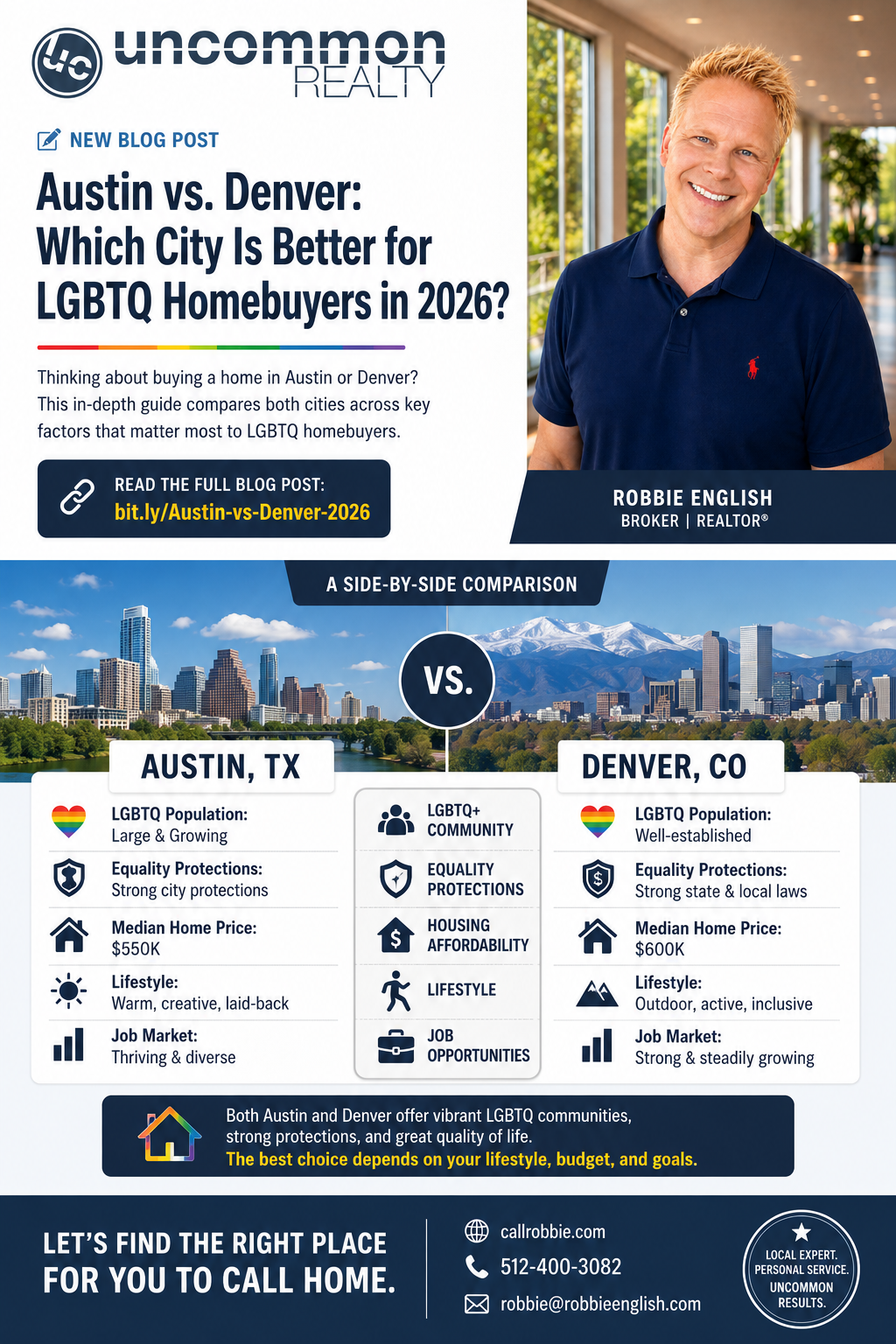
Austin vs Denver is one of the most common questions I get from LGBTQ+ clients relocating to Texas. Being gay myself, I believe both cities land near the top of national rankings for LGBTQ+ friendliness, both have visible, long-established communities, and both attract people leaving less welcoming states. The honest answer isn't that one city wins — it's that they solve different problems for different people, and the right one depends on climate preference, budget, and how you want your day-to-day life to feel.
I work with LGBTQ+ buyers moving to Austin every month, so I can speak to that side of this comparison from direct experience — what neighborhoods people gravitate toward, what surprises them, what they wish they'd known before moving. On the Denver side, I'm drawing on what clients who lived there before moving to Austin have told me, plus public cost-of-living and demographic data. I'd rather say that upfront than pretend to have Denver expertise I don't actually have.

TLDR: Austin vs Denver for LGBTQ+ Homebuyers
- Austin is warmer, flatter, and built around a music and food culture that runs late into the night.
- Denver is built around the mountains — if outdoor recreation is your main hobby, that matters a lot.
- Housing costs are similar citywide, but you get more house for the money in Austin's suburbs than in Denver's.
- Both cities have local nondiscrimination ordinances, but Texas lags Colorado on statewide LGBTQ+ protections.
- Denver's community is concentrated in Capitol Hill; Austin's is more spread out across several neighborhoods.
Climate and Day-to-Day Life
This is usually the deciding factor once people sit with the decision long enough. Austin has short, mild winters and long, hot summers — expect stretches of 100-plus-degree days from June through August most years. Denver has real winters with regular snow, but more sunny days annually than people assume, and summer evenings that cool off fast once the sun drops.
If you hike, ski, or want easy weekend access to mountains, that's a Denver advantage Austin can't match — the closest thing here is the Hill Country, which is lovely but nothing like the Rockies. If you want a long outdoor patio season, live music most nights of the week, and less cold-weather gear in your closet, Austin usually wins that comparison for my clients.
Cost of Living and Housing
Median home prices in Austin and Denver aren't far apart citywide, but the gap widens once you move outside the core. In Austin's suburbs — Northwest Austin, Round Rock, Leander — you can still find single-family homes under $500K with a reasonable commute. Denver's comparable suburbs, like Aurora and Arvada, tend to run higher for similar square footage, partly because Denver's buildable land is more boxed in by the mountains.
Texas also has no state income tax, which matters more the higher your income climbs; Colorado has a flat 4.4% state income tax. Property taxes cut the other way — Texas leans harder on property tax to fund schools and local services, so your annual tax bill on a comparably priced home will usually run higher here than in Colorado. Run both scenarios against your actual income and target price rather than assuming one state is simply cheaper.
LGBTQ+ Community and Legal Landscape
Both cities have city-level nondiscrimination ordinances covering housing, employment, and public accommodations for sexual orientation and gender identity. The difference shows up at the state level: Colorado has statewide LGBTQ+ nondiscrimination protections, while Texas does not. You're relying on Austin's city ordinance, which is solid, but it stops applying the moment you drive outside city limits — something worth factoring in if your job or budget might eventually push you toward a surrounding suburb.
Denver's Capitol Hill neighborhood functions the way you'd expect a historic LGBTQ+ district to — bars, bookstores, and community organizations clustered in one walkable area. Austin's community is just as real but more dispersed, concentrated around events like Pride and the Rainbow Round-Up rather than one defined district. Clients coming from Denver sometimes read that as less visible at first, even though the community here is just as active — it's organized differently, not smaller. Austin Pride draws more than 400,000 people each year according to organizers, making it one of the larger Pride events in the country, and there's a steady calendar of smaller events — the Rainbow Round-Up, drag brunches scattered across East Austin and the Domain, and a handful of LGBTQ+-owned bars and businesses that aren't concentrated in one strip but show up across several parts of town.
Why People Are Actually Making This Move
Most of the LGBTQ+ clients I talk to aren't choosing between Austin and Denver in a vacuum — they're choosing based on a job, a partner's job, or a decision to leave a state where they no longer feel safe or represented. Austin's job market leans heavily on tech (Apple, Tesla, Oracle, a dense startup scene), along with the state government and university jobs tied to UT. Denver's economy is more diversified across aerospace, healthcare, and its own growing tech sector, with a stronger built-in outdoor recreation industry around it.
If your move is job-driven, start with where the offer actually is rather than which city ranks higher on a "best for LGBTQ+ people" list — both cities clear that bar comfortably, and the deciding factors end up being the same ones anyone weighs: commute, cost, and climate.
Healthcare Access
This comes up often enough that I want to address it directly rather than skip it. Colorado's state laws around LGBTQ+ healthcare access, including gender-affirming care, are generally more protective than Texas law right now, and Texas has passed restrictions in recent years that specifically affect minors. Laws in this area move quickly and I'm not the right source for current legal detail — if healthcare access is a deciding factor for you or your family, I'd talk to a healthcare provider or an organization like Equality Texas or Out Youth before finalizing a decision, not a real estate agent. What I can tell you is that Austin itself has LGBTQ+-affirming providers and clinics, even where state law is less favorable than Colorado's.
Renting First vs. Buying Right Away
I get asked this a lot by relocating clients, and my answer depends on how sure you are about the city, not just the neighborhood. If you've never spent real time in Austin outside of a visit, I'll often suggest a six-to-twelve-month lease first, especially in a neighborhood you're not 100% sold on. If you already know Austin well — you've visited repeatedly, you have friends here, you've done the research — buying directly on a relocation trip is completely reasonable, and I've helped plenty of clients do exactly that on a three-day house-hunting trip.
The one thing I'd avoid is buying sight unseen based only on photos and a virtual tour. Texas summers, HOA rules, and the difference between a neighborhood at 8am and 8pm are things photos don't capture well, and I'd rather you see it in person even if that means one extra trip.
Neighborhoods Worth Looking At in Austin
If Austin ends up being the pick, where you land inside the metro matters as much as the city-level comparison. Central Austin puts you closest to downtown, the density, and the walkability a lot of people coming from Denver expect. Northwest Austin trades some of that density for more space, quieter streets, and a shorter commute if you're relocating for a job in the tech corridor.
I'd rather walk you through specific streets and price points on a call than generalize here — the right neighborhood ends up different for almost every client depending on commute, budget, and whether they want to be in the middle of things or a step back from it.
Making the Move From Out of State
If you're relocating sight unseen or working with a short house-hunting trip, real-time access to listings matters more than usual — homes in Austin's more competitive price bands can move in days. My mobile app gives you live MLS data, so you can track new listings and price changes without waiting on a re-sent email from an agent, which is especially useful if you're still in Denver and want to see what's coming on the market before booking a flight.
I also work with lenders who are used to out-of-state and relocation buyers, including clients moving here specifically for a more welcoming environment. That context matters when you're picking a lender and title company, and I'll point you toward people I trust rather than hand you a random referral.
Bottom Line
Neither city is objectively "better." Denver wins on mountain access and statewide legal protections; Austin wins on cost of living outside the core, warmer weather, and no state income tax. Tell me what you're actually optimizing for and I can tell you fairly quickly which one fits — and if it's Austin, I can start narrowing down neighborhoods the same day. You can reach me directly through my profile at Uncommon Realty.
Written for LGBT buyers and sellers in the Greater Austin, Texas area by Robbie English, REALTOR, Broker at Uncommon Realty.
Categories
- All Blogs (970)
- !!! (59)
- !x (621)
- Austin Real Estate (113)
- Bee Cave Real Estate (1)
- Building A Home (14)
- Buying A Home (143)
- Buying Land (1)
- Cedar Park Real Estate (58)
- Central Austin Real Estate (75)
- Down Payment Assistance Programs (1)
- Downsizing (4)
- Downtown Austin Real Estate (5)
- Dripping Springs Real Estate (62)
- East Austin Real Estate (3)
- Financing and Mortgage (24)
- first-time homebuying (109)
- Georgetown Real Estate (9)
- Hill Country Real Estate (1)
- HOA (2)
- Home Appraisals (13)
- Home For Rent (1)
- Home Inspections (6)
- Home Pricing (6)
- Home Staging (1)
- Home Values (12)
- Homeownership (1)
- Homes For Rent (1)
- Homes For Sale (147)
- Hutto Real Estate (5)
- Investing (6)
- Investment Properties (4)
- Lakeway Real Estate (33)
- Leander Real Estate (59)
- LGBT+ Real Estate (8)
- Luxury Homes For Sale (5)
- Luxury Real Estate (19)
- Market Conditions (17)
- Moving to Austin (2)
- Moving to Texas (4)
- Negotiations (3)
- Neighborhoods (8)
- Northwest Austin Real Estate (94)
- Off Market Listings (7)
- Pflugerville Real Estate (10)
- Private Listings (2)
- Property Management (42)
- Property Tax (3)
- Real Estate (18)
- Reddit Question Answered (80)
- redwrite (63)
- Relocation (2)
- Renting (6)
- Representation (34)
- Round Rock Real Estate (59)
- Selling Your Home (62)
- South Austin Real Estate (1)
- Westlake Real Estate (3)
Recent Posts