Best Cedar Park Neighborhoods for Families

I get some version of this question almost every week from families looking at Cedar Park: "Where should we actually be looking?" And I get why it's confusing. Cedar Park isn't one neighborhood — it's dozens of them, built across four decades, ranging from shaded 1980s streets to subdivisions where the paint on the trim is still fresh. There's no single "best" answer, but there is an honest one, and that depends on what you're optimizing for: a specific school, a certain price range, a new build versus something with grown trees and a settled feel.
So let me walk you through it the way I would if you were sitting across from me. I'll cover seven neighborhoods that represent the real range of what's out here, how the school situation actually breaks down (it's not as simple as people assume), what to expect at different price points, and the trade-offs between buying new construction versus something already established.

Seven Cedar Park Neighborhoods Worth a Look
These aren't the only good options in Cedar Park — not even close — but they cover the spread of price, age, and character that most families are weighing against each other.
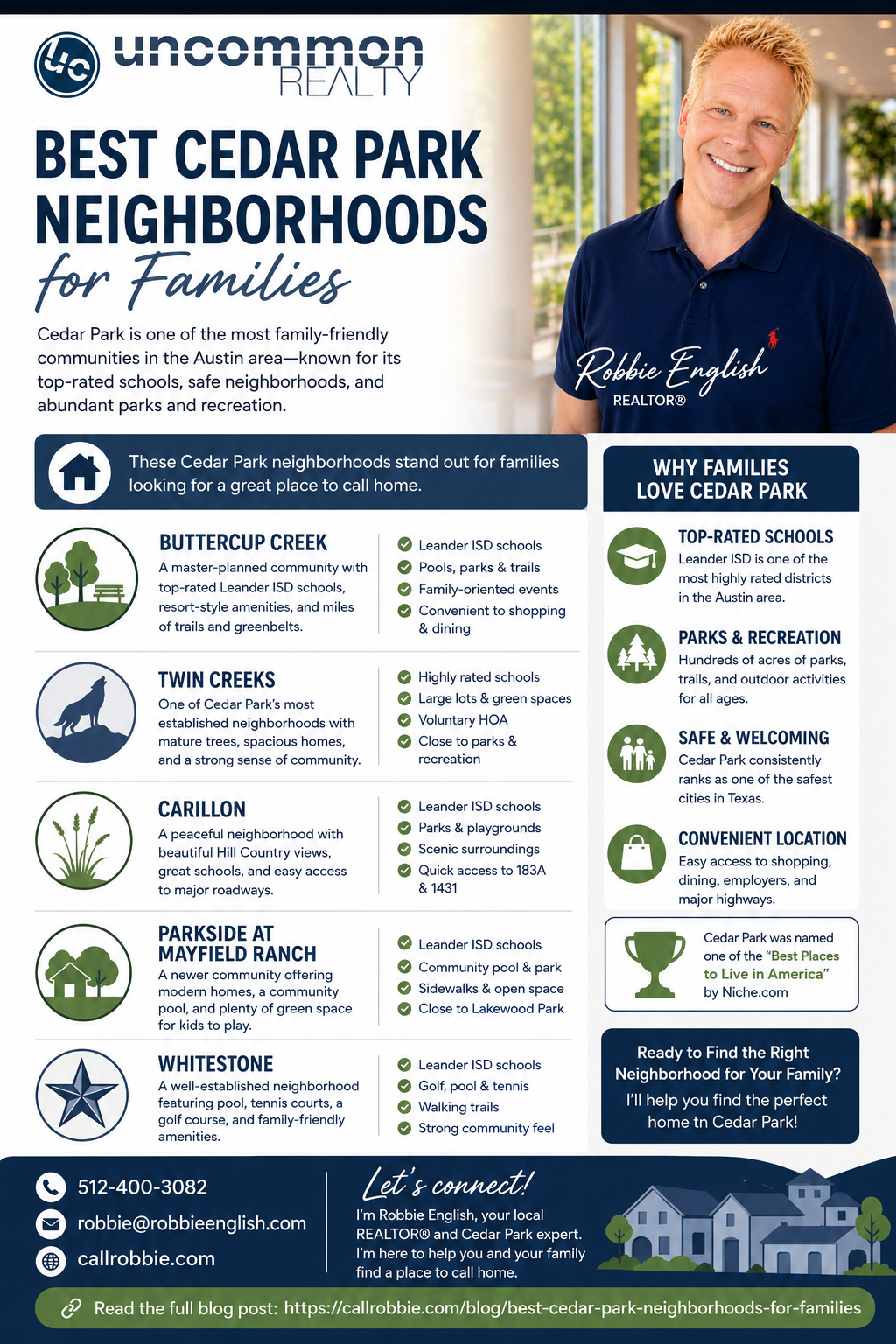
Buttercup Creek is probably the neighborhood most people picture when they think "Cedar Park." It's one of the largest and oldest subdivisions in the city, which means it's got real tree canopy, established landscaping, and a wide range of home styles and price points simply because it was built out over so many years. You'll find everything from modest one-story homes to larger two-stories, and because it covers so much ground off the 1431 corridor, it's genuinely walkable to parks and schools in a lot of pockets. If you want a neighborhood that already feels lived-in — sidewalks worn smooth, kids riding bikes after school — this is a strong starting point.
Ranch at Cypress Creek has a quieter, more spread-out feel than Buttercup Creek. Lots here tend to run a bit larger, and the neighborhood backs up to green space and creek corridor in several sections, which families with dogs or kids who like to roam tend to appreciate. It's established enough to have mature landscaping but doesn't carry quite the same density as some of Cedar Park's bigger subdivisions. It's a good fit if you want room to breathe without leaving the conveniences of Cedar Park behind.
Twin Creeks is Cedar Park's answer to a true master-planned community, built around the Twin Creeks Country Club and golf course. What sets it apart is the amenity package — trails, pools, and green space woven through the neighborhood — plus enough variety in home age and size that you'll find both comfortably-priced homes and larger ones closer to the golf course itself. Families drawn to Twin Creeks usually want that resort-adjacent feel without actually being in a resort town.
Anderson Mill West is one of the more affordable entry points into Cedar Park, and it's also one of the older ones. The homes are straightforward ranch-style builds from an earlier era of Cedar Park's growth, and the trees have had decades to fill in. If you're priced out of some of the newer subdivisions but still want to be zoned into Cedar Park's schools and close to the 183 corridor, this is where a lot of buyers end up looking, and it's often underrated for exactly that reason.
Cedar Park Town Center is the neighborhood for people who want to walk to dinner. It sits right up against the shops and restaurants along the 183A corridor, and the housing mix leans toward townhomes and lower-maintenance single-family options rather than the sprawling lots you'll find elsewhere in the city. It's a smaller footprint, but for families who value convenience over square footage — or who are downsizing from a bigger yard they no longer want to maintain — it fills a real gap in Cedar Park's housing stock.
Whitestone Landing represents the newer side of Cedar Park, up in the northern part of the city. Homes here tend to be recently built with more current floor plans — open layouts, larger primary suites, that sort of thing — and the neighborhood is still filling in with newer phases in some areas. If the idea of buying something nobody else has lived in appeals to you, and you want that without leaving Cedar Park for one of the outlying suburbs, this is a natural fit.
Carriage Hills tends to fly under the radar compared to some of Cedar Park's bigger-name subdivisions, and I think that's a shame, because it's a genuinely solid, tucked-away pocket. It's smaller in scale than Buttercup Creek, quieter on the streets, and has that settled, mature feel without the size or turnover of the bigger neighborhoods. It's a good one to keep on your list if you want established character but don't need a huge subdivision to find it in.
How the Schools Actually Break Down
Here's where I want to clear something up, because I hear this question get muddled a lot: Cedar Park is not split between a "Cedar Park ISD" and a separate district. The entire city is served by Leander ISD. What changes from one part of Cedar Park to another isn't the district — it's which high school you're zoned to within that district, and that's where Cedar Park High School, Vandegrift High School, and Rouse High School come into play.
Generally speaking, the more central and western parts of Cedar Park — including a lot of Buttercup Creek and Ranch at Cypress Creek — feed into Cedar Park High School, which has been around long enough to feel like a true community fixture. Vandegrift, which is newer, tends to draw from the northwestern parts of the city, including areas out toward Twin Creeks and the newer construction corridors — you can browse homes in the Vandegrift zone if that's a priority. Rouse High School, meanwhile, picks up some of the eastern edges of Cedar Park closer to the Round Rock line, including parts of the Anderson Mill area. The boundaries shift periodically as Leander ISD manages growth, so if a specific high school matters to your decision, that's exactly the kind of thing worth confirming on a house-by-house basis before you fall in love with a listing.
What You'll Actually Pay in Different Parts of Cedar Park
Price in Cedar Park has less to do with which neighborhood you pick and more to do with the age and size of the specific home, since a neighborhood like Buttercup Creek alone spans a wide range depending on when a section was built. That said, there's a rough pattern. The most affordable entry points tend to be in the older, established neighborhoods — places like Anderson Mill West or the smaller original sections of Buttercup Creek — where you're paying for the location and the mature lot rather than modern finishes. As you move toward newer construction, whether that's in Whitestone Landing or newer phases within Twin Creeks, prices climb along with the size and updated layouts. And the amenity-rich, golf-adjacent sections of Twin Creeks or the larger new builds tend to sit at the top of the local range. If you're trying to figure out where your budget actually lands, it's worth looking at new construction homes in Cedar Park side by side with resale listings in the same part of town — the difference is often smaller than people expect, and sometimes it isn't.
New Construction or Established — Which Is Right for You
This is the trade-off I talk through with almost every family looking in Cedar Park, and there's no universally right answer. New construction gets you a home built to current code and current tastes — better insulation, more open layouts, warranties on the big systems — but you're often trading away tree cover, since it takes years for landscaping to fill in, and you may be one of the last houses on a street where construction traffic is still rolling through. Established neighborhoods like Buttercup Creek, Ranch at Cypress Creek, or Carriage Hills give you the opposite: shade, a settled community with neighbors who've been there a while, and often a bit more house for the money once you factor in resale value on an older layout — but you may be looking at an aging roof, an HVAC system on its last few years, or a kitchen that hasn't been touched since it was built. Neither path is wrong. It really comes down to whether you'd rather budget for updates over time or pay a premium up front for everything being brand new.
A Few Questions I Get Asked Often
What's the best neighborhood in Cedar Park for a family with young kids?
Honestly, most of the neighborhoods I've covered here work well for young families — that's part of why Cedar Park has such a strong reputation for it. If I had to narrow it down, I'd point toward Buttercup Creek or Ranch at Cypress Creek for the combination of established parks, sidewalks, and proximity to schools, but a lot of it comes down to which school zone matters most to you.
Is Cedar Park zoned to Leander ISD or Round Rock ISD?
The vast majority of Cedar Park is Leander ISD, split among Cedar Park High School, Vandegrift High School, and Rouse High School depending on the exact address. A small sliver of far-eastern Cedar Park can border Round Rock ISD territory, but that's the exception rather than the rule, and it's always worth double-checking the specific zoning for any home you're serious about.
Should I buy new construction or an established home in Cedar Park?
It depends on whether you value modern systems and layouts more than mature trees and an established community, and how comfortable you are budgeting for updates on an older home down the road. Both paths are common and both work well here — I'd just make sure you're going in with eyes open about the trade-off rather than assuming one is objectively better.
Are there Cedar Park neighborhoods within walking distance of shops and restaurants?
Cedar Park Town Center is the clearest answer here — it's built specifically around that walkable, mixed-use feel along 183A. A few pockets of Buttercup Creek and Twin Creeks also put you within a short drive, if not a walk, of shopping and dining.
How much house can I expect to get for my budget in Cedar Park?
That really depends on whether you're prioritizing new construction, lot size, or an established location, since all three pull price in different directions. The most reliable way to get a real answer is to look at actual current listings in the areas you're considering rather than relying on a general number, since Cedar Park's range is wide enough that averages can be misleading.
If you want to talk through any of this in more detail — which school zone actually fits your family, whether new construction makes sense for you, or just which of these neighborhoods is worth touring first — I'm happy to walk through it with you. No pressure, just a real conversation about what makes sense for your situation.
Categories
- All Blogs (970)
- !!! (59)
- !x (621)
- Austin Real Estate (113)
- Bee Cave Real Estate (1)
- Building A Home (14)
- Buying A Home (143)
- Buying Land (1)
- Cedar Park Real Estate (58)
- Central Austin Real Estate (75)
- Down Payment Assistance Programs (1)
- Downsizing (4)
- Downtown Austin Real Estate (5)
- Dripping Springs Real Estate (62)
- East Austin Real Estate (3)
- Financing and Mortgage (24)
- first-time homebuying (109)
- Georgetown Real Estate (9)
- Hill Country Real Estate (1)
- HOA (2)
- Home Appraisals (13)
- Home For Rent (1)
- Home Inspections (6)
- Home Pricing (6)
- Home Staging (1)
- Home Values (12)
- Homeownership (1)
- Homes For Rent (1)
- Homes For Sale (147)
- Hutto Real Estate (5)
- Investing (6)
- Investment Properties (4)
- Lakeway Real Estate (33)
- Leander Real Estate (59)
- LGBT+ Real Estate (8)
- Luxury Homes For Sale (5)
- Luxury Real Estate (19)
- Market Conditions (17)
- Moving to Austin (2)
- Moving to Texas (4)
- Negotiations (3)
- Neighborhoods (8)
- Northwest Austin Real Estate (94)
- Off Market Listings (7)
- Pflugerville Real Estate (10)
- Private Listings (2)
- Property Management (42)
- Property Tax (3)
- Real Estate (18)
- Reddit Question Answered (80)
- redwrite (63)
- Relocation (2)
- Renting (6)
- Representation (34)
- Round Rock Real Estate (59)
- Selling Your Home (62)
- South Austin Real Estate (1)
- Westlake Real Estate (3)
Recent Posts