
Buying a Home With an HOA in Austin, TX

Buying a home with an HOA in Austin TX can give you access to attractive common areas, neighborhood amenities, architectural standards, and shared maintenance. It can also introduce monthly or annual dues, use restrictions, approval requirements, special assessments, and rules that may affect how you enjoy your property.
That is why I tell buyers to look beyond the community pool and landscaped entrance. An homeowners association is not simply a neighborhood social club. It is a legal organization with governing documents, financial responsibilities, enforcement powers, and rules that may remain in place long after closing day.
I am Robbie English, Broker, REALTOR with Uncommon Realty. I have spent more than 40 years helping buyers understand the details behind real estate decisions, and I teach real estate professionals across the country. My goal is not to convince you that an HOA is good or bad. My goal is to help you understand what you are agreeing to before you own the home.

TLDR: Five Things to Know Before Buying in an HOA
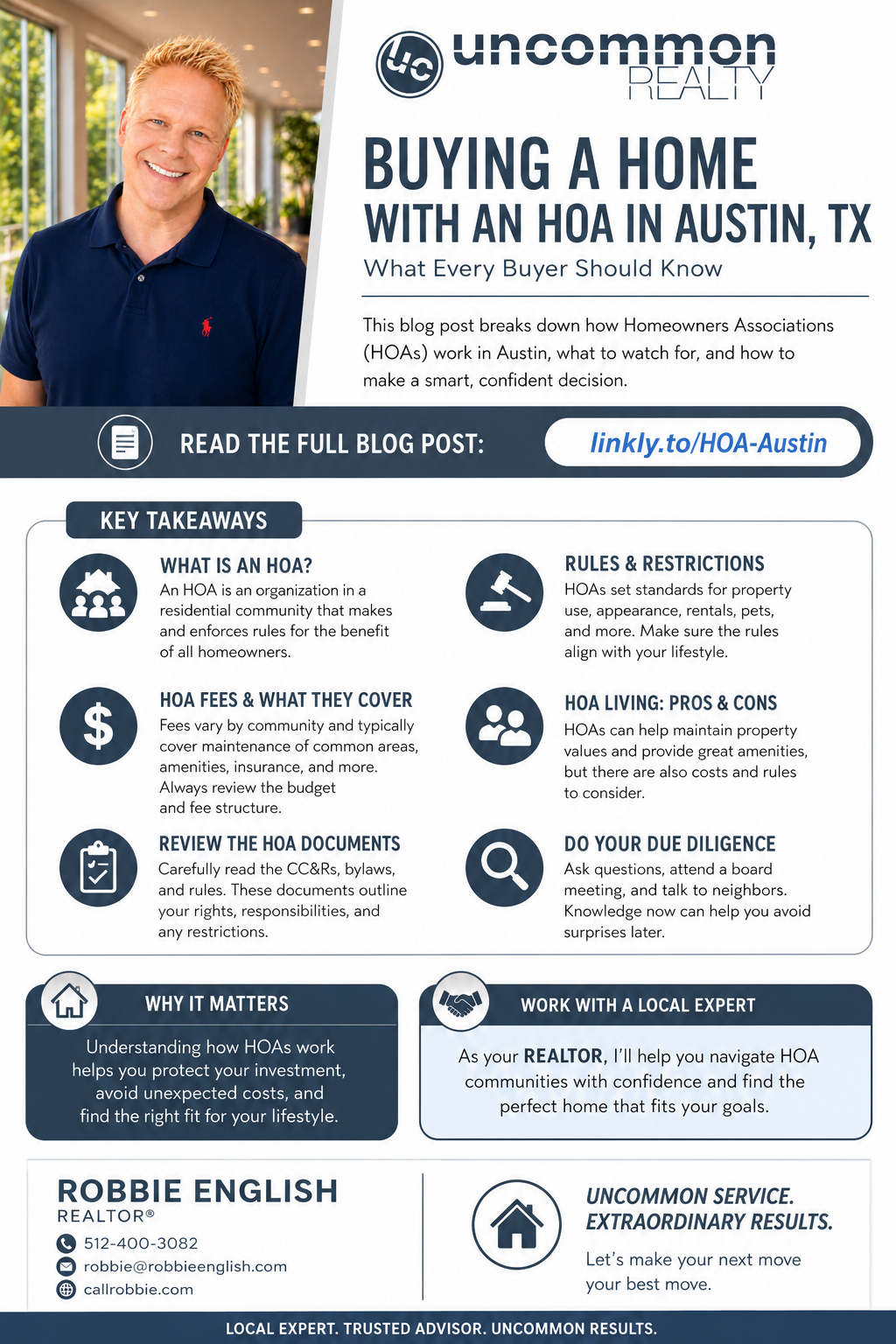
- Read the governing documents before closing. The declaration, bylaws, rules, budgets, and resale certificate can reveal restrictions and financial concerns.
- HOA dues are only part of the cost. Buyers should also investigate special assessments, transfer fees, initiation charges, insurance obligations, and future capital projects.
- Rules can affect everyday ownership. Parking, pets, rentals, exterior changes, fencing, landscaping, signs, and home businesses may all be regulated.
- The HOA's financial health matters. Weak reserves, unpaid assessments, deferred maintenance, or active litigation can create risk for owners.
- Never assume all Austin HOAs operate alike. Each association has its own documents, management practices, amenities, enforcement approach, and financial condition.
What Is an HOA?
A homeowners association is an organization created to manage and enforce rules for a residential community. Depending on the property, the HOA may maintain neighborhood entrances, private streets, pools, parks, gates, trails, landscaping, drainage areas, roofs, exterior walls, or other shared elements.
When you buy a property subject to mandatory membership, you generally become a member of the association automatically. That membership comes with rights and responsibilities. You may have voting rights, access to amenities, and the ability to attend meetings. You will also be expected to pay assessments and follow the governing documents.
In the Austin area, HOAs are common in newer subdivisions, condominiums, townhome communities, planned developments, gated neighborhoods, and amenity-rich communities. They can also appear in older neighborhoods where residents wanted a formal structure for maintaining shared property or enforcing development standards.
The Atmosphere of an HOA Community
The feel of an HOA neighborhood often depends on how actively the association manages the community. Some associations focus mainly on maintaining common areas and collecting dues. Others organize social events, enforce detailed appearance standards, operate recreation facilities, and closely review exterior changes.
Buyers who appreciate consistency may value rules governing lawn care, paint colors, fencing, parking, and property maintenance. Those standards can help create a more uniform appearance throughout the neighborhood. Buyers who prefer maximum freedom may feel restricted by those same rules.
The neighborhood atmosphere can also vary based on the type of community. A condominium association in Downtown Austin may focus on elevators, parking garages, insurance, security, and building maintenance. A suburban association in Cedar Park or Leander may focus more on pools, playgrounds, trails, landscaping, and architectural standards.
Home Styles Commonly Found in Austin HOA Communities
HOAs can govern nearly every type of residential property. Buyers may encounter mandatory associations in detached single-family neighborhoods, gated communities, condominiums, townhomes, duplex developments, patio-home communities, and master-planned subdivisions.
| Property Type | What the HOA May Maintain | What Buyers Should Review |
|---|---|---|
| Single-family home | Entrances, pools, parks, trails, landscaping, and private roads | Exterior restrictions, fencing, parking, rentals, dues, and special assessments |
| Condominium | Building exterior, roof, elevators, hallways, insurance, and shared systems | Master insurance policy, reserves, litigation, owner responsibilities, and rental limits |
| Townhome | Common landscaping, exterior elements, private streets, and amenities | Maintenance boundaries, roof obligations, insurance, and architectural approval rules |
| Master-planned community | Pools, trails, parks, amenity centers, landscaping, and community programming | Multiple assessments, district costs, amenity rules, development plans, and builder control |
Do not assume the association maintains something simply because it is shared or visible from the street. The governing documents should explain which party is responsible for roofs, fences, landscaping, foundations, windows, driveways, exterior paint, plumbing lines, and structural components.
How HOA Fees Affect Home Affordability
HOA dues should be included in your housing budget from the beginning. A home with a lower purchase price may still carry a higher monthly ownership cost if the association charges substantial dues or regularly imposes additional assessments.
Dues may be billed monthly, quarterly, semiannually, or annually. The amount may cover landscaping, amenity maintenance, management fees, insurance, utilities for common areas, reserve contributions, security, or other shared expenses.
Buyers should also look for costs beyond regular dues. These may include transfer fees, resale certificate charges, capital contributions, initiation fees, move-in deposits, access-card fees, parking charges, or special assessments. Your lender may count recurring HOA dues when calculating your debt-to-income ratio, which can affect how much you qualify to borrow.
Before making an offer, use the mortgage calculator to estimate your payment, then add HOA dues, property taxes, insurance, utilities, tolls, maintenance, and other recurring expenses. A realistic budget should reflect the entire cost of ownership, not just principal and interest.
Walkability, Amenities, and Shared Spaces
An HOA can improve a neighborhood's recreational walkability by maintaining sidewalks, trails, parks, greenbelts, pools, playgrounds, fitness areas, or gathering spaces. In communities such as Avery Ranch, Steiner Ranch, or Bryson, shared amenities can be a meaningful part of the lifestyle.
Still, buyers should separate neighborhood walkability from practical walkability. A community may offer miles of trails while still requiring a car for groceries, restaurants, work, and medical appointments. Visit the neighborhood at different times and walk the routes you expect to use.
You should also verify whether the amenities shown in marketing materials are complete, under construction, planned for a future phase, or available only with an additional fee. Ask about operating hours, guest policies, reservation requirements, age restrictions, and seasonal closures.
Restaurants, Shopping, and Nearby Conveniences
An HOA does not control the restaurants or shopping outside the neighborhood, but the community's location will still affect your daily routine. Some HOA neighborhoods sit near commercial centers, while others offer a quieter residential setting that requires a longer drive for errands.
Communities near The Domain may give residents convenient access to dining, shopping, entertainment, and major employers. Neighborhoods farther west or toward the lake may offer more scenery and privacy but require additional driving for everyday services.
Drive from the property to your preferred grocery store, restaurant, gym, school, and medical provider before deciding that the location works. An attractive amenity center does not make up for a commute or errand pattern that does not fit your life.
Parks and Recreation in HOA Neighborhoods
Many Austin-area HOAs maintain neighborhood parks, pools, dog areas, sport courts, trails, playgrounds, picnic spaces, and open lawns. These features can create convenient recreation close to home, especially for buyers who expect to use them regularly.
Ask who owns and maintains each amenity. Some facilities may belong to the HOA, while others may be owned by a municipal utility district, city, private club, or separate master association. Ownership can affect access, maintenance standards, dues, and future costs.
You should also examine whether the association has enough money set aside to repair or replace expensive amenities. Pools, retaining walls, private roads, gates, irrigation systems, roofs, and clubhouses eventually require major work. If the reserve fund is inadequate, homeowners may face increased dues or a special assessment.
Schools and HOA Boundaries
An HOA boundary does not necessarily match a school attendance boundary. Two homes in the same master-planned community may occasionally be assigned to different campuses, particularly when the neighborhood crosses district lines or develops in multiple phases.
Never rely solely on the listing, builder representative, neighborhood website, or current owner's statement regarding school assignments. Confirm the schools for the specific property address directly with the applicable district.
School boundaries can change as enrollment grows and districts open new campuses. Buyers should investigate current assignments, transportation options, special programs, extracurricular activities, and any proposed boundary changes that may affect the property.
Commuting From an HOA Community
Many HOA neighborhoods are located along Austin's major growth corridors. Depending on the location, residents may use Interstate 35, MoPac Expressway, US 183, 183A, SH 45, Loop 360, or local arterial roads.
Buyers considering communities in Northwest Austin or North Austin may value access to technology employers and major commercial areas. Buyers considering Lakeway, Bee Cave, or Steiner Ranch may prioritize Hill Country surroundings while accepting a longer drive to certain employment centers.
| Commute Issue | Why It Matters | Buyer Action |
|---|---|---|
| Gated entry | Traffic may back up during peak periods or when gates malfunction | Visit during morning and evening traffic |
| Toll-road access | Can shorten travel time but increase monthly expenses | Estimate toll usage before setting your budget |
| School traffic | Nearby campuses may affect neighborhood entry and exit times | Test the route during school arrival and dismissal |
| Future development | New homes and commercial projects may change traffic patterns | Review nearby land use and planned road improvements |
Who Is an HOA Community Best Suited For?
An HOA neighborhood may be a good fit for buyers who value maintained common areas, community amenities, architectural consistency, and established neighborhood standards. It can also appeal to owners who prefer a more organized approach to shared maintenance and community governance.
Condominium and townhome associations may suit buyers who want reduced exterior maintenance, although the exact responsibility depends on the documents. Master-planned communities may appeal to households that expect to use pools, trails, parks, social events, and recreation facilities.
An HOA may be less suitable for buyers who want to park recreational vehicles on the property, operate certain businesses from home, rent the property without restrictions, keep multiple large animals, install exterior improvements without approval, or make highly individualized changes to the property.
HOA Documents Every Buyer Should Review
The governing documents tell you what the association can do, what owners must do, and how the community is managed. Buyers should review these materials carefully during the contract period and consult appropriate legal or financial professionals when questions arise.
- Declaration of covenants, conditions, and restrictions: Establishes property restrictions, assessment obligations, maintenance duties, and enforcement rights.
- Bylaws: Explain how the association operates, including meetings, elections, voting, directors, and officer responsibilities.
- Rules and regulations: Provide detailed requirements concerning parking, pets, amenities, leasing, landscaping, signs, noise, and other activities.
- Current budget: Shows expected income and expenses and may reveal whether regular dues adequately support operations.
- Reserve information: Helps buyers evaluate whether the association is preparing for major repairs and replacements.
- Meeting minutes: May identify disputes, maintenance concerns, rule changes, owner complaints, or upcoming projects.
- Insurance information: Explains what the master policy covers and what coverage the individual owner must obtain.
- Resale certificate: May provide information about dues, violations, litigation, special assessments, and the status of the individual property.
Long-Term Appreciation Potential in an HOA
No HOA can guarantee appreciation. Property values depend on many factors, including location, property condition, buyer demand, employment trends, schools, financing conditions, surrounding development, and the broader economy.
A well-managed association may support long-term appeal by maintaining shared areas, planning for major expenses, enforcing reasonable standards, and protecting community amenities. Poor management can have the opposite effect. Deferred maintenance, frequent disputes, weak reserves, excessive restrictions, or recurring assessments may make a community less attractive to future buyers.
Financing can also affect resale potential. Certain lenders may hesitate to finance a condominium or townhome in a community with inadequate insurance, high delinquency rates, unresolved litigation, commercial-use concerns, or other financial issues. Even when you are purchasing a detached home, the association's condition can influence buyer perception and affordability.
The strongest purchase is usually a home with broad appeal, a practical floor plan, a desirable lot, manageable dues, reasonable rules, and an association that appears financially responsible.
Common Buyer Mistakes With Austin HOAs
- Waiting until after closing to read the rules. Buyers should review the documents while they still have contractual rights and time to ask questions.
- Assuming verbal statements override written restrictions. A seller, neighbor, or sales representative may be mistaken. The written documents control.
- Ignoring special assessments. A low regular fee does not guarantee low costs if the association has insufficient reserves.
- Failing to investigate rental restrictions. Minimum lease terms, waiting periods, rental caps, registration requirements, and short-term rental rules can affect future plans.
- Overlooking architectural approval. Fences, pools, paint colors, solar equipment, sheds, landscaping, and additions may require written approval.
- Not checking insurance obligations. The association's master policy may not cover the owner's interior, improvements, personal property, liability, or loss-assessment exposure.
- Assuming amenities will remain unchanged. Operating hours, rules, access, fees, and facilities may change through association decisions.
- Failing to review violations tied to the property. Existing violations can become a problem if they are not resolved before closing.
Another mistake is assuming the listing agent, builder representative, or HOA manager is responsible for protecting the buyer's interests. Before touring or negotiating, review my buying a home information and establish clear representation.
Questions to Ask Before Making an Offer
- How much are the regular assessments, and how often are they billed?
- Are any special assessments approved, pending, or under discussion?
- What are the association's largest upcoming repair or replacement projects?
- How much money is held in reserves?
- Are there active lawsuits involving the association?
- What percentage of owners are delinquent on assessments?
- Are rentals limited, capped, or subject to minimum lease periods?
- What exterior changes require architectural approval?
- Which property components are maintained by the owner?
- Are there parking, pet, vehicle, business, or occupancy restrictions?
- Does the property currently have any violations or unpaid charges?
- What does the association's insurance policy cover?
These questions may not produce a simple yes or no answer, but they can help you identify whether additional investigation is needed before you move forward.
Frequently Asked Questions About Buying a Home With an HOA in Austin TX
Are HOA fees included in the mortgage payment?
HOA dues are generally separate from principal, interest, property taxes, and homeowners insurance. A lender may include the dues when calculating qualification, but the homeowner usually pays the association directly.
Can an HOA increase its dues?
An association may be able to increase regular assessments according to its governing documents and applicable law. Buyers should review historical dues, the current budget, reserve planning, and any proposed increases.
Can an HOA stop me from renting my home?
Some associations regulate leasing through rental caps, waiting periods, minimum lease terms, registration rules, tenant screening requirements, or short-term rental restrictions. Review the documents before purchasing if renting is part of your plan.
Can an HOA regulate exterior changes?
Yes. Many associations require approval for paint colors, fences, sheds, pools, landscaping, solar equipment, additions, patios, roofing materials, and other exterior changes. Obtain written approval before beginning work.
What is a special assessment?
A special assessment is an additional charge imposed on owners to pay for expenses not fully covered by regular dues or reserves. It may be used for repairs, insurance costs, legal expenses, major projects, or unexpected damage.
Should I review HOA meeting minutes?
Yes. Meeting minutes may reveal maintenance problems, owner disputes, planned assessments, rule changes, insurance concerns, litigation, or major projects that are not obvious during a property showing.
Can an HOA place a lien on a property?
An association may have lien rights for unpaid assessments or other authorized charges. Buyers should verify that dues, fines, and property-specific obligations are properly addressed before closing.
Is buying in an HOA a good idea?
It depends on your priorities, the association's rules, financial condition, management quality, amenities, and costs. The right HOA can support a lifestyle you enjoy. The wrong one can create restrictions or expenses that do not fit your plans.
Make the HOA Part of Your Buying Decision
Buying a home with an HOA in Austin TX should involve more than choosing a floor plan and calculating a payment. You are also buying into a legal and financial organization that can affect your property rights, monthly expenses, maintenance responsibilities, and future resale.
Again, I am Robbie English, Broker, REALTOR with Uncommon Realty. With more than 40 years in real estate and years spent teaching agents across the country, I believe buyers deserve clear information before they sign a contract.
When you are ready to compare Austin-area HOA communities, begin your home search, review my home buying resources, or contact me so we can discuss your priorities, representation options, and the documents that deserve careful review.
Categories
- All Blogs (970)
- !!! (59)
- !x (621)
- Austin Real Estate (113)
- Bee Cave Real Estate (1)
- Building A Home (14)
- Buying A Home (143)
- Buying Land (1)
- Cedar Park Real Estate (58)
- Central Austin Real Estate (75)
- Down Payment Assistance Programs (1)
- Downsizing (4)
- Downtown Austin Real Estate (5)
- Dripping Springs Real Estate (62)
- East Austin Real Estate (3)
- Financing and Mortgage (24)
- first-time homebuying (109)
- Georgetown Real Estate (9)
- Hill Country Real Estate (1)
- HOA (2)
- Home Appraisals (13)
- Home For Rent (1)
- Home Inspections (6)
- Home Pricing (6)
- Home Staging (1)
- Home Values (12)
- Homeownership (1)
- Homes For Rent (1)
- Homes For Sale (147)
- Hutto Real Estate (5)
- Investing (6)
- Investment Properties (4)
- Lakeway Real Estate (33)
- Leander Real Estate (59)
- LGBT+ Real Estate (8)
- Luxury Homes For Sale (5)
- Luxury Real Estate (19)
- Market Conditions (17)
- Moving to Austin (2)
- Moving to Texas (4)
- Negotiations (3)
- Neighborhoods (8)
- Northwest Austin Real Estate (94)
- Off Market Listings (7)
- Pflugerville Real Estate (10)
- Private Listings (2)
- Property Management (42)
- Property Tax (3)
- Real Estate (18)
- Reddit Question Answered (80)
- redwrite (63)
- Relocation (2)
- Renting (6)
- Representation (34)
- Round Rock Real Estate (59)
- Selling Your Home (62)
- South Austin Real Estate (1)
- Westlake Real Estate (3)
Recent Posts