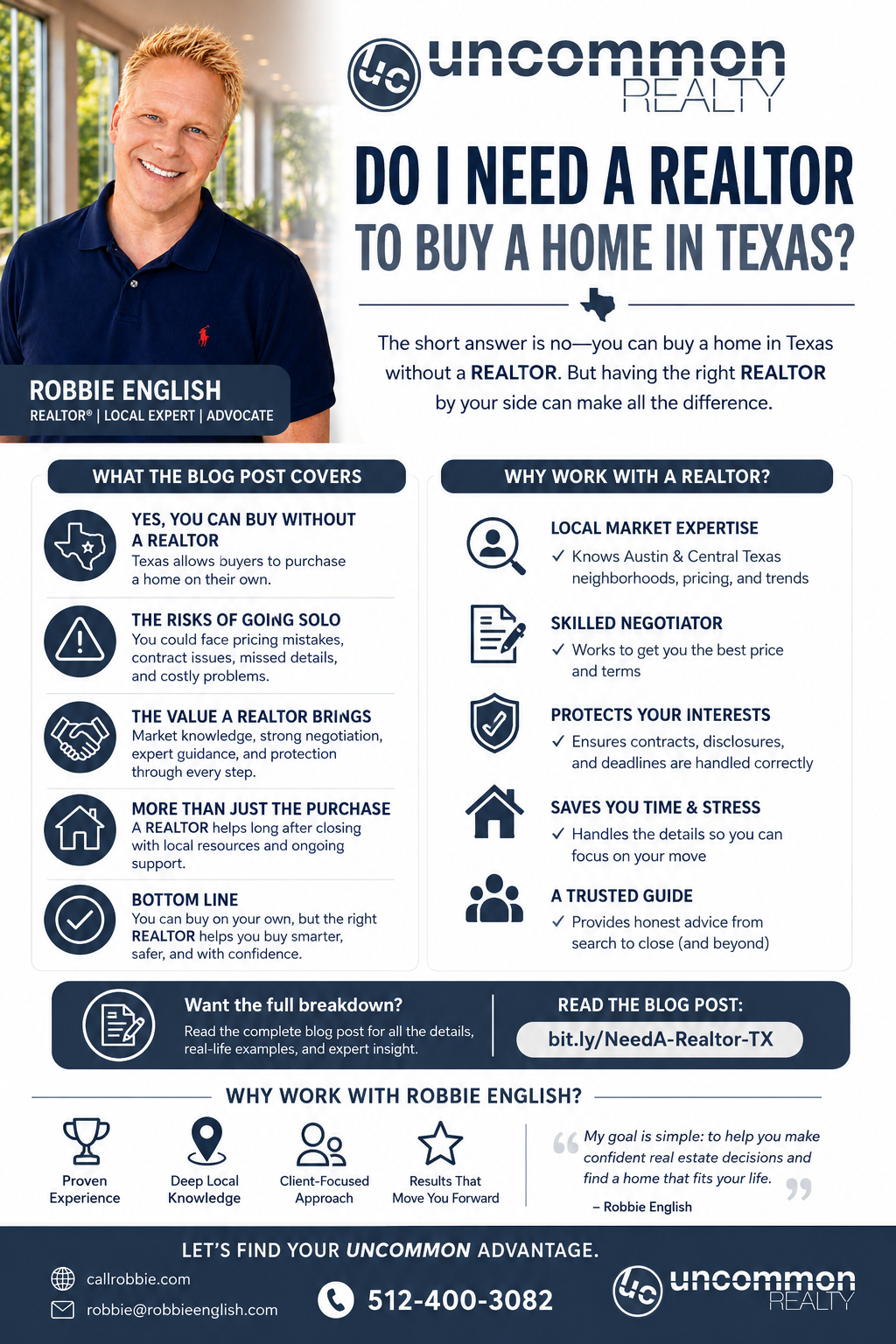
Do I Need A REALTOR To Buy A Home In Texas?

Do you need a REALTOR to buy a home in Texas? Legally, no — you are entirely free to buy a home entirely on your own without one. Practically, and especially under the rules that took effect in 2026, the honest answer is that representation protects you in ways that are hard to replicate on your own. This guide covers what a REALTOR actually does in a Texas transaction, the new buyer-representation-agreement requirement, and what you genuinely risk by going without one.
I am Robbie English, Broker, REALTOR at Uncommon Realty. I have represented buyers through markets that have shifted repeatedly over the years, and my goal here is to give you a clear, honest answer rather than a sales pitch.

The New Rule: Written Representation Is Now Required
This is the most important, and most recent, piece of the puzzle. As of January 1, 2026, Texas law requires a written buyer representation agreement before a REALTOR can show you a property, or before presenting an offer if no showing occurs. That agreement is no longer optional, and it must spell out specific terms: how the agent is compensated, whether the relationship is exclusive, and a termination date, rather than leaving compensation as an open question to be settled later.
What this means practically is that the days of an informal, undocumented relationship with a buyer's agent are over. You will sign something before you tour homes, and that document will tell you exactly what representation costs and what you are agreeing to. Far from being a burden, this actually protects buyers by putting the terms in writing up front instead of leaving them ambiguous.
How Buyer-Agent Compensation Actually Works Now
Since the 2024 national settlement reshaped how real estate compensation is disclosed, the rules in Texas have tightened further. Broker compensation is not set by law and is fully negotiable, and your representation agreement must state the amount or rate before you begin touring homes. As the buyer, you are technically responsible for your agent's fee unless the seller agrees to cover it as part of the deal, which remains common in most Texas transactions in 2026 through a seller concession negotiated into the contract.
The practical upshot is that you now know exactly what representation costs before you commit to it, and in most cases the cost is built into the transaction through seller-paid concessions rather than coming directly out of your pocket. Ask your agent to walk through this plainly before you sign anything, since "fully negotiable" also means you should understand what you are negotiating.
It also means you should feel free to ask questions before signing: what happens if you tour homes with one agent and later prefer to work with someone else, what the exclusivity period covers, and what triggers the agreement's termination date. A good agent explains all of this without hesitation, because the document exists to protect both sides, not to lock you into something you do not understand.
What A REALTOR Actually Does For You
Beyond the paperwork, a buyer's agent performs real, substantive work. They give you full MLS access and alert you to new listings before they go stale, evaluate comparable sales so you do not overpay, and negotiate price, repairs, and terms on your behalf, work that carries real financial weight in a market where buyers now have genuine leverage. They also manage the Texas-specific contract mechanics: the TREC one-to-four family residential contract, the option period, earnest money, and the deadlines that, if missed, can cost you your option fee or worse.
They also coordinate the moving parts, lenders, inspectors, title companies, appraisers, so that a single missed step does not derail your closing. None of this is impossible to do alone, but doing it well requires understanding a legal document and a process most buyers encounter only a handful of times in their life, versus an agent who works inside it constantly.
A REALTOR also brings market context you cannot easily replicate from listing sites alone: how a specific neighborhood's pricing has moved recently, which comparable sales actually apply to your target home, and whether a listing is priced to attract multiple offers or genuinely reflects value. In a metro as varied as Austin, where neighborhood conditions can differ block to block, that local read is difficult to get from public data alone, and it is exactly the kind of judgment that comes from working the market daily rather than researching it for a single purchase.
What Happens When You Buy Without Representation
Buying unrepresented does not mean buying without an agent involved at all; it usually means working directly with the seller's agent, who legally represents the seller's interests, not yours. That agent's job is to get the seller the best price and terms, which puts you at a structural disadvantage in any negotiation. You also take on full responsibility for reviewing the TREC contract, tracking option-period deadlines, and catching anything unusual in the transaction, with no one specifically looking out for your side.
The most common costly mistakes I see from unrepresented buyers are overpaying because they had no independent comparable-sales analysis, missing an option-period deadline and losing negotiating leverage or their earnest money, signing addenda they did not fully understand, and not knowing what is actually negotiable, repairs, closing costs, timelines, because no one explained it to them. None of these mistakes are dramatic on their own, but together they can easily cost far more than an agent's compensation would have.
There is also a psychological cost that is easy to underestimate: buying a home unrepresented in a fast-moving negotiation is stressful, and stress leads to rushed decisions. Buyers who have someone experienced reviewing every step tend to make calmer, clearer choices, particularly during the option period when inspection results come in and a negotiation over repairs or price adjustments has to happen quickly. I walk buyers through exactly this process in my broader guide to the step-by-step Texas home buying process, which covers what happens after you are under contract in more detail.
Why Texas Real Estate Has Its Own Learning Curve
Texas transactions run on their own standardized forms and rules, and they differ from what buyers relocating from other states expect. The TREC one-to-four family contract, the option period as a Texas-specific inspection and negotiation window, and TREC's licensing rules around who can practice real estate all shape how a deal actually proceeds here. An agent licensed and experienced in Texas navigates this by default; a buyer going it alone, especially one new to the state, is learning it in real time on the most expensive purchase of their life.
Access to full, real-time MLS data matters here too. Public search portals lag behind or omit information that agents see immediately, including pending status changes, price history, and off-market or coming-soon activity in some cases. That gap can be the difference between seeing a well-priced home the day it lists and seeing it after it is already under contract.
Texas also has a few statutes worth knowing about even if an agent is handling the paperwork for you. The seller's disclosure requirements under the Texas Property Code shape what you should expect to learn about a home's condition and history before you buy. The homestead exemption process affects your property taxes once you close, and the timing of when you file matters. None of this is exotic, but it is the kind of detail that an experienced Texas agent handles as routine and a first-time or out-of-state buyer often does not know to ask about.
When Going Unrepresented Might Make Sense
To be fair, there are narrow cases where a buyer reasonably skips representation: an experienced investor who transacts constantly and has in-house legal and contract expertise, or a private, off-market deal between parties who already know and trust each other with an attorney reviewing the paperwork. Even in those cases, a written contract review is still worth having, since Texas contracts are not something to freehand.
For the large majority of buyers, especially first-time buyers, families relocating from out of state, or anyone unfamiliar with Texas contracts, the value of representation clearly outweighs the cost, particularly now that the cost itself is disclosed up front rather than hidden or buried in the fine print.
How To Choose The Right REALTOR
If you decide representation is right for you, choosing well matters just as much as deciding to have representation in the first place. Look for someone who knows your specific market and price range, communicates clearly and promptly, and is straightforward about compensation and what your written agreement says before you sign it. Ask how many transactions they have closed recently, in what price range and neighborhoods, and for references you can actually call and speak with directly.
A good agent should welcome these questions rather than deflect them, and the conversation itself is a useful test of how they will handle the rest of the process.
It is also worth asking how an agent handles the parts of the transaction beyond the offer itself: how they coordinate with your lender, whether they attend the inspection, and how quickly they respond when a deadline is approaching. The best agents treat those logistics as seriously as the negotiation, because a missed communication with a title company or lender can delay closing just as easily as a poorly negotiated price. If you are preparing to buy for the first time, my guide on what to do before buying a home in Austin covers the groundwork worth doing before you even start interviewing agents.
What Changes If You Are Selling At The Same Time
Many buyers are also sellers, and the same representation questions apply on that side of the transaction. A listing agent's compensation is likewise fully negotiable and must be documented in writing, and Texas sellers navigate their own disclosure obligations under the Property Code. If you are buying and selling together, coordinating both transactions, timing the closing dates, structuring contingencies, and managing two sets of deadlines, is another place where representation earns its keep, since the margin for error effectively doubles.
Bringing It All Together
You do not legally need a REALTOR to buy a home in Texas, but the 2026 requirement for a written, upfront representation agreement has made the decision easier, not harder: you now see exactly what representation costs before you commit, and in most transactions that cost is offset by a seller concession rather than coming directly from your pocket. Weighed against the real risk of overpaying, missing a deadline, or navigating a Texas contract alone, representation is worth it for the vast majority of buyers.
If you are getting ready to buy, I am glad to walk you through exactly what a representation agreement with me would look like, no pressure, and answer any questions before you tour a single home or sign anything. You can explore current listings on my website or through my app in the Austin area.
Written for buyers and sellers in the Greater Austin, Texas area by Robbie English, REALTOR, Broker at Uncommon Realty.
Categories
- All Blogs (970)
- !!! (59)
- !x (621)
- Austin Real Estate (113)
- Bee Cave Real Estate (1)
- Building A Home (14)
- Buying A Home (143)
- Buying Land (1)
- Cedar Park Real Estate (58)
- Central Austin Real Estate (75)
- Down Payment Assistance Programs (1)
- Downsizing (4)
- Downtown Austin Real Estate (5)
- Dripping Springs Real Estate (62)
- East Austin Real Estate (3)
- Financing and Mortgage (24)
- first-time homebuying (109)
- Georgetown Real Estate (9)
- Hill Country Real Estate (1)
- HOA (2)
- Home Appraisals (13)
- Home For Rent (1)
- Home Inspections (6)
- Home Pricing (6)
- Home Staging (1)
- Home Values (12)
- Homeownership (1)
- Homes For Rent (1)
- Homes For Sale (147)
- Hutto Real Estate (5)
- Investing (6)
- Investment Properties (4)
- Lakeway Real Estate (33)
- Leander Real Estate (59)
- LGBT+ Real Estate (8)
- Luxury Homes For Sale (5)
- Luxury Real Estate (19)
- Market Conditions (17)
- Moving to Austin (2)
- Moving to Texas (4)
- Negotiations (3)
- Neighborhoods (8)
- Northwest Austin Real Estate (94)
- Off Market Listings (7)
- Pflugerville Real Estate (10)
- Private Listings (2)
- Property Management (42)
- Property Tax (3)
- Real Estate (18)
- Reddit Question Answered (80)
- redwrite (63)
- Relocation (2)
- Renting (6)
- Representation (34)
- Round Rock Real Estate (59)
- Selling Your Home (62)
- South Austin Real Estate (1)
- Westlake Real Estate (3)
Recent Posts