
Homes For Sale In Austin With No HOA

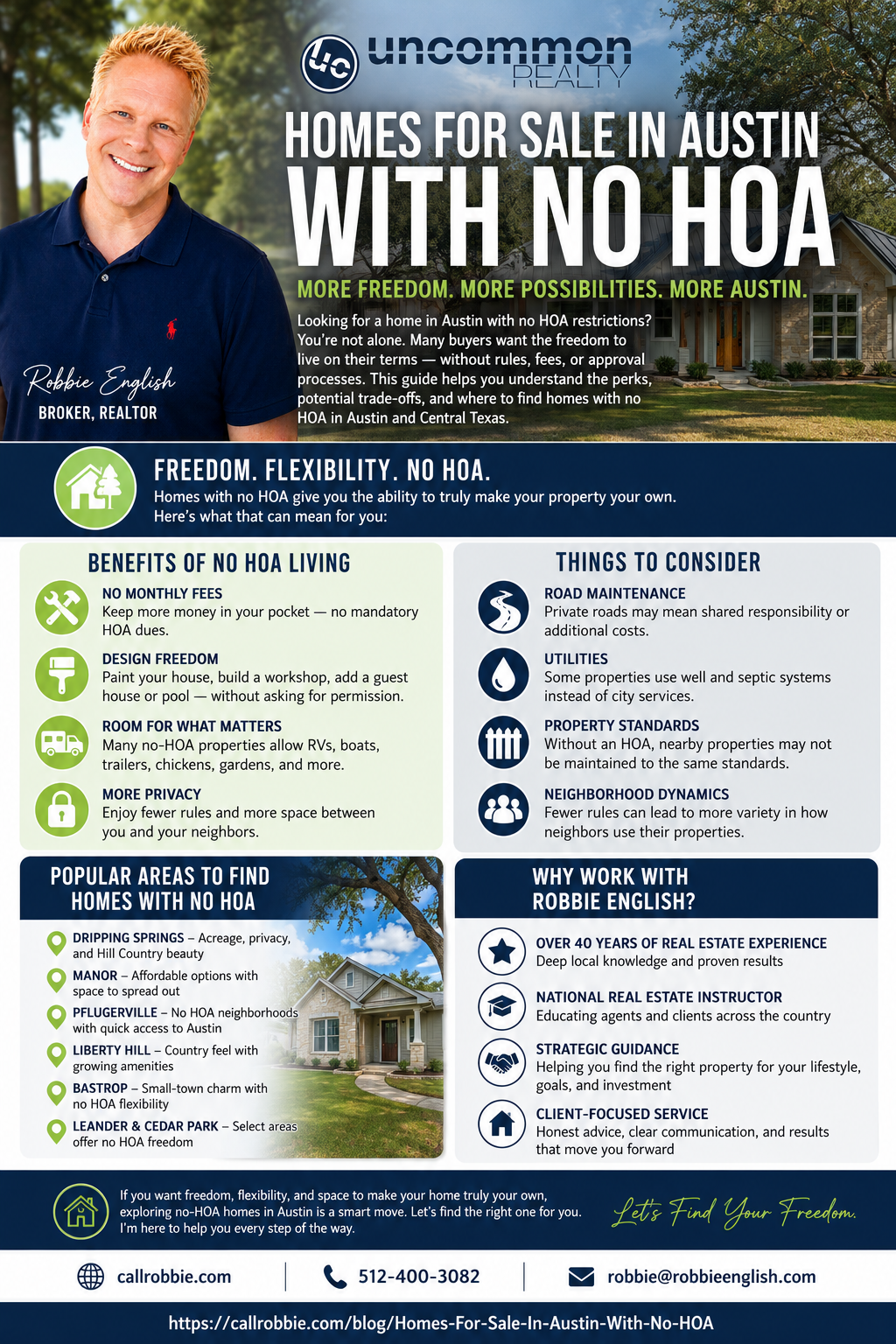
Homes for sale in Austin with no HOA exist across the city, but "no HOA" doesn't mean "no restrictions" — that's the single most important thing to understand before you search for one specifically. Here's what's actually true.

I'm Robbie English, Broker, REALTOR with Uncommon Realty. This search comes up constantly, usually from buyers who want more flexibility — so let's get into what that flexibility actually looks like in practice.
No HOA Doesn't Mean No Restrictions
This is the detail that trips people up. Many of Austin's older neighborhoods, especially those developed in the 1960s-80s, have private deed restrictions recorded directly on the property title, even though there's no active HOA collecting dues or enforcing anything day to day. These are covenants written by the original developer decades ago that still legally run with the land — they can limit things like adding a second structure, parking a commercial vehicle, or certain exterior changes, and they don't expire just because no one's been enforcing them recently. The real difference between a deed-restricted-but-HOA-free neighborhood and a true no-restrictions property is enforcement mechanism, not the existence of rules: with an HOA, a board follows a defined violation-and-fine process; with deed restrictions alone, enforcement typically falls to an individual neighbor filing a private legal action, which is rarer but not impossible. Always pull the actual title work and deed restrictions for a specific property — "no HOA" in a listing description isn't the same as confirming there are no restrictions at all.
What You Actually Gain Without an HOA
Real, genuine advantages: no monthly or annual dues, no architectural review board approval needed for changes (assuming no deed restrictions apply), more flexibility to park what you want, build what you want, and modify the property without a committee's sign-off, and — increasingly relevant in Austin specifically — better ability to take advantage of the city's HOME Act zoning changes, which expanded rights to add accessory dwelling units and build on smaller lots. HOA-governed communities can restrict or complicate ADU additions even where the city itself allows them, so a no-HOA property genuinely gives you more room to act on those expanded rights if that's part of your plan.
What You Give Up
Less uniform maintenance and curb appeal across the block — no HOA means no one is enforcing lawn care or exterior upkeep on your neighbors, which can mean more variability street to street than in a managed community. Shared amenities (pools, gated entries, common green space) are also typically absent, since those require an HOA structure to fund and maintain. And resale comps can be slightly less predictable, since buyer expectations and property conditions vary more without an HOA holding everyone to the same standard.
Does Buying Without an HOA Affect Financing?
No — lenders evaluate the specific property and your finances, not whether the neighborhood has an HOA. There's no mortgage penalty or different qualification standard for a no-HOA home. The one place this can matter indirectly: if a neighborhood has meaningfully mismatched home conditions due to the lack of enforced standards, an appraiser might have a harder time finding clean comps, which occasionally affects the appraisal process — but this is the exception, not the rule.

Where No-HOA Inventory Tends to Cluster
Older, established Central Austin neighborhoods — built before HOA structures became standard practice for new developments — are where you'll find the highest concentration of no-HOA (or HOA-free-but-deed-restricted) homes. Most newer master-planned communities in the suburbs, by contrast, are built with an HOA from day one to fund shared infrastructure and amenities, so if no-HOA is a hard requirement, your search will skew naturally toward older, more central inventory rather than newer suburban construction.
Central Austin Neighborhoods Worth Checking
I've covered several established Central Austin neighborhoods in more depth that generally fit this no-HOA, older-development profile: Allandale, Crestview, Brentwood, and North Shoal Creek — all mid-century neighborhoods built well before HOA structures became standard, and all worth reading about individually since deed-restriction specifics and character vary between them even though they share the broad "older, established, no-HOA" profile.
Resale and Negotiation Considerations
Because condition and upkeep vary more without an HOA enforcing shared standards, a well-maintained no-HOA home in an established neighborhood can actually stand out more at resale than it would in a uniformly-maintained HOA community — buyers notice pride of ownership more when it's not the baseline expectation. On the negotiation side, if you're touring a home next to a visibly neglected property, that's worth factoring into your own resale expectations honestly rather than assuming your home's value is fully independent of what's next door — proximity to poorly-maintained properties can be a real, if modest, drag on comps even without an HOA connecting the two properties formally.
What to Actually Check on a Specific Listing
Before you get attached to a "no HOA" listing: pull the deed restrictions from the title company or county records (your agent or title company can get this), ask the seller directly whether any private restrictions have historically been enforced by neighbors, and check with the city on current zoning and any HOME Act eligibility if ADU potential matters to your plans. None of this takes long, but skipping it means you might discover a restriction you didn't expect after you've already closed.
Who a No-HOA Home Actually Fits
This makes the most sense for buyers who genuinely value maximum control over their own property, don't mind (or actively prefer) more variability in how neighbors maintain theirs, and have a specific plan — an ADU, a workshop, a non-standard vehicle, a major renovation — that an HOA's architectural review process would likely complicate or block. If what you actually want is predictable, uniform curb appeal and shared amenities, and dues don't bother you, an HOA-governed community will probably serve you better regardless of the appeal of "no rules" in the abstract.
Common Questions
If there's no HOA, can I do whatever I want with the property?
Not necessarily — deed restrictions, city zoning, and building codes can all still apply even with zero HOA involvement. "No HOA" just means no organization collecting dues and actively managing community standards.
Are no-HOA homes cheaper?
Not automatically — price depends on location, condition, and size like any home. You're saving on monthly dues, but that's a separate factor from the purchase price itself.
Can deed restrictions be removed?
Sometimes, through a formal legal process, but it's not simple or guaranteed — don't buy assuming you'll be able to remove an inconvenient restriction later.
Reach out and I'll help you search specifically for no-HOA inventory and pull the real deed-restriction picture on anything you're seriously considering, rather than relying on the listing description alone.
You can also track new listings in real time through my app: https://closely.app.link/e/nY80KrwCWYb. I'm Robbie English, Broker, REALTOR with Uncommon Realty.
Categories
- All Blogs (970)
- !!! (59)
- !x (621)
- Austin Real Estate (113)
- Bee Cave Real Estate (1)
- Building A Home (14)
- Buying A Home (143)
- Buying Land (1)
- Cedar Park Real Estate (58)
- Central Austin Real Estate (75)
- Down Payment Assistance Programs (1)
- Downsizing (4)
- Downtown Austin Real Estate (5)
- Dripping Springs Real Estate (62)
- East Austin Real Estate (3)
- Financing and Mortgage (24)
- first-time homebuying (109)
- Georgetown Real Estate (9)
- Hill Country Real Estate (1)
- HOA (2)
- Home Appraisals (13)
- Home For Rent (1)
- Home Inspections (6)
- Home Pricing (6)
- Home Staging (1)
- Home Values (12)
- Homeownership (1)
- Homes For Rent (1)
- Homes For Sale (147)
- Hutto Real Estate (5)
- Investing (6)
- Investment Properties (4)
- Lakeway Real Estate (33)
- Leander Real Estate (59)
- LGBT+ Real Estate (8)
- Luxury Homes For Sale (5)
- Luxury Real Estate (19)
- Market Conditions (17)
- Moving to Austin (2)
- Moving to Texas (4)
- Negotiations (3)
- Neighborhoods (8)
- Northwest Austin Real Estate (94)
- Off Market Listings (7)
- Pflugerville Real Estate (10)
- Private Listings (2)
- Property Management (42)
- Property Tax (3)
- Real Estate (18)
- Reddit Question Answered (80)
- redwrite (63)
- Relocation (2)
- Renting (6)
- Representation (34)
- Round Rock Real Estate (59)
- Selling Your Home (62)
- South Austin Real Estate (1)
- Westlake Real Estate (3)
Recent Posts