
How To Sell Your House In Today’s Market And What Sellers Need To Know Before Listing

Selling a house in today's market takes more preparation than it did a few years ago. The Austin area has shifted toward buyers, with more inventory, longer days on market, and homes frequently selling at or below asking price. That does not mean you cannot sell well; it means pricing, preparation, and strategy matter more than ever. This guide covers what sellers genuinely need to know before listing, from reading the current market to pricing, prepping, and evaluating offers.
I am Robbie English, Broker, REALTOR at Uncommon Realty. I have guided many sellers through changing markets, and my goal here is to give you an honest, practical picture so you can list with a plan rather than crossing your fingers.

The 2026 Market: What Sellers Are Actually Facing
The most important thing to accept up front is that the market sets the price, not your purchase price, your renovation budget, or what you hoped to net. In 2026 the Austin metro is meaningfully softer than its 2022 peak, with several months of inventory, homes sitting longer, and buyers negotiating rather than rushing. Prices across the metro have come down from the highs, so pricing to yesterday's market is the single most common seller mistake.
This is not a doom-and-gloom picture; well-prepared, well-priced homes still sell, and often at strong prices. But sellers who understand the current reality, and price and prepare to it, consistently outperform those who anchor to peak-era expectations. For a fuller read on conditions, see my overview of Austin real estate market conditions.
Buyer Behavior Has Shifted
Buyers today have more choices and more leverage, and it changes how they shop. They are patient, they compare, and they expect either a move-in-ready home or a price that reflects the work a home needs. They negotiate on price and repairs, they scrutinize condition, and they walk away more readily when something feels off or overpriced. The frantic, waive-everything behavior of the boom is largely gone.
What this means for you as a seller is straightforward: presentation and pricing carry more weight, and you cannot count on a bidding war to paper over a flaw or an aggressive price. Meeting buyers where they are, with a home that shows well and is priced fairly, is how you generate real interest.
It also helps to understand who your buyer likely is. Many Austin-area buyers are relocating from higher-cost markets and comparing your home against several others in a single weekend, so anything that makes yours easier to choose, clear pricing, clean condition, flexible showings, and prompt responses to questions, gives you an edge. Buyers reward homes that reduce their uncertainty and friction. The seller who makes the buying decision feel easy and safe consistently attracts stronger offers than the one who makes buyers work to see past clutter, deferred maintenance, or an inflated price.
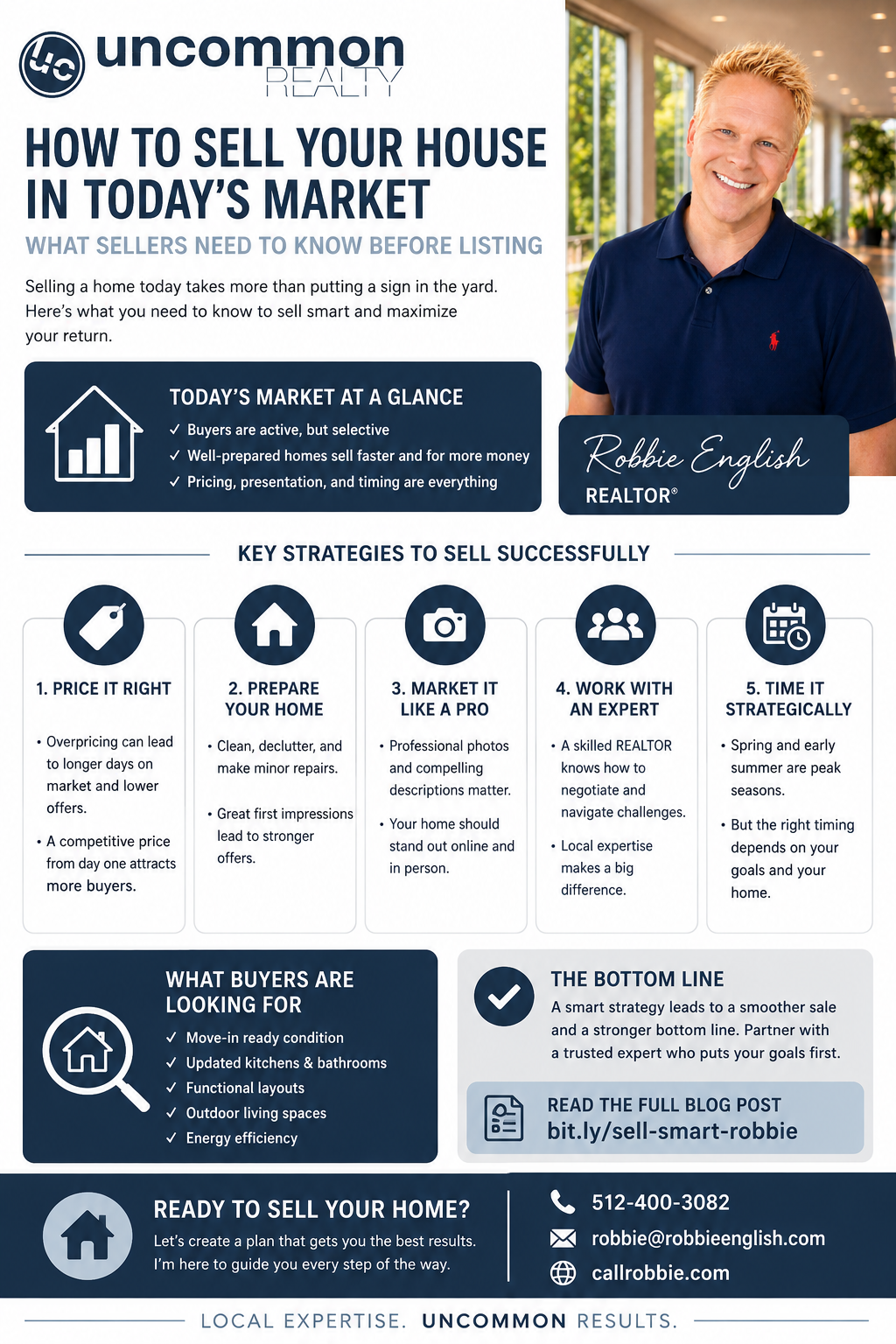
Price It Right The First Time
Pricing is the most consequential decision you will make, and the window that matters most is the first couple of weeks, when your listing gets peak attention. Price it correctly then and you attract the most qualified buyers and often the best offers. Overprice it, and the listing sits, grows stale, and forces price cuts, each of which signals weakness to the market and frequently leads to a lower final sale than if you had priced right from the start.
Set your price to recent comparable sales and your home's true condition, not to a number you need or a neighbor's outdated sale. It is also worth understanding the danger of going back on market: a home that goes under contract and then falls through carries a stigma, so vetting a buyer's financing and terms up front protects you from that outcome. Getting an honest, data-driven home valuation before you list is the foundation of the whole strategy.
Prepare Your Home For Today's Buyer
In a selective market, preparation directly affects both price and speed. Start with the inexpensive, high-impact basics: declutter and depersonalize, deep clean, touch up or refresh paint in neutral tones, and address the small repairs that make a home feel cared for. Curb appeal sets the first impression before a buyer walks in, so tidy the landscaping and entry. Professional photography is non-negotiable, since the vast majority of buyers judge your home online first.
Staging, whether full or light, helps buyers picture themselves in the space and can shorten your time on market. Many sellers also benefit from a pre-listing inspection, which surfaces issues on your terms so you can fix them or price for them, rather than being caught off guard during the buyer's option period. Preparation is where you control the outcome; the more move-in-ready your home feels, the less a buyer can use condition to negotiate you down.
Be strategic about which improvements you make, though. Not every upgrade returns its cost at sale, so focus on the ones buyers reward: clean, neutral, and functional almost always beats expensive and personalized. A fresh, well-maintained home in move-in condition typically earns more than one with a costly renovation done to the seller's taste. When in doubt, spend on the basics that remove objections rather than on statement projects, and ask your agent which specific fixes are worth doing for your home and price point before you write any checks.
Marketing That Actually Reaches Buyers
Once your home is prepared, how it is marketed determines how many of the right buyers see it. In a market where buyers are comparing many options, strong online presentation is what earns the click and the showing. That means professional photography, an accurate and compelling listing description, and syndication across the major portals where buyers actually look. For many homes, video or a virtual tour helps out-of-town and busy buyers shortlist your property before they ever visit.
Beyond the listing itself, targeted exposure matters: reaching buyers' agents, promoting to the right audiences, and making the home easy to show. The goal is to concentrate attention in those crucial first days on market when your listing is freshest. A home that is well-prepared but poorly marketed leaves buyers, and offers, on the table, which is why presentation and distribution deserve as much attention as the price itself.
What Sellers Need To Know Before Listing In Texas
Beyond price and prep, there are Texas-specific realities to prepare for. Texas requires a Seller's Disclosure Notice, in which you disclose known conditions and defects; completing it accurately and honestly protects you legally, so gather your records early. Have your survey and title information ready, since these come up in the transaction and gaps can cause delays. Property taxes are prorated at closing, and while Texas has no state income tax, remember that federal capital gains rules apply, with a primary-residence exclusion for many sellers, which is worth confirming with a tax professional for your situation.
Just as important, understand your net proceeds before you list, not after. Your take-home is the sale price minus the mortgage payoff, closing costs, agent compensation, and any concessions you agree to. Knowing that number up front lets you set expectations and make sound decisions rather than being surprised at the closing table. I am glad to walk you through a realistic net sheet as part of planning your home sale.
Evaluating Offers Beyond The Price
When offers come in, the highest number is not automatically the best deal. Look at the whole picture: the buyer's financing type and strength, the size of the earnest money, the contingencies and option period, appraisal risk, the requested closing timeline, and any concessions being asked for. A slightly lower offer from a fully underwritten buyer with few contingencies can be far more reliable, and net you more, than a higher offer that carries real risk of falling through.
This is where experience earns its keep. Reading offers for their true strength, and negotiating terms as well as price, is what turns interest into a clean, successful closing. The goal is not merely to accept an offer; it is to accept the right one and get it to the finish line.
Timing Your Sale
Timing still plays a role, even if it matters less than pricing and preparation. Spring and early summer traditionally bring the most buyer activity, which can help in a slower market, while late fall and winter see thinner demand but also less competing inventory. If you have flexibility, aligning your listing with stronger demand can help, but do not let a calendar target push you into listing before your home is genuinely ready.
The current market rewards readiness over rushing. A well-prepared home listed at the right price in a quieter month will usually outperform a rushed, underprepared home listed at the "perfect" time. Preparation and pricing beat timing almost every time.
Removing Emotion From The Decision
Selling a home you have lived in is emotional, and that emotion can quietly work against you, on pricing, on reacting to feedback, and on negotiating. The buyers evaluating your home are looking at it as a purchase, not a memory, so the more you can approach the sale as a business decision, the better your results tend to be. That means pricing to the market even when it is lower than you hoped, taking staging and repair feedback without defensiveness, and negotiating on the numbers rather than the feelings.
A good agent helps here by being the objective voice in the room, keeping the process grounded in data and strategy. Detaching emotionally does not mean you stop caring; it means you make clearer decisions that serve your bottom line.
Bringing It All Together
Selling in today's market comes down to a few disciplined moves: accept that the market sets the price, prepare your home so it shows move-in-ready, price it correctly the first time, handle the Texas disclosure and net-proceeds details up front, and evaluate offers on their full terms rather than the top-line number. Do those, and you position yourself for a strong, smooth sale even in a buyer-leaning market.
If you are thinking about selling, the best next step is an honest conversation about your home, your timeline, and your goals. You can start with a home valuation or review the latest market snapshot, and reach out through my seller resources or my app when you are ready to plan your listing in the Austin area.
Written for buyers and sellers in the Greater Austin, Texas area by Robbie English, REALTOR, Broker at Uncommon Realty.
Categories
- All Blogs (970)
- !!! (59)
- !x (621)
- Austin Real Estate (113)
- Bee Cave Real Estate (1)
- Building A Home (14)
- Buying A Home (143)
- Buying Land (1)
- Cedar Park Real Estate (58)
- Central Austin Real Estate (75)
- Down Payment Assistance Programs (1)
- Downsizing (4)
- Downtown Austin Real Estate (5)
- Dripping Springs Real Estate (62)
- East Austin Real Estate (3)
- Financing and Mortgage (24)
- first-time homebuying (109)
- Georgetown Real Estate (9)
- Hill Country Real Estate (1)
- HOA (2)
- Home Appraisals (13)
- Home For Rent (1)
- Home Inspections (6)
- Home Pricing (6)
- Home Staging (1)
- Home Values (12)
- Homeownership (1)
- Homes For Rent (1)
- Homes For Sale (147)
- Hutto Real Estate (5)
- Investing (6)
- Investment Properties (4)
- Lakeway Real Estate (33)
- Leander Real Estate (59)
- LGBT+ Real Estate (8)
- Luxury Homes For Sale (5)
- Luxury Real Estate (19)
- Market Conditions (17)
- Moving to Austin (2)
- Moving to Texas (4)
- Negotiations (3)
- Neighborhoods (8)
- Northwest Austin Real Estate (94)
- Off Market Listings (7)
- Pflugerville Real Estate (10)
- Private Listings (2)
- Property Management (42)
- Property Tax (3)
- Real Estate (18)
- Reddit Question Answered (80)
- redwrite (63)
- Relocation (2)
- Renting (6)
- Representation (34)
- Round Rock Real Estate (59)
- Selling Your Home (62)
- South Austin Real Estate (1)
- Westlake Real Estate (3)
Recent Posts