Hyde Park Real Estate For Sale In Austin TX
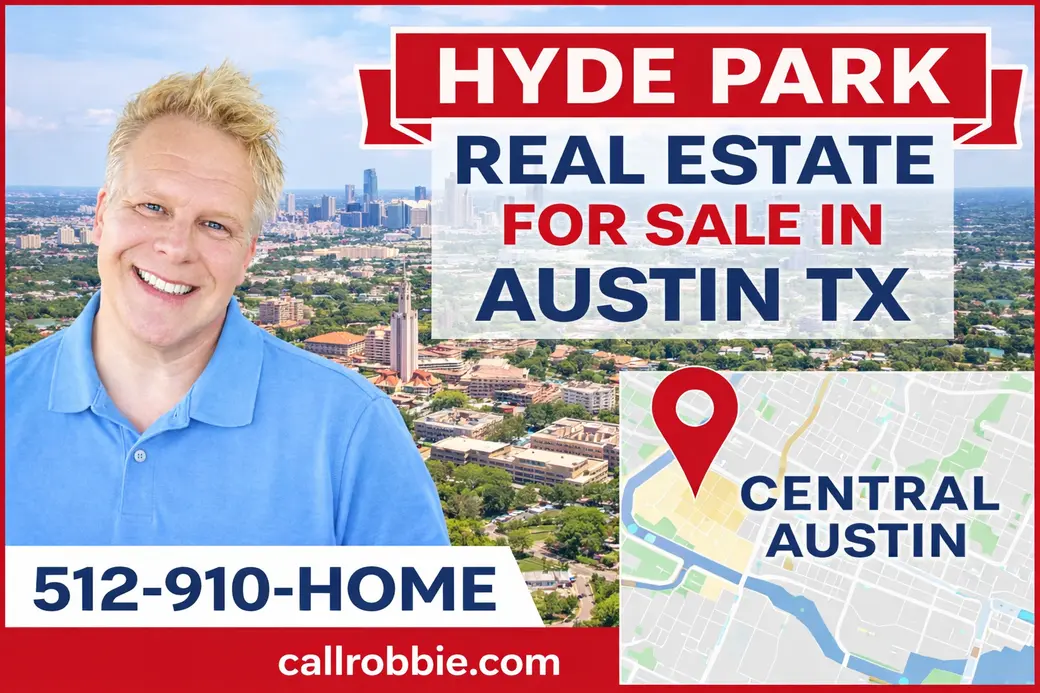
Hyde Park real estate for sale in Austin TX sits in zip code 78751, Austin's first suburb, established in 1891 and defined today by 38th Street to the south, 45th Street to the north, Duval Street to the east, and Guadalupe Street to the west. This guide covers the real history, boundaries, and facts behind Hyde Park rather than generic neighborhood praise.
I am Robbie English, Broker, REALTOR at Uncommon Realty, and I've helped buyers and sellers navigate Hyde Park alongside the surrounding Central Austin neighborhoods for years. My goal here is to give you real, verified facts, not marketing language.
A Real History, Not A Marketing Story
Hyde Park was established in 1891 by Monroe M. Shipe and the Missouri, Kansas and Texas Land and Town Company, built around a new electric streetcar line running from downtown Austin up Guadalupe Street to the neighborhood. It's considered Austin's first true suburb. The area's history includes an uncomfortable chapter worth being honest about: it was originally marketed exclusively to white buyers, explicitly excluding the city's racially integrated neighborhoods, a pattern documented in Austin's broader zoning and housing history. Hyde Park today looks nothing like that original marketing, having become one of Central Austin's most eclectic, diverse communities, but the history is real and worth acknowledging rather than glossing over.
Interestingly, the State Fair of Texas was actually held in eastern Hyde Park from 1875 until it moved to Dallas in 1884; a curved segment of 39th Street between Avenue F and Duval Street still reflects part of the old horse-racing track.
From Grand Homes To Affordable Bungalows
Hyde Park's earliest homes, built in the 1890s, were substantial Queen Anne-style residences built for locally prominent citizens; noted sculptor Elisabet Ney was among the neighborhood's first property owners, building a small castle-style studio called Formosa that's now the Elisabet Ney Museum. By the early 1900s, though, Hyde Park's marketing shifted toward affordability for working buyers, and the neighborhood's architectural character shifted along with it, toward smaller, more modest frame houses and bungalows. The neighborhood's greatest building boom actually happened between 1924 and 1935, and Shipe Park, named for the neighborhood's founder, was dedicated in 1928.
Austin's First Streetcar Suburb
Hyde Park's founding is tied directly to one specific piece of infrastructure: Monroe Shipe's Austin Rapid Transit Railway Company, which the City Council granted a franchise to build in 1890. The company's first line ran from Congress Avenue, west on Sixth Street, then north on Rio Grande Street and what's now Guadalupe Street, straight into Hyde Park. That streetcar line is precisely why Hyde Park exists where it does and why its street grid orients the way it does; the neighborhood was designed around getting residents to and from that rail line efficiently, decades before the automobile reshaped how Austin's later suburbs were planned.
This history is part of why Hyde Park's street pattern feels different from car-oriented postwar suburbs: it's a walkable, grid-based layout built for a pedestrian-and-streetcar lifestyle from the very beginning, not retrofitted for walkability after the fact.
Historic District Status
Part of Hyde Park was added to the National Register of Historic Places as the Hyde Park Historic District in 1990, covering roughly 138.5 acres and roughly bounded by 40th Street, 45th Street, Duval Street, and Avenue A, a smaller footprint than the broader neighborhood boundaries. The district includes real Victorian, Tudor Revival, and bungalow architecture. A second, smaller historic district, Shadow Lawn, sits in southeast Hyde Park, roughly bounded by 38th Street, 39th Street, Avenue G, and Duval Street.
Schools: Austin ISD
Hyde Park is zoned to Austin ISD, with students typically assigned to Lee Elementary School, Kealing Middle School, and McCallum High School. Confirm current zoning for a specific address directly with Austin ISD, since attendance boundaries can shift over time.
What Homes Here Actually Cost
Hyde Park pricing varies meaningfully by source and month, reflecting genuinely diverse inventory across the neighborhood: recent 2026 figures put the median list price roughly in the $600K-$750K range depending on the specific data source and time of year, with smaller condos and cottages starting lower and fully renovated historic homes running well above $1M in some cases. Given how much this range varies, work from genuinely recent comparable sales for a specific block and home type rather than relying on a single neighborhood-wide average.
What Homes Here Typically Look Like
Single-family homes make up roughly 95% of Hyde Park's built environment, with most lots improved between the late 1890s and 1935. Bungalows are the most common home type, followed by homes reflecting Queen Anne and Tudor Revival influences. Today's Hyde Park is known for its eclectic character: renovated historic bungalows sit alongside modern duplex-style residences, many painted in bright colors with the kind of unorthodox decoration that fits Austin's "Keep Austin Weird" identity.
Notable Historic Homes Worth Knowing
Beyond the Elisabet Ney Museum, Hyde Park is home to several individually recognized historic properties, including the Col. Monroe M. Shipe House (the neighborhood founder's own residence), the Oliphant-Walker House, a well-preserved Queen Anne example from the neighborhood's earliest building period, and the Blue Bonnet Court. If you're considering a specific older Hyde Park property, ask directly whether it carries individual historic recognition beyond simply sitting within the broader historic district, since the two are separate designations with separate implications for what exterior work requires review.
Parks And What's Nearby
Shipe Park, a 1.75-acre neighborhood park, offers two unlighted basketball courts, one multipurpose court, two lighted tennis courts, a playground, and a neighborhood swimming pool. Hyde Park borders the Hancock and North Loop neighborhoods and sits just north of the University of Texas, giving residents a genuinely short commute or bike ride to campus and to the broader Central Austin core.
Comparing Hyde Park To North Loop And Hancock
North Loop, immediately northeast of Hyde Park, shares a similar bungalow-era housing stock but has developed its own distinct, quirkier commercial strip along North Loop Boulevard, vintage shops, local restaurants, a genuinely different feel from Hyde Park's more residential core. Hancock, to the south, centers around the Hancock Golf Course, one of the oldest golf courses in Texas, and tends to have a quieter, less commercially dense character. All three neighborhoods share Central Austin's walkability and proximity to UT, but each has developed its own specific identity worth comparing in person.
Evaluating A Specific Hyde Park Listing
Given the genuine age range across Hyde Park's housing stock, some homes dating to the 1890s, others from the 1920s-1930s building boom, ask directly about the age of major systems (roof, HVAC, plumbing, electrical) on any home you're seriously considering. If a home sits within the Hyde Park Historic District specifically (roughly 40th to 45th, Duval to Avenue A), confirm what exterior modifications require additional city review before assuming you can freely renovate. Never skip a professional inspection during your Texas option period, since a historic bungalow's character can distract from real condition issues.
Structuring A Competitive Offer
Because Hyde Park's inventory is genuinely limited and its price range spans condos to million-dollar-plus historic estates, ground your offer in truly comparable recent sales for the specific home type and block, rather than a broad neighborhood-wide average. A fully underwritten pre-approval, clean terms, and a realistic option period all strengthen your offer independent of price.
Selling In Hyde Park
Sellers here benefit from genuine, sustained demand tied to the neighborhood's history, walkability to UT, and its eclectic character, but accurate pricing grounded in real comparable sales matters more than general neighborhood prestige. Buyers responding to a historic Hyde Park home want documentation, permit history on any renovations, confirmation of major-system updates, since that transparency directly addresses the questions buyers are already anticipating in a neighborhood this old.
Walkability And Getting Around
Hyde Park's original streetcar-suburb design gives it a genuinely walkable street grid by Austin standards, avenues running north-south, numbered cross streets, block after block of consistent, pedestrian-scaled lots. Guadalupe Street on the western edge and Duval Street on the eastern edge both carry CapMetro bus service connecting the neighborhood to downtown and to North Austin, and the neighborhood's proximity to UT makes it a genuinely realistic car-free or car-light option for students, faculty, and staff. For residents who want to walk or bike to daily errands, Hyde Park's commercial nodes along 45th Street and Duval Street offer real options most car-dependent Austin neighborhoods don't.
The Local Businesses That Anchor The Neighborhood
Hyde Park's commercial character is shaped by longstanding, independently owned businesses rather than national chains, part of what gives the neighborhood its distinctly local feel. Shops and restaurants along 45th Street and Duval Street have served the neighborhood for decades in some cases, and that continuity is part of what residents consistently point to when explaining why they've stayed in the neighborhood long-term rather than moving to a newer subdivision with more modern amenities but less character.
What A Century-Plus-Old Neighborhood Means For Long-Term Value
Central Austin historic neighborhoods like Hyde Park have generally held value well over time, driven in real part by a genuinely fixed supply, no new Hyde Park lots are being created, combined with strong, durable demand tied to UT proximity and the neighborhood's historic character. This scarcity is worth understanding as context for why demand here has remained resilient even through broader market slowdowns, though it's not a guarantee that values move in one direction indefinitely; the 2026 price softening noted above shows this neighborhood isn't immune to broader market cycles either.
Renting Versus Buying In Hyde Park
Given Hyde Park's proximity to UT, a meaningful share of the neighborhood's housing stock is renter-occupied, particularly smaller units and converted duplexes, rather than the overwhelmingly owner-occupied pattern you'd find in a suburban subdivision. This matters for buyers considering an investment property here: rental demand tends to stay durable given the university's steady enrollment, but it's worth understanding a specific property's zoning and any occupancy restrictions before assuming a rental strategy will work as expected on a given lot.
Who This Neighborhood Fits
Hyde Park tends to fit buyers who want genuine architectural and historical character, are comfortable navigating the additional diligence an older neighborhood requires, and want a short commute to UT and downtown without the density of a downtown high-rise. It's a weaker fit for buyers who want brand-new construction with zero historic-district considerations at all.
Getting A True Read On A Specific Block
Because Hyde Park spans such a wide range of home types and ages within a relatively small footprint, a neighborhood-wide statistic can genuinely mislead you about what a specific block actually looks like. A street of original 1920s bungalows a few blocks from a street of recently renovated duplexes can carry meaningfully different pricing, condition expectations, and even different feel day to day. Walk the specific block you're considering at different times of day before deciding, and ask your agent for comparable sales on that exact street rather than the zip code as a whole.
Bringing It All Together
Hyde Park is a real, historically significant Central Austin neighborhood in zip code 78751, established in 1891 as Austin's first suburb, zoned to Austin ISD's Lee Elementary, Kealing Middle School, and McCallum High School, and home to the Hyde Park Historic District added to the National Register in 1990. Understanding its real history, more than general reputation, is what actually helps you evaluate whether it's the right fit.
Whether you're evaluating a specific Hyde Park listing, weighing a renovated historic bungalow against a modern duplex on the same block, or comparing it against North Loop, Hancock, or other Central Austin neighborhoods, I'm glad to walk you through current listings and how they genuinely compare, property by property. You can browse current listings on my website or through my app.
Written for buyers and sellers in the Greater Austin, Texas area by Robbie English, REALTOR, Broker at Uncommon Realty.
Categories
- All Blogs (970)
- !!! (59)
- !x (621)
- Austin Real Estate (113)
- Bee Cave Real Estate (1)
- Building A Home (14)
- Buying A Home (143)
- Buying Land (1)
- Cedar Park Real Estate (58)
- Central Austin Real Estate (75)
- Down Payment Assistance Programs (1)
- Downsizing (4)
- Downtown Austin Real Estate (5)
- Dripping Springs Real Estate (62)
- East Austin Real Estate (3)
- Financing and Mortgage (24)
- first-time homebuying (109)
- Georgetown Real Estate (9)
- Hill Country Real Estate (1)
- HOA (2)
- Home Appraisals (13)
- Home For Rent (1)
- Home Inspections (6)
- Home Pricing (6)
- Home Staging (1)
- Home Values (12)
- Homeownership (1)
- Homes For Rent (1)
- Homes For Sale (147)
- Hutto Real Estate (5)
- Investing (6)
- Investment Properties (4)
- Lakeway Real Estate (33)
- Leander Real Estate (59)
- LGBT+ Real Estate (8)
- Luxury Homes For Sale (5)
- Luxury Real Estate (19)
- Market Conditions (17)
- Moving to Austin (2)
- Moving to Texas (4)
- Negotiations (3)
- Neighborhoods (8)
- Northwest Austin Real Estate (94)
- Off Market Listings (7)
- Pflugerville Real Estate (10)
- Private Listings (2)
- Property Management (42)
- Property Tax (3)
- Real Estate (18)
- Reddit Question Answered (80)
- redwrite (63)
- Relocation (2)
- Renting (6)
- Representation (34)
- Round Rock Real Estate (59)
- Selling Your Home (62)
- South Austin Real Estate (1)
- Westlake Real Estate (3)
Recent Posts