
Lakeway Waterfront Homes: The Complete Buying Guide (Docks, Pricing, What to Watch For)

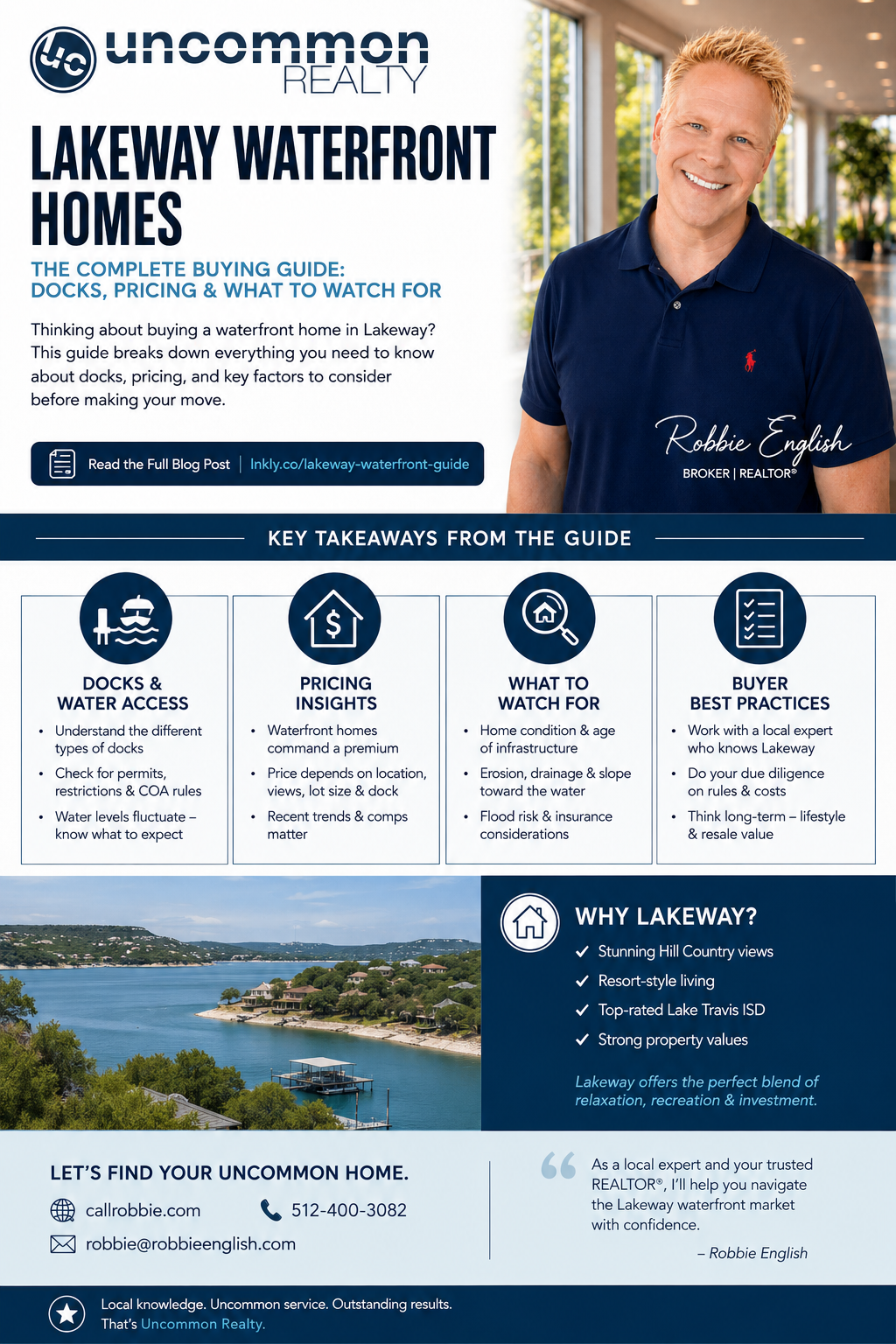
Waterfront homes on Lake Travis get shopped differently than everything else in the Austin area, and Lakeway is where most of that shopping happens. The lake is the whole reason people pay a premium here, but it's also the part buyers understand the least going in — how the water level actually behaves, what a dock permit really covers, and why two homes on the same street can be priced $400K apart even though they look similar from the street.
I work Lakeway waterfront transactions regularly, and most of the surprises I see aren't about the house — they're about the water. This guide covers the parts of a Lakeway waterfront purchase that standard home-buying advice doesn't cover.

TLDR: Lakeway Waterfront Buying Guide
- Lake Travis is a flood-control lake managed by the LCRA, and its level swings far more than Lake Austin or Lake LBJ.
- Dock type matters more than dock existence — floating docks handle low-water years better than fixed ones.
- Dock permits are tied to the LCRA, not just the property, and older permits may be grandfathered under rules that no longer apply to new construction.
- "Deep water" access at full lake level is not the same as deep water access during a drought year.
- Rough Hollow and Vineyard Bay are the two master-planned communities with the most organized marina and dock infrastructure in Lakeway; older shoreline lots outside those communities vary a lot more property to property.
Why Lake Travis Water Levels Matter More Than People Expect
Lake Travis exists primarily as flood control for the Highland Lakes chain, which the LCRA operates. That means its level is managed for flood capacity first, not kept constant for aesthetics or docks — unlike Lake Austin or Lake LBJ downstream, which the LCRA keeps at a nearly constant level year-round. Travis can swing dozens of feet between a wet year and a drought year. Full pool is 681 feet (which it just was in July, 2026); during the 2011 drought the lake dropped to around 626 feet — 55 feet below full — and it has come close to that again more than once since. A dock and shoreline that look perfect in a wet year can be a very different experience five years later.
This is the single biggest thing that separates buying on Travis from buying on almost any other lake in the area. A property that has beautiful, walk-off-the-dock deep water access at full lake level (681 feet) can end up with a long walk across exposed shoreline to reach the water when the lake drops. Floating docks ride up and down with the water and stay functional through those swings. Fixed docks on pilings don't — they can end up stranded above the waterline in a low year.
Dock Permits and Ownership
Every dock on Lake Travis sits on LCRA-managed lake bed, which means the dock itself is covered by an LCRA permit, not a straightforward extension of the property deed. When you buy a home with an existing dock, you're typically also assuming or transferring that permit, and older permits were sometimes issued under rules that are more permissive than what the LCRA allows for new construction today. If a dock ever needs to be rebuilt or significantly repaired, it may have to come into compliance with current regulations, even if the original structure was grandfathered in.
Before you get attached to a specific dock, it's worth confirming the permit is transferable, current, and that there's no pending compliance issue. This is a document check, not a guess, and I pull it before we get deep into negotiations on any waterfront listing.
Pricing and What Actually Drives It
Square footage matters less here than it does on a typical Austin listing. What drives price on Lakeway waterfront homes is water depth at the dock across a range of lake levels, whether the lot has a gentle walk to the water or a steep drop, how much usable flat yard sits between the house and the shoreline, and whether the view is open water or a narrower cove. Two homes with the same square footage and the same lake frontage number can be priced very differently once you account for those factors.
Ask for the historical depth at the dock during at least one low-water period, not just current conditions. A listing photographed during a full lake year can look very different than what you'll actually experience most summers.
Boat Slip vs. Private Dock
Not everyone who wants Lakeway waterfront living actually wants to own and maintain a dock. A marina slip through a community like Rough Hollow's yacht club gives you lake access, a place to keep a boat, and none of the maintenance, permit renewal, or storm-damage responsibility that comes with owning a private dock outright. It typically costs less upfront than a home with private deep-water access, and it's worth considering if what you actually want is boat access rather than a dock attached to your specific lot.
The tradeoff is convenience and privacy — a private dock means walking out your own backyard rather than driving to a marina, and it adds real value to the property itself if you ever sell. Which one fits depends on how often you'll actually use the water and whether you want that maintenance responsibility or would rather hand it off.
Where to Look in Lakeway
Two communities do most of the heavy lifting for buyers who want organized, low-maintenance waterfront access rather than a private dock to manage themselves. Rough Hollow is built around a yacht club and marina on the south shore, with boat slips and rentals available separately from home ownership — useful if you want lake access without owning and maintaining a private dock. Vineyard Bay is the other major waterfront community, built around private docks attached to individual lakefront lots rather than a shared marina.
Outside those two communities, Lakeway has a long stretch of older, individually built shoreline homes where dock quality, permit status, and lot grading vary property to property. Those older lots can be some of the best values on the lake if the dock situation checks out, and some of the biggest headaches if it doesn't — there's no substitute for checking each one individually.
What to Check During Due Diligence
Beyond a standard inspection, a waterfront purchase should include a review of the dock permit status with the LCRA, a survey confirming where the property line actually sits relative to the water (which can shift with lake level and erosion over time), and, if the home is in a community like Rough Hollow, a look at HOA or marina fees that run separately from standard HOA dues. I'd also walk the shoreline at whatever the current lake level happens to be, rather than relying only on listing photos.
If the seller can't produce a current dock permit or clear documentation on the shoreline, that's not automatically a dealbreaker, but it changes the negotiation and the timeline — budget extra time to resolve it before closing.
Insurance and Flood Zone Considerations
Waterfront property near Lake Travis can fall inside a FEMA-designated flood zone depending on elevation and exact location, which affects whether a lender requires flood insurance and how much it costs. This varies lot by lot along the shoreline, not community by community, so I wouldn't assume a home is or isn't in a flood zone based on its neighbors. Pull the FEMA flood map for the specific parcel, and if it's borderline, an elevation certificate can sometimes lower the premium significantly.
This is an area where I'd rather hand you off to a lender and insurance agent who deal with Lake Travis waterfront regularly than guess at numbers myself — the difference between a standard homeowners policy and one with flood coverage added can run into thousands of dollars a year, and it's worth pricing out before you're under contract, not after.
Moving Quickly When the Right Property Comes Up
Waterfront inventory in Lakeway is genuinely limited, and the good ones move fast. Live MLS search and my mobile app both give you real-time listing alerts rather than a once-a-day email digest, which matters more here than in most other segments of the market. You can reach me directly through the app if you want a same-day read on a new listing's dock and permit situation before you commit to seeing it in person.
Working With Someone Who Knows This Segment
Waterfront deals have more moving pieces than a standard purchase — permits, surveys, lake-level history, HOA marina structures — and most of those pieces aren't things a generic home search turns up. I'm Robbie English, Broker, REALTOR at Uncommon Realty, and I walk clients through each of these specifically rather than treating a waterfront listing like any other house. If you're looking seriously at Lakeway waterfront, reach out and I'll pull the dock permit and lake-level history on any listing you're considering before you make a decision.
Written for buyers and sellers in the Greater Austin, Texas area by Robbie English, REALTOR, Broker at Uncommon Realty.
Categories
- All Blogs (970)
- !!! (59)
- !x (621)
- Austin Real Estate (113)
- Bee Cave Real Estate (1)
- Building A Home (14)
- Buying A Home (143)
- Buying Land (1)
- Cedar Park Real Estate (58)
- Central Austin Real Estate (75)
- Down Payment Assistance Programs (1)
- Downsizing (4)
- Downtown Austin Real Estate (5)
- Dripping Springs Real Estate (62)
- East Austin Real Estate (3)
- Financing and Mortgage (24)
- first-time homebuying (109)
- Georgetown Real Estate (9)
- Hill Country Real Estate (1)
- HOA (2)
- Home Appraisals (13)
- Home For Rent (1)
- Home Inspections (6)
- Home Pricing (6)
- Home Staging (1)
- Home Values (12)
- Homeownership (1)
- Homes For Rent (1)
- Homes For Sale (147)
- Hutto Real Estate (5)
- Investing (6)
- Investment Properties (4)
- Lakeway Real Estate (33)
- Leander Real Estate (59)
- LGBT+ Real Estate (8)
- Luxury Homes For Sale (5)
- Luxury Real Estate (19)
- Market Conditions (17)
- Moving to Austin (2)
- Moving to Texas (4)
- Negotiations (3)
- Neighborhoods (8)
- Northwest Austin Real Estate (94)
- Off Market Listings (7)
- Pflugerville Real Estate (10)
- Private Listings (2)
- Property Management (42)
- Property Tax (3)
- Real Estate (18)
- Reddit Question Answered (80)
- redwrite (63)
- Relocation (2)
- Renting (6)
- Representation (34)
- Round Rock Real Estate (59)
- Selling Your Home (62)
- South Austin Real Estate (1)
- Westlake Real Estate (3)
Recent Posts