MLS Search in Austin

An MLS search in Austin means something more specific than "searching for homes online." Here's what the MLS actually is, why it differs from Zillow or Realtor.com, and how to actually use it well.

I'm Robbie English, Broker, REALTOR with Uncommon Realty. This gets confused constantly, so let's clear up what MLS actually means before getting into how to search it well.
What "MLS" Actually Is
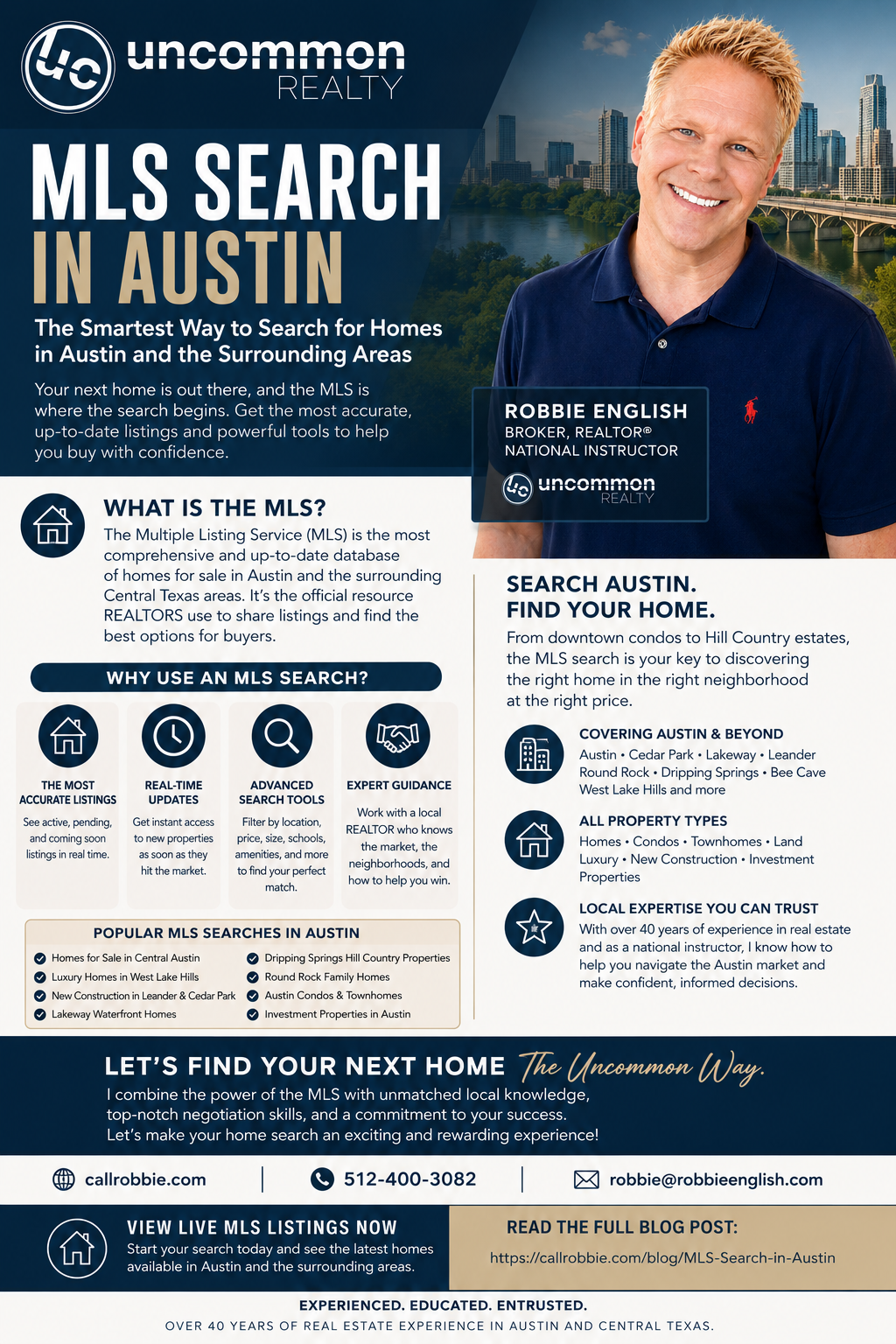
MLS stands for Multiple Listing Service — a private database maintained by licensed real estate professionals (in Austin, primarily Unlock MLS, formerly ACTRIS) where virtually every home actively listed for sale gets entered directly by the listing agent. It's the original source of truth for what's actually on the market, including details, photos, and status changes, entered and updated by the people directly involved in each transaction.
Why Public Sites Aren't the Same Thing
Zillow, Realtor.com, and similar public sites don't maintain their own listing data — they receive it through IDX (Internet Data Exchange) feeds pulled from the MLS, often with some delay and sometimes with details stripped out or altered from the original listing. A status change (price drop, pending, back on market) can show up in the MLS itself before it propagates to every public site, and some public sites are simply slower or less accurate feeds than others. If you're relying entirely on a public site, you're seeing a secondhand, delayed version of the actual market.
Getting Closer to Real-Time Access
Agents can set clients up with MLS-connected portals (not the same as a direct MLS login, which requires a license) that pull data much closer to real time than public consumer sites, often the same portal the agent themselves uses to search. This is standard, free access any agent can provide — the gap between this and a public site search is bigger than most buyers realize, especially in fast-moving segments of the market.

What Data Actually Lives in the MLS
Beyond the basics, MLS listings include fields most public sites don't surface clearly: exact days on market and full price-change history, agent remarks (often containing details not in the public description), showing instructions, and sometimes information on offer deadlines or multiple-offer situations. Sold data, beyond active listings alone, is also in the MLS and is the actual source for real comparable sales, which matters far more for pricing accuracy than public "estimate" tools that use automated valuation models rather than real transaction data.
Coming Soon and Pre-MLS Activity
Some listings get flagged "coming soon" in the MLS before going fully active, giving MLS-connected searchers a preview window public sites may not show as clearly or as early. This is different from a truly off-market deal (which never hits the MLS at all and moves through agent networks directly) — coming-soon status is still MLS-based, just earlier in the listing lifecycle.
Regional MLS Coverage
Unlock MLS (the region's primary MLS, historically known as ACTRIS) covers Austin and stretches out to Leander, Cedar Park, Georgetown, Round Rock, and Dripping Springs, among other surrounding communities. That regional scope matters if you're searching across city lines — a single MLS-connected search can cover the whole metro rather than requiring separate searches per city, which some public sites handle less cleanly, especially near county or MLS-boundary edges.
Understanding Listing Status Accurately
The MLS tracks status with more precision than a simple "for sale" or "sold" — active, active-under-contract (often called "active option" locally, meaning a buyer is in their option period but the seller may still accept backup offers), pending, and sold are all distinct statuses with different implications for whether it's worth reaching out about a specific home. Public sites sometimes collapse these into simpler labels or lag on status updates, which can lead to wasted time inquiring about a home that's already effectively under contract. Reading the actual MLS status, rather than relying on a public site's simplified badge, tells you whether a home is truly still available to pursue.
Why This Matters More in a Competitive Segment
In popular Austin neighborhoods or price bands where well-priced listings still move quickly even in today's more buyer-favorable overall market, the lag between MLS entry and public-site visibility can be the difference between touring a home the day it's listed versus finding out after it's already under contract. The gap matters less for a broad, unhurried search and matters a lot when you're targeting something specific and competitive.
Using MLS History to Understand a Neighborhood
Beyond finding a specific home, MLS-level sold and pending data is genuinely useful for understanding a neighborhood before you commit to a serious search there: recent closed sale prices tell you what homes actually sold for, not what someone hoped to get; typical days-on-market for the area gives you a real read on competitiveness; and price-history on active listings shows you which sellers have already signaled flexibility through a reduction. None of this level of detail is reliably available on a public consumer site the way it is through MLS-connected access.
What This Doesn't Replace
Even with full MLS-level access, the data itself doesn't evaluate a home's condition, tell you whether a price is actually justified for that specific property, or negotiate on your behalf. Search access gets you to the right listings faster; it doesn't replace the judgment and negotiation that come from actually walking a property and understanding the transaction. Think of MLS-level search as removing the information gap, not as a substitute for representation.
Common Questions
Can I get direct MLS access without an agent? Direct login is generally licensee-only, but an agent can set you up with a portal showing MLS-level data — you get the substance of MLS access without needing a license yourself.
Is Zillow's data wrong? Not necessarily wrong, but it's a secondhand feed with potential delay and sometimes incomplete detail compared to the original MLS entry — worth treating as a starting point rather than the definitive current status of a listing.
Do all agents have access to the same MLS data? Within the same MLS coverage area (Unlock MLS covers Austin and much of the surrounding region), yes — the data itself is shared. What differs is how quickly and clearly an individual agent surfaces and explains it to you.
Reach out and I'll set you up with real MLS-connected search access rather than a delayed public-site feed.
You can also search and track listings in real time through my app: https://closely.app.link/e/nY80KrwCWYb. I'm Robbie English, Broker, REALTOR with Uncommon Realty.
Categories
- All Blogs (970)
- !!! (59)
- !x (621)
- Austin Real Estate (113)
- Bee Cave Real Estate (1)
- Building A Home (14)
- Buying A Home (143)
- Buying Land (1)
- Cedar Park Real Estate (58)
- Central Austin Real Estate (75)
- Down Payment Assistance Programs (1)
- Downsizing (4)
- Downtown Austin Real Estate (5)
- Dripping Springs Real Estate (62)
- East Austin Real Estate (3)
- Financing and Mortgage (24)
- first-time homebuying (109)
- Georgetown Real Estate (9)
- Hill Country Real Estate (1)
- HOA (2)
- Home Appraisals (13)
- Home For Rent (1)
- Home Inspections (6)
- Home Pricing (6)
- Home Staging (1)
- Home Values (12)
- Homeownership (1)
- Homes For Rent (1)
- Homes For Sale (147)
- Hutto Real Estate (5)
- Investing (6)
- Investment Properties (4)
- Lakeway Real Estate (33)
- Leander Real Estate (59)
- LGBT+ Real Estate (8)
- Luxury Homes For Sale (5)
- Luxury Real Estate (19)
- Market Conditions (17)
- Moving to Austin (2)
- Moving to Texas (4)
- Negotiations (3)
- Neighborhoods (8)
- Northwest Austin Real Estate (94)
- Off Market Listings (7)
- Pflugerville Real Estate (10)
- Private Listings (2)
- Property Management (42)
- Property Tax (3)
- Real Estate (18)
- Reddit Question Answered (80)
- redwrite (63)
- Relocation (2)
- Renting (6)
- Representation (34)
- Round Rock Real Estate (59)
- Selling Your Home (62)
- South Austin Real Estate (1)
- Westlake Real Estate (3)
Recent Posts