
Should You Ask for Closing Costs or a Lower Home Price? What Austin Home Buyers Need to Know

Should I ask for closing costs or lower purchase price? That question comes up all the time with Austin area home buyers, and y'all, it is one of the most misunderstood negotiation decisions in real estate. Most buyers naturally focus on the purchase price first because the price feels like the biggest number in the transaction. That makes sense. The purchase price matters. However, the strongest negotiation strategy is not always about getting the seller to reduce the price. In many situations, asking for seller-paid closing costs can help a buyer keep more cash, improve monthly affordability, reduce stress before closing, and create a stronger financial position after moving into the home.
My name is Robbie English and I am a Texas Broker and Texas Designated REALTOR with Uncommon Realty helps buyers understand should I ask for closing costs or lower purchase price through both strategy and math. I bring decades of experience to the table, and that experience can become your competitive advantage when you are buying in Austin, Northwest Austin, Central Austin, Cedar Park, Dripping Springs, Leander, Round Rock, Lakeway, and throughout the greater Austin metro area. My team and I provide expert guidance regarding real estate pursuits by helping clients understand not only what to offer, but how to structure the offer in a way that better supports their goals.
This matters because a $10,000 price reduction and $10,000 in seller-paid concessions are not the same thing for the buyer. They may look similar to the seller's bottom line, but they can create very different outcomes for the person purchasing the home. A price reduction may only lower the monthly payment slightly. A seller-paid concession may help cover closing costs, preserve cash, reduce prepaid expenses, or even help buy down the interest rate. That can be a much bigger deal than many buyers realize.
I am a national real estate speaker and real estate instructor teaching agents nationwide the ins and outs of real estate, contracts, negotiation, buyer representation, pricing strategy, and client protection. I have strategically worked to master real estate for the betterment of my clients, and that skill becomes especially valuable when buyers need to decide whether to negotiate price, concessions, terms, timelines, or a combination of all of them.

TLDR: Should You Ask For Closing Costs Or A Lower Home Price? What Austin Home Buyers Need To Know
- A lower price may not save much monthly.
- Seller concessions can preserve your cash.
- Concessions may help buy down your rate.
- Offer structure can matter more than price.
- I help buyers negotiate smarter.
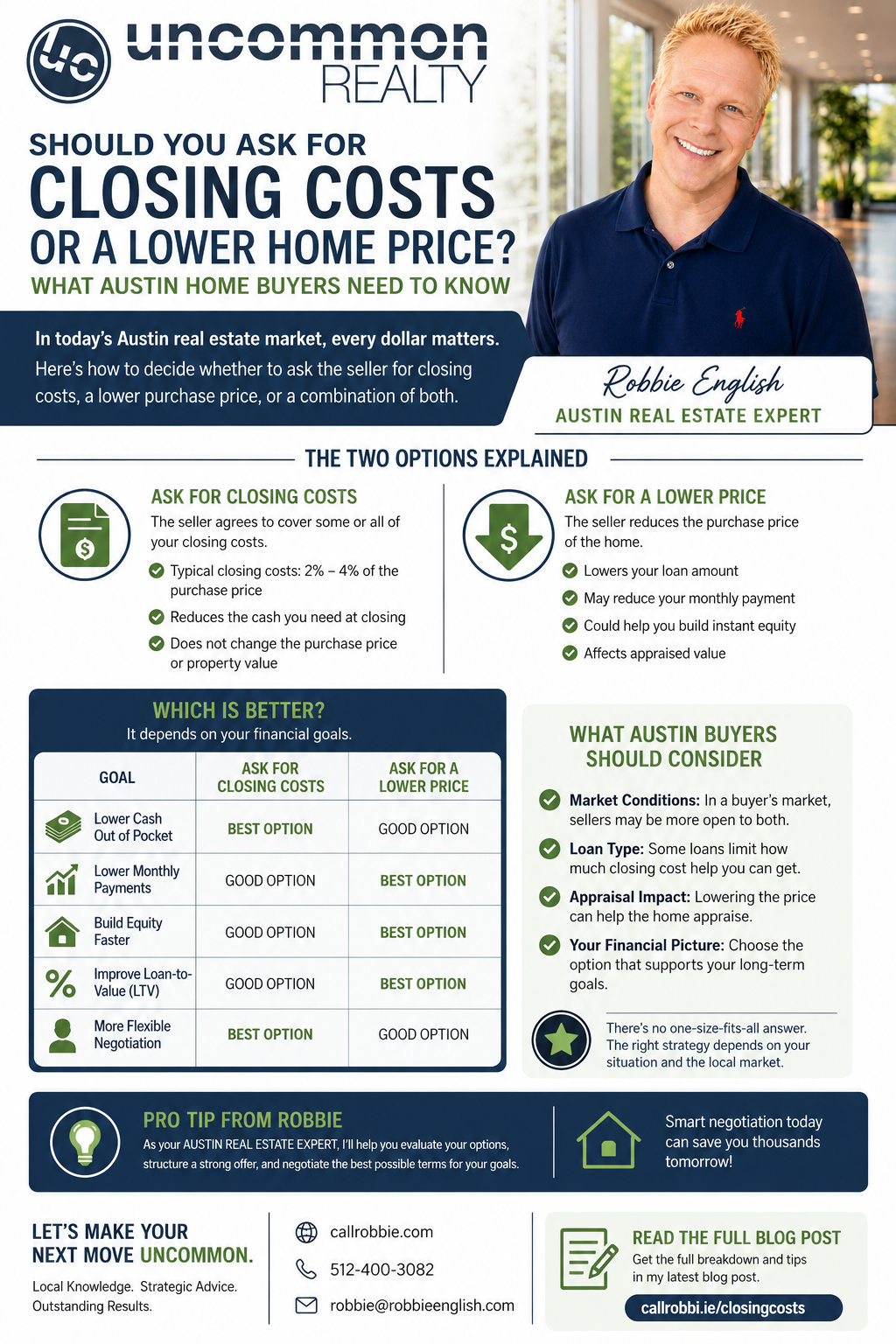
What Is The Difference Between A Price Reduction And Seller-Paid Closing Costs?
A price reduction lowers the contract sales price. Seller-paid closing costs, also called seller concessions, keep the sales price the same but ask the seller to contribute money toward certain buyer costs allowed by the loan program and contract structure. On paper, both requests may seem similar because the seller may net less money either way. For the buyer, though, the difference can be huge. (Note: different loan programs and different downpayment amounts allow for different amounts of seller concessions. I know this, but make sure if you do not use me or my team, that your agent knows this.)
When a buyer asks for a lower purchase price, the main benefit usually shows up in the loan amount and monthly payment. If the buyer finances most of the home, a $10,000 reduction may only reduce the monthly payment by a modest amount. It can help, but it may not change the buyer's closing day cash situation very much.
When a buyer asks for seller-paid closing costs, the benefit may show up immediately. That money can help cover loan costs, title expenses, escrow setup, prepaid taxes, insurance, and other allowable closing expenses. In some cases, it can also help with a rate buydown. That can preserve thousands of dollars in cash that the buyer would otherwise bring to closing.
This is why buyers should not negotiate blindly. The better question is not simply, "Can I get the price lower?" The better question is, "Which structure leaves me in the strongest position?" That is what my team and I do, structure better deals.
The $10,000 Example Every Buyer Should Understand
Let's use a simple example. A buyer asks the seller for $10,000 off the sales price. The seller agrees. The contract price drops by $10,000. That sounds great, and sometimes it is. However, if the buyer is financing the purchase, the buyer may only feel that reduction through a slightly lower mortgage payment.
Now let's look at another option. The buyer keeps the purchase price the same but asks the seller for $10,000 in seller-paid concessions. The seller may still see a similar impact to net proceeds, but the buyer receives a very different benefit. Instead of slowly realizing savings through a slightly lower loan amount, the buyer may use that $10,000 to reduce cash needed at closing.
For many buyers, that can be a game-changer. Moving costs money. Furniture costs money. Repairs cost money. Utility deposits, insurance, taxes, inspections, and life after closing all require cash. Keeping more money in the bank can matter much more than reducing the monthly payment by a small amount.
That is why the $10,000 example matters so much. The same dollar amount can create two very different buyer outcomes. My team and I help buyers compare those outcomes before writing an offer, not after emotions take over.
Why A $10,000 Price Reduction May Not Save As Much As Buyers Think
Many buyers overestimate how much a modest price reduction will change the monthly payment. A $10,000 price reduction sounds powerful because $10,000 is real money. It absolutely matters. But when that amount gets spread over a thirty-year loan, the monthly payment savings may feel much smaller than expected.
That does not mean asking for a lower price is wrong. Sometimes it is absolutely the right move. If the home appears overpriced, if appraisal concerns exist, if the buyer has plenty of cash, or if long-term equity is the top priority, a lower sales price can make strong sense.
However, buyers need to understand the tradeoff. Would you rather reduce the loan slightly, or would you rather keep more cash in the bank at closing? The answer depends on your financial situation, loan structure, lender guidance, and long-term goals.
This is why I focus on strategy. Buyers need to understand the real impact of each negotiation option before deciding what to ask for. Price is only one lever. It is not the only lever.
How Seller Concessions Can Help Buyers Keep More Cash In The Bank
Seller concessions can be incredibly helpful because they may reduce how much cash a buyer needs to bring to closing. Depending on loan type, lender rules, and contract terms, seller-paid concessions may help cover loan costs, title fees, escrow expenses, prepaid taxes, homeowner's insurance, and other allowable buyer expenses. Again, different loan programs and different downpayment amounts allow for different amounts of seller concessions. I know this, but make sure if you do not use me or my team, that your agent knows this.
Cash reserves matter after closing. A buyer who spends nearly every available dollar to purchase a home may feel financially stretched immediately afterward. That can create stress when moving expenses, furniture purchases, utility deposits, maintenance needs, or unexpected repairs appear.
I want buyers to feel strong after closing, not just relieved that they made it to closing.
There is a difference. A well-structured offer should help a buyer purchase
the home while still protecting life after the transaction.
In Austin, Northwest Austin, Central Austin, Cedar Park, Leander, Round Rock, Lakeway, and the greater Austin metro, buyers often face different levels of negotiation opportunity depending on inventory, property condition, seller motivation, and competition. Seller concessions may be more realistic in some situations than others. That is why local strategy matters.
How Seller Concessions Can Be Used To Buy Down An Interest Rate
One of the most powerful uses of seller concessions can be an interest rate buydown. This is where the strategy often becomes much more valuable than a simple price reduction.
A permanent rate buydown uses money upfront to lower the interest rate for the life of the loan. A temporary buydown may reduce the payment for a shorter period, often during the early years of ownership. Both strategies can help buyers manage affordability, depending on loan program, lender approval, and buyer goals.
In some situations, using seller concessions for a rate buydown can save a buyer more money over time than a modest price reduction would. That is why buyers should not automatically ask for money off the price before reviewing the numbers with a knowledgeable lender and skilled real estate advisor like my team I are.
Rate buydowns became more popular as buyers became more sensitive to monthly payment changes. When affordability tightens, structure matters. A smart concession strategy may make the home more comfortable to own while still creating an offer the seller can understand.
My preferred lender partners (for example) can help buyers compare these options clearly. Of course, buyers always have the right to use any lender or service provider they choose. Over decades of working with service providers, I have curated a trusted team that works well together and has a track record of success.
Why Strong Cash Reserves Can Help A Transaction Reach Closing
Cash reserves can matter before, during, and after closing. Lenders may evaluate reserves during underwriting. Buyers may need cash flexibility for closing adjustments. Life may also create unexpected expenses while the transaction is moving forward.
A buyer with more cash left in the bank may feel less stressed during the process. They may also feel better prepared for repairs, moving expenses, appliances, utility setup, furniture, landscaping, or immediate improvements after closing.
That financial stability can help the transaction feel smoother. It can also reduce last-minute panic. A buyer who spends every available dollar at closing may enter homeownership in a fragile position.
Seller concessions may help prevent that. By reducing the amount of cash needed at closing, concessions may help buyers maintain reserves. That can be especially valuable for first-time buyers, move-up buyers, and relocation buyers who are managing multiple expenses at once.
In my experience, the strongest buyers are not always the buyers who negotiated the lowest price. Sometimes the strongest buyers are the ones who structured the offer so they can close confidently and live comfortably after closing.
Why Some Sellers Prefer Concessions Over Price Reductions
Many sellers assume a lower price and a concession are basically the same. In terms of net proceeds, they may look similar in some cases. But emotionally and strategically, sellers may prefer one over the other.
A seller may prefer concessions because the contract price remains stronger. That can matter to seller perception, neighborhood perception, and sometimes appraisal framing. A seller may also understand that concessions help the buyer preserve cash and stay stronger through closing.
A buyer with stronger reserves may present less risk. A buyer who has enough cash to handle closing, moving, and unexpected expenses may be less likely to experience stress before closing.
Some sellers also prefer concessions because they feel more targeted. The seller is helping solve a buyer's closing challenge rather than simply lowering the value of the home.
This is where a skilled agent can explain the structure clearly. My team and I help buyers present offers in a way sellers can understand. That can create better conversations and better outcomes.
Why Buyers And Sellers Often Negotiate The Wrong Thing
Buyers and sellers often negotiate the wrong thing because they focus too narrowly on price. Buyers may ask for a lower purchase price when seller concessions would help them more. Sellers may reject concessions without understanding that the request may improve the buyer's ability to close.
This happens because people naturally anchor to the sales price. It is the biggest number. It feels like the headline. But the headline does not always tell the full financial story.
Real estate negotiation includes price, terms, timing, risk, financing, earnest money, option terms, repairs, concessions, title expenses, survey costs, and closing date. Each piece can affect the strength of the deal.
Structure wins deals. A buyer who understands structure can often create an offer that serves their interests while still making sense to the seller. That is where real negotiation skill shows up.
I also teach negotiation, contracts, and strategy to agents nationwide, and I bring that same expertise to my buyer clients. This is where experience becomes a real advantage.
Structure Wins Deals
Structure wins deals because an offer is more than a number. The purchase price matters, but so do the earnest money amount, option period, financing terms, closing timeline, seller concessions, leaseback needs, appraisal strategy, repair expectations, and communication style.
A buyer may offer slightly less but create a cleaner path to closing. Another buyer may offer more but bring higher risk. Sellers do not only evaluate price. They evaluate certainty.
In Austin and Central Texas, the right structure depends on the property and the market. A highly competitive home in Northwest Austin may require a different strategy than a home sitting longer in Leander. A Central Austin property may require different positioning than a Round Rock or Lakeway property. A seller with multiple offers may respond differently than a seller who has been waiting patiently for the right buyer.
This is why buyers need a plan before writing an offer. A strong offer should be intentional. It should not be a random price with random terms attached.
I help buyers understand the whole playing field before stepping into negotiation. That is how buyers avoid costly mistakes.
When Asking For A Lower Price Makes More Sense
Asking for a lower purchase price can make sense in several situations. If seller concessions are limited by lending guidelines, a price reduction may become the cleaner option. Loan programs can cap how much a seller may contribute, so the buyer's lender must be involved early.
A lower price may also make sense when the buyer has plenty of cash and cares more about long-term equity than immediate cash preservation. Some buyers would rather reduce the loan amount and keep the transaction simpler.
Appraisal concerns may also make a lower price more attractive. If the list price appears unsupported by comparable sales, lowering the price may reduce risk.
Some buyers also prefer a lower price when they plan to own the home long term and want every possible dollar reflected in equity instead of closing expense relief.
There is no one-size-fits-all answer. The right answer depends on the buyer's goals, lender guidance, property value, and seller motivation.
When Asking For Seller-Paid Closing Costs Makes More Sense
Seller-paid closing costs may make more sense when cash is tight, when buyers want to preserve reserves, when a rate buydown is attractive, or when buyers need more financial flexibility after closing.
This strategy can be especially helpful for buyers who have strong income but prefer not to drain savings. It can also help relocation buyers who are juggling moving expenses, deposits, furniture, and life transitions.
Seller concessions may also make sense when the monthly payment benefit from a lower price would be modest. If a price reduction barely changes the payment, a concession may create more practical value.
The key is running the numbers before making the request. I have my entire team encourage buyers to work closely with a strong lender so they understand what is possible and what creates the best outcome.
This is where my carefully curated service providers can help. Buyers may use anyone they choose, and that is their right. However, I have specifically curated a team that works in the buyer's best interest and has a track record of success. A coordinated team often benefits buyers more than choosing a one-off service provider found online. Why? I have a fiduciary duty to you to put your interests above my own. A mortgage person (for example) does not have that same fiduciary requirement and remain simply sales people. Yes, you can use who you want, but there is often a lot of risk involved working with someone that is not a team player or doesn't play well with the rest of the team.
How Austin Area Buyers Can Use This Strategy In Today's Market
Austin area buyers can use this strategy by matching the offer structure to the specific property and seller situation. A home in Austin may create one opportunity. A property in Northwest Austin may require another approach. A Central Austin home may bring different buyer competition. Cedar Park, Leander, Round Rock, and Lakeway can each behave differently based on inventory, property condition, and seller motivation.
My service area sepcifically includes Northwest Austin, Central Austin, Austin proper, Cedar Park, Leander, Round Rock, and Lakeway. I also work throughout the entire Austin metro area depending on where my clients need me to go and have travelled to other metropolitan areas when the need has arisen.
In areas where inventory gives buyers more leverage, seller concessions may be a powerful tool. In tighter segments, buyers may need to balance concessions with stronger terms elsewhere. The goal is not to ask for everything. The goal is to ask strategically.
Buyers should also remember that sellers are human. A well-explained offer may perform better than an aggressive but poorly structured offer. The way a request is presented can influence how the seller receives it.
Why Your Agent And Lender Need To Talk Before You Offer
A buyer should never decide between closing costs and price reduction in isolation. The buyer's agent and lender should communicate before the offer is written.
The lender can explain concession limits, closing cost estimates, rate buydown options, cash-to-close impact, and monthly payment differences. The agent can explain seller motivation, property value, negotiation leverage, market conditions, and offer strategy.
Together, that information helps the buyer make a better decision.
This is one of the reasons I encourages buyers to work with trusted vendors. A team that communicates well can reduce confusion and help buyers avoid preventable mistakes. Again, buyers can choose their own providers. That is always their right. My recommendation comes from experience. Having an entire team that works well together often provides more benefit than randomly selecting disconnected providers from online searches.
How Robbie's Mobile Real Estate App Helps Buyers Stay Ahead
My highly-intuitive mobile real estate app gives buyers access to up-to-date MLS listings, intuitive search tools, custom criteria, saved searches, organized favorites, detailed property information, and timely listing alerts.
That matters because strategy begins before the offer. Buyers need to understand what is active, what is sitting, what is moving, and what price ranges create opportunity. The app helps buyers stay organized while monitoring homes for sale and new ones that come on the market
You can create your own search criteria, save properties, review detailed listing information, and reach out to my team and I directly through the app with questions. That direct connection can help you evaluate whether a home may support a closing cost request, price reduction, rate buydown strategy, or stronger offer structure.
Better search tools create better decisions. Better decisions create better outcomes.
The Conversation Every Buyer Should Have Before Writing An Offer
Before writing an offer, every buyer should ask this question: what structure puts me in the strongest position before, during, and after closing?
That conversation should include purchase price, seller concessions, rate buydown options, cash reserves, closing costs, appraisal risk, inspection strategy, earnest money, option terms, closing timeline, and seller motivation.
Buyers should not treat negotiations as one-dimensional. A smart offer is built, not guessed.
This is exactly where I, Robbie English, Broker, REALTOR at Uncommon Realty become such a powerful advantage. I understands the math, the psychology, the contract structure, and the negotiation strategy behind winning offers. I help buyers avoid focusing on the wrong thing and instead build an offer that supports their actual goals.
Should I ask for closing costs or lower purchase price? The answer depends on your numbers, your lender, the property, the seller, and the market. But you should never make that decision without understanding the strategy behind both options.
Why Robbie English And Uncommon Realty Are The Right Choice
Again, I am Robbie English, Broker, REALTOR at Uncommon Realty and I provide expert guidance for my buyers clients. With decades of experience, national teaching authority, and a strategic approach to buyer representation, I work to help educate clients make better decisions before they ever submit an offer.
I have strategically worked to master real estate for the betterment of my clients. That matters when a buyer needs to understand whether to ask for closing costs, a lower price, a rate buydown, a better timeline, or a stronger overall structure.
Real estate comes down to protecting your money, your options, your confidence, and your future, not just finding a house. Y'all deserve an advisor who understands both the math and the strategy.
If you are preparing to buy a home in the Austin area, have the right conversation before writing the offer. The strongest deal is not always the lowest price. Sometimes the strongest deal is the one structured to help you win, close, and breathe easier after moving in.
Note: Areas mentioned in this article are for educational purposes only. Mentioning Austin, Northwest Austin, Central Austin, Cedar Park, Leander, Round Rock, Lakeway, or any other area should not be considered steering. Buyers should independently evaluate all areas that appeal to them and make their own housing decisions based on budget, commute, lifestyle, goals, and personal due diligence. If the word family appears in this article, remember that familial status is protected under HUD guidelines, and every buyer should choose the area that works best for them and their family after doing their own research.
Categories
- All Blogs (970)
- !!! (59)
- !x (621)
- Austin Real Estate (113)
- Bee Cave Real Estate (1)
- Building A Home (14)
- Buying A Home (143)
- Buying Land (1)
- Cedar Park Real Estate (58)
- Central Austin Real Estate (75)
- Down Payment Assistance Programs (1)
- Downsizing (4)
- Downtown Austin Real Estate (5)
- Dripping Springs Real Estate (62)
- East Austin Real Estate (3)
- Financing and Mortgage (24)
- first-time homebuying (109)
- Georgetown Real Estate (9)
- Hill Country Real Estate (1)
- HOA (2)
- Home Appraisals (13)
- Home For Rent (1)
- Home Inspections (6)
- Home Pricing (6)
- Home Staging (1)
- Home Values (12)
- Homeownership (1)
- Homes For Rent (1)
- Homes For Sale (147)
- Hutto Real Estate (5)
- Investing (6)
- Investment Properties (4)
- Lakeway Real Estate (33)
- Leander Real Estate (59)
- LGBT+ Real Estate (8)
- Luxury Homes For Sale (5)
- Luxury Real Estate (19)
- Market Conditions (17)
- Moving to Austin (2)
- Moving to Texas (4)
- Negotiations (3)
- Neighborhoods (8)
- Northwest Austin Real Estate (94)
- Off Market Listings (7)
- Pflugerville Real Estate (10)
- Private Listings (2)
- Property Management (42)
- Property Tax (3)
- Real Estate (18)
- Reddit Question Answered (80)
- redwrite (63)
- Relocation (2)
- Renting (6)
- Representation (34)
- Round Rock Real Estate (59)
- Selling Your Home (62)
- South Austin Real Estate (1)
- Westlake Real Estate (3)
Recent Posts