The Best Northwest Austin Neighborhoods for Tech Professionals Who Want More Than Just a Short Commute

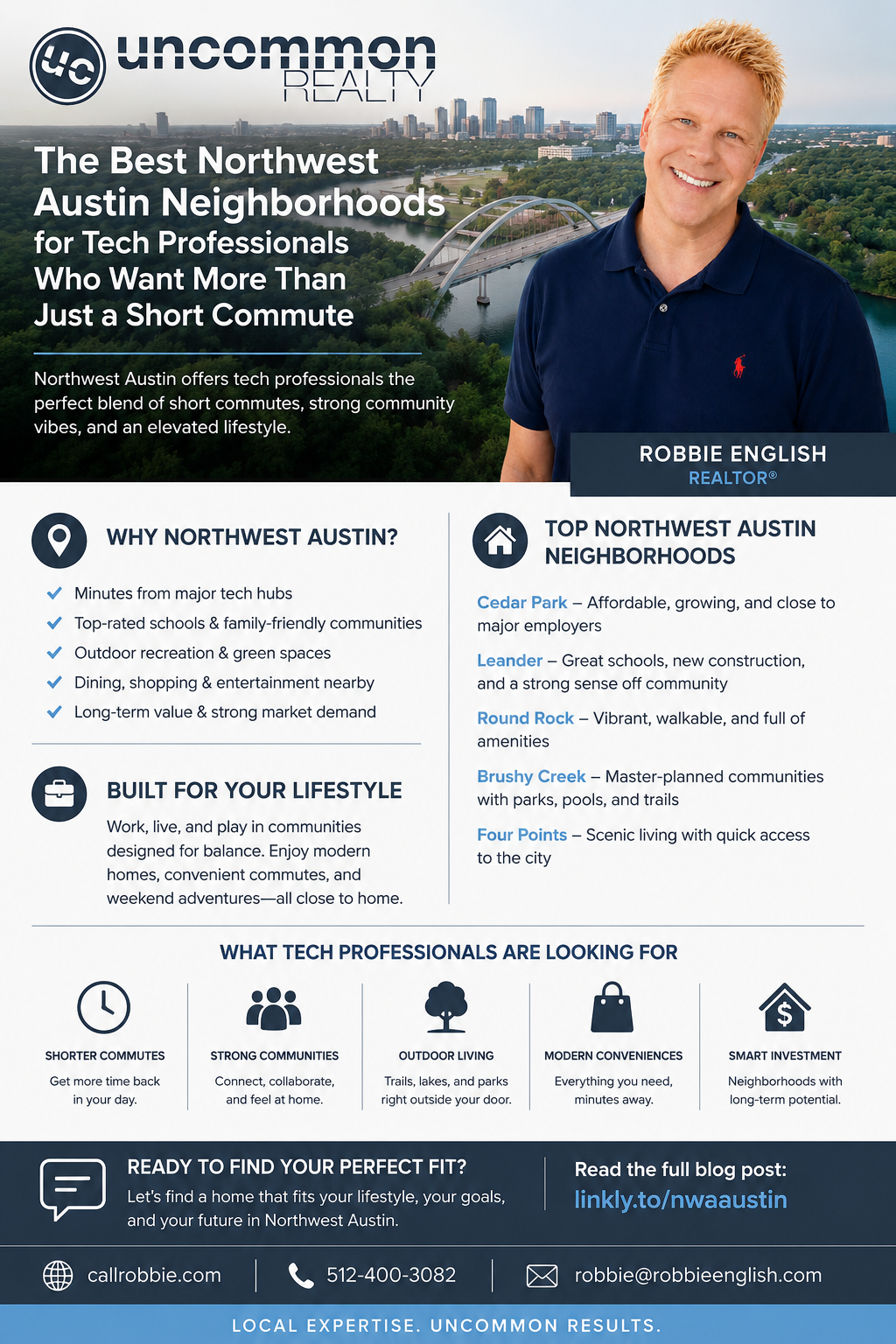
Proximity to Apple, the Domain, or the broader North Austin tech corridor is the easy part of a Northwest Austin search. What actually determines whether a neighborhood works long-term is what your daily life looks like once you're off the clock — trails, parks, and how insulated the streets feel from the traffic that got you home. This covers three real neighborhoods built around exactly that, not just commute time — because two homes with the same drive time to the office can offer completely different daily lives once you're actually home.

TLDR: More Than a Short Commute
- Anderson Mill has nearly six miles of bike and hike trails, seven neighborhood parks, and greenbelt access via the El Salido and Lake Creek trail systems.
- Canyon Creek sits within about 15 miles of Apple and IBM offices, with a layout that stays insulated from the busy 620 corridor nearby.
- Four Points backs up to the Balcones Canyonlands Preserve, trading some commute time for genuine Hill Country quiet and Lake Travis proximity.
- All three sit along the 620/2222/Anderson Mill Road corridor, so the actual commute difference between them is smaller than the lifestyle difference.
- None of these are new construction — expect established trees, varied lot sizes, and a mix of original and updated homes.
Anderson Mill: Built Around Its Trail System
Anderson Mill has nearly six miles of bike and hike trails running through it, along with seven neighborhood parks and multiple dog parks. The El Salido Greenbelt path follows a creekbed through Harper Park and past the El Salido pool, and the Lake Creek Trail connects out to Town & Country Park and its sports facilities. For a tech professional who wants a genuine daily walk or run without driving to a trailhead, this is one of the more built-out trail networks in Northwest Austin.
Canyon Creek: Close to the Office, Quiet at Home
Canyon Creek sits within roughly 15 miles of Apple and IBM office locations, with easy access via 620, 2222, and Anderson Mill Road to the broader tech corridor, downtown, and UT. What sets it apart day to day is how insulated the interior streets feel from that same busy 620 corridor — the neighborhood's layout keeps traffic noise at the edges rather than running through it. Two community centers with junior Olympic-sized pools and tennis courts add real amenities beyond just the commute math.
Four Points: Trading Some Commute for Real Quiet
Four Points backs up to the Balcones Canyonlands Preserve, which gives it a genuinely different feel from the other two — more greenbelt, more distance between homes, and a Hill Country setting that trades some commute time for real quiet. It sits along RM 620, which gives quick access to Lake Travis on one side and the Domain and North Austin employers on the other. If your ideal is coming home to something that feels removed from the city rather than adjacent to it, this is the one on the list built for that.
The Commute Difference Is Smaller Than People Expect
All three of these neighborhoods sit along the same general 620/2222/Anderson Mill Road corridor, which means the actual drive-time difference between them to a given North Austin office is often smaller than buyers assume going in. The bigger differentiator is what you're driving home to — Anderson Mill's trail network, Canyon Creek's insulated interior streets and closer proximity, or Four Points' genuine Hill Country separation. Pick based on daily lifestyle first, then confirm the specific commute from a specific address.

What to Expect From the Housing Stock
None of these three are new-construction communities. Expect established trees, a real mix of original-condition and renovated homes, and lot sizes that vary more than a newer subdivision would offer. That's part of the appeal for buyers who want mature landscaping and character over a uniform new-build streetscape, but it also means inspection diligence matters more here than in a newer community — ask directly what's been updated on any specific listing rather than assuming similar age means similar condition.
Home Office and Remote Work Considerations
Tech professionals shopping these three neighborhoods often need more than a spare bedroom for a home office — a dedicated room with good natural light, distance from household noise, or space for a second monitor setup and video calls without a bookshelf backdrop. Because none of these are new-construction communities, floor plans vary widely even within the same street, so a true home office setup isn't guaranteed just because a listing shows an extra bedroom. Walk any serious contender with your actual work-from-home routine in mind, not just bedroom count.
HOA Structure and What It Funds
Dues and HOA structure differ across these three, and it's worth pulling the specific numbers rather than assuming they're similar. Canyon Creek's community centers and pools come with dues that fund that infrastructure directly; Anderson Mill's more extensive park and trail system is partly city-maintained rather than purely HOA-funded, which can mean a different dues structure than you'd expect from the amenity level. Four Points, being closer to unincorporated county land in parts, can vary property to property more than the other two. Confirm the actual HOA situation for a specific address before comparing prices across neighborhoods.
Schools Across These Three
Anderson Mill, Canyon Creek, and Four Points all sit within reach of well-regarded Austin- and Round Rock-area campuses, but specific attendance zones vary by exact address and can cross district lines depending on the street. If schools are part of your decision, confirm the zoning for a specific listing directly rather than assuming neighborhood reputation alone tells you which campus a given address feeds.
Long-Term Value Across These Three
Established neighborhoods with real trail systems and greenbelt access, like all three of these, tend to hold buyer interest across market cycles better than newer subdivisions with no built-in outdoor infrastructure, since the amenity isn't something a future developer can replicate next door. That said, resale timing and pricing still track the broader Austin market, not just neighborhood character, so don't treat any of these as immune to market swings — the trail access and greenbelt proximity is a durable feature, not a guarantee against price movement.
Moving Quickly When the Right Home Comes Up
Live MLS search and my mobile app both send real-time alerts rather than a daily digest, and you can message me directly through the app if a new listing comes up in one of these three and you want a same-day read on its trail access, school zone, or actual commute.
Working With Someone Who Knows the Lifestyle Difference
All three of these get grouped under "Northwest Austin" in a generic search, but they deliver genuinely different daily experiences once you're actually living there. I'm Robbie English, Broker, REALTOR at Uncommon Realty, and if you're weighing commute against lifestyle, I'll walk you through which of these three actually fits what you want your evenings and weekends to look like, and confirm the real trail access, HOA structure, and school zoning for any specific address before you get attached to a listing based on the neighborhood name alone.
Written for buyers and sellers in the Greater Austin, Texas area by Robbie English, REALTOR, Broker at Uncommon Realty.
Categories
- All Blogs (966)
- !!! (59)
- !x (621)
- Austin Real Estate (110)
- Bee Cave Real Estate (1)
- Building A Home (14)
- Buying A Home (143)
- Buying Land (1)
- Cedar Park Real Estate (57)
- Central Austin Real Estate (75)
- Down Payment Assistance Programs (1)
- Downsizing (4)
- Downtown Austin Real Estate (5)
- Dripping Springs Real Estate (62)
- East Austin Real Estate (3)
- Financing and Mortgage (24)
- first-time homebuying (109)
- Georgetown Real Estate (9)
- Hill Country Real Estate (1)
- HOA (2)
- Home Appraisals (13)
- Home For Rent (1)
- Home Inspections (6)
- Home Pricing (6)
- Home Staging (1)
- Home Values (12)
- Homeownership (1)
- Homes For Rent (1)
- Homes For Sale (147)
- Hutto Real Estate (5)
- Investing (6)
- Investment Properties (4)
- Lakeway Real Estate (33)
- Leander Real Estate (59)
- LGBT+ Real Estate (8)
- Luxury Homes For Sale (5)
- Luxury Real Estate (19)
- Market Conditions (17)
- Moving to Austin (2)
- Moving to Texas (4)
- Negotiations (3)
- Neighborhoods (8)
- Northwest Austin Real Estate (94)
- Off Market Listings (7)
- Pflugerville Real Estate (10)
- Private Listings (2)
- Property Management (42)
- Property Tax (3)
- Real Estate (18)
- Reddit Question Answered (80)
- redwrite (63)
- Relocation (2)
- Renting (6)
- Representation (34)
- Round Rock Real Estate (58)
- Selling Your Home (62)
- South Austin Real Estate (1)
- Westlake Real Estate (3)
Recent Posts