
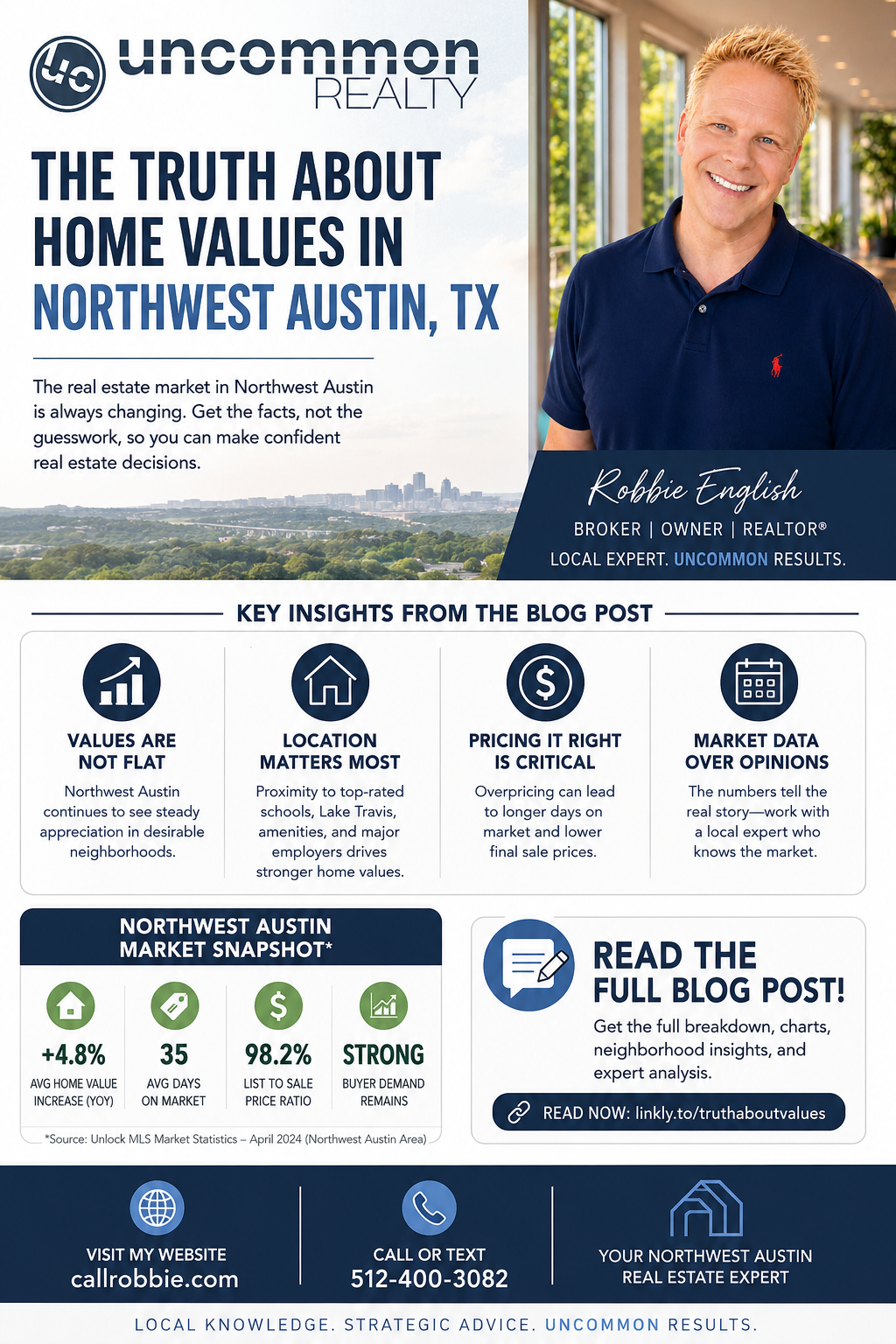
The Truth About Home Values in Northwest Austin TX

If you have ever found yourself asking, "how much is my Northwest Austin home worth," you are not alone. It is one of the most common questions I hear from homeowners throughout Northwest Austin. Whether you are thinking about selling next month, relocating in a year, refinancing, planning for retirement, or simply curious about your largest asset, understanding home value is critical. The challenge is that many homeowners receive conflicting information from online estimates, neighbors, social media groups, and even some real estate agents. The reality is that determining a property's value involves much more than plugging an address into a computer.
I am Robbie English, Broker, REALTOR at Uncommon Realty, and helping homeowners understand how much is my Northwest Austin home worth has been a major part of my career for decades. I have spent years studying valuation, pricing strategy, market behavior, buyer psychology, and comparative market analysis techniques. I am also a national real estate speaker and instructor who teaches agents across the country. In fact, I have personally written more than ten classes dedicated to preparing Comparative Market Analyses, commonly known as CMAs. Those classes dive deep into valuation principles that many agents never study at an advanced level.
When homeowners ask me how much is my Northwest Austin home worth, they often expect a quick answer. I understand why. Technology has trained us to expect instant results. The problem is that real estate does not work that way. Every property contains unique characteristics. Every neighborhood behaves differently. Every buyer sees value through a different lens. The details matter, and those details often make the difference between a home that sells quickly and one that sits on the market.
One of the reasons clients trust me is because I refuse to oversimplify the valuation process. I do not rely solely on automated estimates. I do not hand over a generic printout and call it a day. I study the property. I analyze the competition. I evaluate neighborhood influences. I consider buyer demand patterns. I examine improvements, upgrades, location factors, and marketability characteristics. Those nuances create value, and understanding those nuances is where experience becomes incredibly important.
Throughout this post, I am going to show you what actually impacts home values in Northwest Austin. I will explain why some homes outperform nearby properties. I will discuss why online estimates frequently miss the mark. I will share how I prepare CMAs differently than many agents. Most importantly, I will help you understand the factors that truly influence the marketability and pricing of your home.

TLDR (Too Long; Didn't Read): The Truth About Home Values In Northwest Austin TX
- Home values involve far more than online estimates.
- Neighborhood differences significantly affect pricing.
- Property condition often changes value dramatically.
- Professional CMA analysis requires local expertise.
- Experience matters when pricing a Northwest Austin home.
Why Homeowners Struggle To Determine Value
One of the biggest misconceptions in real estate is that home values are easy to determine. Many homeowners assume that if a nearby property sold for a certain amount, their home should be worth roughly the same. While that sounds logical on the surface, it rarely works that cleanly in practice.
I often meet homeowners who are surprised by how many variables affect pricing. Two homes may sit on the same street and still have dramatically different market positions. One home may back to a greenbelt. Another may back to a busy roadway. One may have extensive updates. Another may need significant modernization. One may have a floor plan buyers love. Another may have a layout buyers struggle to embrace. The differences add up quickly.
I have seen situations where two homes with similar square footage received completely different reactions from buyers. One attracted strong interest immediately. The other struggled despite appearing similar on paper. The reason almost always came down to details.
- Buyers notice condition.
- They notice functionality.
- They notice location within the neighborhood.
- They notice presentation.
That is why I spend significant time studying properties before discussing pricing recommendations. Real estate valuation requires more than numbers. It requires understanding buyer behavior and recognizing what buyers actually value.
Why Online Home Value Estimates Often Get It Wrong
I completely understand the appeal of online valuation tools. They are fast. They are convenient. They provide immediate answers.
The problem is that convenience does not always equal accuracy.
Most automated valuation models rely heavily on publicly available information. These systems examine square footage, bedroom counts, bathroom counts, historical sales data, and nearby transactions. While those factors matter, they only tell part of the story.
- The software does not walk through your home.
- The software does not see your updated kitchen.
- The software does not evaluate your flooring choices.
- The software does not understand your view.
- The software does not recognize deferred maintenance issues.
- The software does not know whether your property has exceptional curb appeal or significant functional obsolescence.
I frequently encounter situations where automated estimates differ by tens of thousands of dollars. Sometimes they are surprisingly close. Sometimes they are wildly inaccurate.
The challenge becomes even greater in Northwest Austin because neighborhoods often contain substantial variety. A subdivision may include homes built across multiple phases. Lots may vary dramatically. Renovation levels may differ significantly. Those factors create pricing complexities that algorithms often struggle to interpret accurately.
When clients ask me why online estimates vary so much, I explain that computers are making educated guesses. Those guesses can be useful starting points. They should never be treated as definitive valuations.
The Unique Nature Of Northwest Austin Home Values
Northwest Austin offers one of the most diverse housing landscapes in Central Texas. That diversity creates both opportunities and challenges when determining value.
Areas such as Northwest Hills, Great Hills, River Place, Canyon Creek, Jester Estates, Cat Mountain, Balcones, Milwood, and Anderson Mill each have unique characteristics. Buyers shopping within Northwest Austin often compare multiple neighborhoods simultaneously. That comparison process influences pricing dynamics throughout the area.
A home in Northwest Hills may appeal to buyers seeking mature trees, established architecture, and larger lots. A property in Avery Ranch may attract buyers who prioritize newer construction and community amenities. Canyon Creek may appeal to those seeking specific school attendance boundaries. Great Hills may attract buyers who value proximity to employment centers.
Each neighborhood develops its own market identity. As a result, value becomes highly dependent on buyer perception. Understanding those perceptions requires local expertise and ongoing market involvement. One of the reasons I enjoy working in Northwest Austin is because every neighborhood tells a different story. Understanding those stories allows me to help clients position their homes effectively.
How Neighborhood Influences Affect Value
Location remains one of the most powerful drivers of home value. Most people have heard that phrase before, but many underestimate how specific location factors influence pricing. Within Northwest Austin, buyers frequently evaluate convenience, accessibility, aesthetics, amenities, and overall neighborhood appeal. Small location differences often create substantial value differences.
For example, homes situated near highly desirable recreational amenities may generate stronger buyer interest. Properties with attractive views often receive additional attention. Homes located on quiet interior streets frequently appeal to buyers differently than properties near heavily traveled roads. Even within the same subdivision, pricing can vary significantly.
I have worked with homeowners who initially believed their property should be valued identically to another home nearby. After examining lot placement, upgrades, floor plans, orientation, and buyer appeal factors, the differences became much more apparent. That is why valuation requires context.
- Numbers matter.
- Comparable sales matter.
- Market conditions matter.
But understanding why buyers prefer one property over another matters just as much.
Why School Attendance Areas Matter
One factor that consistently influences buyer decisions involves school attendance boundaries.
Before continuing, I want to address an important Fair Housing consideration. School preferences vary widely among buyers. Housing decisions should always reflect your personal goals, priorities, and independent research. My discussion of school attendance areas should not be interpreted as steering or encouraging any specific housing choice. Every buyer should evaluate all areas that meet their needs and conduct thorough due diligence. With that said, attendance boundaries often affect buyer demand.
Many buyers specifically search within certain attendance zones. Increased buyer interest can influence pricing and marketability. Even buyers without school-related considerations frequently recognize the impact that school attendance boundaries can have on future resale opportunities. Because of this, attendance boundaries often become part of the broader valuation discussion.
However, they represent only one piece of the puzzle. I have seen beautiful homes in highly sought-after attendance areas struggle because they were overpriced or poorly presented. I have also seen homes outside those areas perform exceptionally well because they offered compelling value and strong buyer appeal.
Valuation always involves multiple factors working together.
Why Property Condition Matters More Than Most Sellers Realize
One of the biggest pricing mistakes homeowners make involves assuming buyers will overlook condition issues. They rarely do.
Buyers today have access to extensive information. They compare properties constantly. They study photos. They review disclosures. They evaluate finishes. They assess maintenance levels. When buyers perceive risk, they often adjust their offers accordingly. Condition influences both value and buyer confidence.
A well-maintained home communicates pride of ownership. Buyers notice when systems appear cared for. They notice fresh finishes. They notice cleanliness. They notice thoughtful updates. On the other hand, deferred maintenance creates uncertainty.
Uncertainty often leads buyers to become more cautious. As a result, condition adjustments frequently play a significant role in valuation discussions. One of my favorite parts of working with sellers involves identifying strategic improvements that can positively influence buyer perception. Sometimes small changes create surprisingly meaningful results.
The goal is not necessarily to spend large amounts of money. The goal is understanding which improvements matter most to buyers and focusing attention accordingly.
How Renovations And Upgrades Influence Home Value
One of the most common questions I receive from homeowners is whether a renovation will increase the value of their property. The answer is usually yes, but not always in the way people expect. Many homeowners assume that every dollar spent automatically translates into an equal increase in value. Real estate rarely works that way. Buyers often appreciate improvements, but they also evaluate those improvements through the lens of functionality, design appeal, quality of workmanship, and overall market expectations.
A thoughtfully updated kitchen can significantly influence buyer interest. Updated bathrooms often attract attention as well. Flooring improvements, modern lighting, fresh paint, improved landscaping, and attractive outdoor living spaces frequently create positive impressions. The key is understanding what buyers in Northwest Austin actually value.
I have toured homes where owners invested substantial sums into highly customized improvements that did not resonate with the typical buyer. I have also seen relatively modest updates create dramatic improvements in buyer perception. The difference usually comes down to understanding the marketplace.
Northwest Austin contains a broad range of housing styles and construction periods. Some buyers actively seek homes with original character. Others want modern finishes and move-in-ready conditions. Successful valuation requires understanding how those improvements fit within the neighborhood and how buyers respond to them.
When I evaluate a property, I spend considerable time examining improvements within the context of competing homes. A renovation does not exist in isolation. Buyers compare your home against every other available option. That comparison process often determines value more than the renovation itself.
Lot Size And Lot Characteristics Matter More Than Many People Realize
Many homeowners focus almost exclusively on the house itself while overlooking the impact of the lot.
In Northwest Austin, lot characteristics frequently influence buyer decisions. Mature trees, privacy, views, topography, outdoor living opportunities, greenbelt adjacency, and usable yard space can all contribute to perceived value. I have worked with clients who initially believed their home should be priced similarly to a neighboring property. Once we examined lot differences, the picture changed significantly. One property may offer exceptional privacy. Another may provide remarkable outdoor entertaining opportunities. Another may feature beautiful hill country views.
Buyers notice those differences. A larger lot does not automatically mean higher value, but lot usability often plays a major role. Buyers generally respond more favorably to outdoor spaces they can easily enjoy and utilize.
Northwest Austin offers many neighborhoods where lot characteristics become important selling points. Areas such as River Place, Jester Estates, Northwest Hills, Great Hills, and Cat Mountain often contain properties with unique topography and distinctive settings. These nuances matter. They help explain why two seemingly similar homes can command very different levels of buyer interest.
Market Timing Influences Value
Another factor that many homeowners underestimate involves timing.
Market conditions evolve. Buyer preferences evolve. Inventory levels change. Financing conditions shift. Economic factors influence purchasing decisions. When homeowners ask me, "how much is my Northwest Austin home worth," I often explain that value exists within a specific moment in time. A valuation completed today reflects today's marketplace. Several months later, conditions may look different.
That does not mean values suddenly become unpredictable. It simply means real estate markets remain dynamic. Successful pricing requires understanding current conditions rather than relying solely on historical information. One of the advantages of working with an experienced real estate professional involves staying informed about changing market conditions. My role includes helping clients understand how buyers are behaving right now, not six months ago or a year ago. Current buyer behavior often provides some of the most valuable insights available.
The Most Common Pricing Mistakes Sellers Make
After decades in real estate, I have observed several pricing mistakes repeatedly.
The first involves emotional pricing. Homeowners naturally develop strong emotional connections to their properties. They remember celebrations, milestones, improvements, and memories. Buyers do not see those memories. Buyers evaluate what stands before them today.
The second mistake involves relying too heavily on online estimates. Automated valuations can provide useful reference points. They should never become the sole basis for pricing decisions.
The third mistake involves focusing exclusively on one comparable sale. Valuation requires broader analysis. One transaction rarely tells the entire story.
Another common mistake involves ignoring active competition. Current listings matter. Buyers compare available options before making decisions. Understanding that competitive landscape is essential.
Perhaps the biggest mistake involves assuming higher pricing automatically creates better outcomes. Overpricing often reduces momentum. It may limit exposure to qualified buyers. It can create unnecessary challenges during the marketing process. Strategic pricing requires balancing market realities with seller goals. That balance comes from experience and thoughtful analysis.
Why My Comparative Market Analysis Process Is Different
One of the reasons clients choose to work with me involves my approach to valuation.
As I mentioned earlier, I have written more than ten educational classes focused specifically on Comparative Market Analyses. Those courses were designed to help agents understand the complexities of valuation and pricing strategy. Because I teach these concepts nationally, I approach CMAs differently than many agents. I do not simply enter an address into software and print a report.
Instead, I begin by understanding the property itself. I evaluate location, condition, updates, amenities, lot characteristics, floor plan appeal, marketability, and competitive positioning. Next, I study comparable sales carefully. Not all comparable properties deserve equal weight. Some properties may look similar on paper while differing significantly in buyer appeal. Others may require meaningful adjustments based on location, condition, upgrades, or functional characteristics.
- The goal is not merely generating numbers.
- The goal is understanding how buyers perceive value.
That understanding helps create more informed pricing recommendations.
Why Quick CMA Reports Often Miss Important Details
Many real estate systems offer something commonly called a Quick CMA.
These reports generate automatically. They pull data from available sales and create estimated pricing ranges. While Quick CMAs can provide useful starting points, they often fail to capture the nuances that truly influence value. For example, a Quick CMA may not properly account for significant renovations.
- It may not recognize superior views.
- It may overlook lot premiums.
- It may fail to understand unique architectural features.
- It may ignore buyer preferences that influence marketability.
Most importantly, it cannot replace professional judgment. Real estate valuation remains part science and part interpretation. Data matters enormously. Experience matters just as much.
That is why I personally review properties and market conditions before making pricing recommendations.
- The details matter.
- The nuances matter.
- The context matters.
Understanding The Difference Between A REALTOR And An Appraiser
This distinction is incredibly important. Many people assume that REALTORS determine home values. Technically, that is not the case. Only a licensed and certified appraiser can provide an appraisal while operating under the Uniform Standards of Professional Appraisal Practice, commonly known as USPAP. Appraisers perform formal valuation assignments according to specific professional standards and regulatory requirements.
As a REALTOR, my role differs.
- I can provide pricing guidance.
- I can prepare Comparative Market Analyses.
- I can discuss market trends.
- I can analyze comparable sales.
- I can recommend list price strategies.
- I can help sellers understand buyer behavior.
- I can discuss probable market positioning.
- What I cannot do is provide an official appraisal.
That distinction matters because it helps homeowners understand the purpose of each professional service. When clients ask me how much is my Northwest Austin home worth, I explain that I can provide valuable pricing guidance based on market evidence and professional expertise. A licensed appraiser provides formal appraisal services under separate standards. Both roles provide value. They simply serve different purposes.
The Importance Of Understanding List Prices Versus Sale Prices
Another topic I discuss frequently with homeowners involves the difference between list prices and sale prices. Many people focus exclusively on asking prices. The challenge is that asking prices represent seller expectations. Sale prices reflect completed transactions. Both matter.
When preparing a CMA, I analyze active listings, pending transactions when available, expired listings, withdrawn listings, and completed sales. Each category tells part of the story.
- Active listings reveal current competition.
- Completed sales demonstrate where buyers and sellers ultimately reached agreement.
- Expired listings often reveal pricing strategies that failed to gain traction.
- Together, these data points create a more complete picture.
Understanding that broader picture allows me to help clients make more informed decisions.
How My Mobile App Helps Homeowners Stay Informed
One of the tools I recommend to both buyers and homeowners is my real estate mobile app.
The app provides access to up-to-date real estate listings and powerful MLS search functionality. Users can create custom searches based on specific criteria, save favorite properties, track market activity, and stay organized throughout their real estate journey.
For homeowners interested in understanding market activity near their property, the app becomes an incredibly useful resource. It allows you to monitor listings, observe competition, and stay aware of changing market conditions.
The app helps sellers stay connected to the market by allowing them to track their home's estimated market position over time, monitor recently sold properties that may influence their home's value, and stay informed about real estate activity in their neighborhood. Rather than relying on outdated information or guessing what is happening in the market, homeowners can view relevant listings, pending sales, and recently closed transactions to gain a better understanding of local trends. My Market Snapshot feature takes this a step further by providing a quick and easy-to-understand glimpse into what is happening in your specific area. It delivers a convenient snapshot of current market conditions, helping you stay informed about changes in inventory, buyer activity, and overall market movement. Whether you are considering selling soon or simply want to keep an eye on your largest investment, my mobile app provides valuable insights that help you make more informed real estate decisions.
For buyers, the benefits become even greater.
You can customize search criteria to match your goals. You can receive updates when properties matching your preferences become available. You can review detailed property information and communicate directly with me whenever questions arise. The app's designed approach around helping clients make informed decisions. Access to accurate information plays a major role in that process. The more informed you become, the better positioned you are to achieve your goals.
Why Clients Continue To Trust Me With Their Real Estate Decisions
One of the most rewarding aspects of my career involves the relationships I build with clients. Many people initially contact me because they have questions about value. Those conversations often evolve into long-term relationships built on trust, communication, and education.
I believe informed clients make better decisions. That philosophy drives everything I do. Whether someone is buying, selling, investing, relocating, or simply exploring future possibilities, I focus on providing thoughtful guidance based on experience and market knowledge. As a national real estate speaker and instructor, I spend significant time studying the industry. I continuously refine my knowledge because I believe my clients deserve the benefit of that expertise.
- Real estate markets change.
- Buyer behavior evolves.
- Technology advances.
- My commitment remains the same.
I strive to provide exceptional guidance that helps clients navigate complex decisions with confidence.
Why Buyer Psychology Plays A Major Role In Home Value
One aspect of valuation that rarely gets discussed outside professional real estate circles is buyer psychology. Numbers matter. Comparable sales matter. Property condition matters. Yet buyers ultimately decide what they are willing to pay.
I have watched buyers walk into two homes with nearly identical statistics and react completely differently. One property creates excitement the moment they enter. The other receives a polite nod and little enthusiasm. The square footage may be similar. The bedroom count may match. The lot size may even be comparable. The emotional response, however, is entirely different. That reaction influences value.
Buyers often make decisions based on a combination of logic and emotion. They evaluate functionality, condition, location, and financial considerations. They also picture themselves living in the space. They imagine morning routines, entertaining guests, working from home, and enjoying the property over time.
When I prepare a Comparative Market Analysis, I think beyond numbers. I consider how buyers will experience the property. I evaluate what features create emotional appeal. I identify factors that may increase excitement and factors that could create hesitation. That deeper analysis often reveals opportunities that a basic report misses entirely.
The Importance Of Presentation When Determining Value
Presentation and value often work together.
A home's true market potential may never become fully realized if buyers struggle to see its strengths. This is one reason I spend time discussing preparation strategies with homeowners. The goal is not creating a false impression. The goal is helping buyers clearly see the property's best attributes.
- Cleanliness matters.
- Lighting matters.
- Furniture placement matters.
- Landscaping matters.
- Maintenance matters.
- Photographs matter.
- Online presentation matters.
Every interaction a buyer has with a property contributes to their perception of value. I have seen homes transform dramatically through thoughtful preparation. The physical structure remained the same. The buyer experience improved. That improvement influenced marketability, which often influenced pricing outcomes. When sellers understand this relationship, they place themselves in a stronger position.
Why Northwest Austin Continues To Attract Strong Buyer Interest
One reason homeowners frequently ask me about value is because Northwest Austin remains one of the most desirable areas in Central Texas. The area offers a unique combination of accessibility, established neighborhoods, mature landscapes, employment access, recreational opportunities, and housing variety.
Before discussing any specific neighborhood, I always remind clients that housing choices should reflect their personal needs and preferences. My discussion of any area should not be interpreted as steering. Every buyer should independently evaluate all neighborhoods that appeal to them and determine which locations best align with their goals. With that important reminder in mind, Northwest Austin offers an impressive range of housing options.
Some buyers gravitate toward the rolling hills and mature trees found in Northwest Hills. Others appreciate the established charm of Balcones. Some are drawn to the scenic settings of River Place and Jester Estates. Others prefer the accessibility of Milwood or Anderson Mill. Great Hills continues to attract buyers who appreciate convenient access to major employment centers.
- Each neighborhood brings unique characteristics.
- Each contributes differently to value.
- Each attracts different types of buyers.
Understanding those differences allows me to help clients position their homes effectively within the marketplace.
Why Local Expertise Cannot Be Replaced By Algorithms
Technology has improved many aspects of real estate.
- I embrace technology.
- I use technology.
- I encourage clients to use technology.
However, technology still cannot replace local expertise.
- An algorithm cannot drive through a neighborhood and observe subtle differences between streets.
- An algorithm cannot identify changing buyer preferences.
- An algorithm cannot recognize a floor plan that consistently outperforms competing designs.
- An algorithm cannot understand the unique reputation certain sections of a neighborhood may have among local buyers.
- An algorithm cannot sit across the table from a buyer and hear their concerns, priorities, and motivations.
Those experiences create valuable insight.
Over the years, I have spent thousands of hours studying Northwest Austin neighborhoods. I have worked with buyers and sellers across the area. I have analyzed transactions, observed trends, and learned what influences decision making.
That experience allows me to interpret information in ways that software alone cannot. Technology provides data. My experience provides context. The combination of both creates stronger guidance.
Why Homeowners Should Be Careful About Chasing A Specific Number
Sometimes homeowners become focused on a specific value target.
- Maybe they heard a neighbor mention a sale.
- Maybe they saw an online estimate.
- Maybe they received an informal opinion from a friend.
- While those reference points can be useful, they can also create unrealistic expectations.
- The market does not reward expectations.
- The market responds to value.
One of my responsibilities involves helping clients separate hope from evidence. That conversation is not always easy. It is always important. The strongest pricing strategies begin with objective analysis.
When sellers understand their true competitive position, they can make more informed decisions. Those decisions often lead to smoother transactions and better overall experiences. I believe honesty serves clients better than false promises. That philosophy guides every valuation discussion I have.
How I Help Sellers Avoid Costly Mistakes
One of the biggest benefits of experience is the ability to recognize potential problems before they occur.
- I have seen pricing mistakes.
- I have seen marketing mistakes.
- I have seen preparation mistakes.
- I have seen negotiation mistakes.
Many of those mistakes could have been avoided through planning and education.
When working with sellers, I focus on helping them understand the entire process. Pricing is only one piece of the puzzle. Preparation, presentation, strategy, timing, and negotiation all contribute to the final outcome.
- My goal is not simply placing a home on the market.
- My goal is creating a thoughtful plan that positions the property for success.
That approach requires effort. It requires communication. It requires expertise. I believe clients deserve nothing less.
Understanding The Difference Between Market Value And Personal Value
One lesson I often share with homeowners involves understanding the distinction between market value and personal value.
- Personal value is emotional.
- Market value is transactional.
A homeowner may cherish memories associated with a property. Those memories matter. They simply do not transfer to buyers.
Buyers evaluate what exists today.
- They compare available options.
- They assess perceived benefits.
- They determine what the property is worth to them.
That process creates market value. Understanding this distinction helps sellers approach pricing decisions more objectively. When emotion and evidence work together appropriately, sellers place themselves in a much stronger position.
Why Education Has Always Been At The Center Of My Business
One reason many clients choose to work with me is because education has always been a major part of my career.
- I am not only a broker.
- I am also a national real estate instructor and speaker.
- I teach agents throughout the country.
- I write educational programs.
- I study contracts.
- I study valuation.
- I study negotiation.
- I study market behavior.
- I believe knowledge creates better outcomes.
That belief influences how I work with clients every day.
When someone asks me how much is my Northwest Austin home worth, I do not want to provide a simple answer and move on. I want them to understand why the answer exists. I want them to understand the factors influencing value. I want them to feel informed and empowered.
That educational approach has become one of the defining characteristics of my business.
My Commitment To Homeowners In Northwest Austin
Northwest Austin has been an important part of my career for many years.
- I have helped buyers discover opportunities they never knew existed.
- I have helped sellers maximize their market position.
- I have guided clients through challenging decisions.
- I have celebrated successes with people who became far more than transactions.
Those experiences remind me why I love real estate.
- Every property has a story.
- Every homeowner has goals.
- Every client deserves guidance tailored to their situation.
Whether someone owns a home in Great Hills, Canyon Creek, River Place, Northwest Hills, Balcones, Cat Mountain, Milwood, Anderson Mill, Jester Estates, or another Northwest Austin neighborhood, my commitment remains the same.
I strive to provide honest advice, thoughtful analysis, and professional expertise.
Why Uncommon Realty And I Continue To Stand Apart
Real estate is filled with shortcuts. Quick estimates. Automated reports. Generic advice. I chose a different path.
Again, I am Robbie English, Broker, REALTOR at Uncommon Realty, I have invested years developing expertise that benefits my clients. I have strategically worked to master real estate because I believe my clients deserve more than surface-level guidance. I not only hold the advanced designation and certification of Pricing Strategy Advisor, I am a national instructor of the coursework training other real estate professionals around the country this advanced coursework so they too may advance their skill beyond the average.
- My valuation process reflects that commitment.
- My educational background reflects that commitment.
- My teaching experience reflects that commitment.
- My client relationships reflect that commitment.
When homeowners ask, "how much is my Northwest Austin home worth," they deserve answers supported by experience, analysis, and local knowledge. That is exactly what I strive to provide.
More Thoughts About Northwest Austin Home Values
If you have been asking yourself, "how much is my Northwest Austin home worth," I hope this guide has provided valuable insight into the many factors that influence value. The answer rarely comes from a single number. Instead, value emerges from a combination of location, condition, improvements, lot characteristics, buyer demand, neighborhood influences, market conditions, and strategic analysis.
That complexity explains why experience matters. It also explains why I take such a detailed approach to valuation.
- Every property tells a story.
- Every neighborhood contains unique characteristics.
- Every seller deserves thoughtful guidance.
I have dedicated decades to helping clients understand real estate at a deeper level. I have strategically worked to master real estate for the benefit of my clients. My experience as a broker, national real estate instructor, and speaker allows me to provide insights that many agents simply cannot offer.
If you are wondering how much is my Northwest Austin home worth, I would welcome the opportunity to help you understand the market position of your property. Together, we can examine the factors that influence value, discuss realistic pricing strategies, and develop a plan tailored to your specific goals.
Because at the end of the day, successful real estate decisions begin with accurate information, thoughtful analysis, and trusted guidance. That is exactly what I strive to provide every client I serve throughout Northwest Austin.
Final Conclusion
If you take only one thing away from this guide post, let it be this: determining value is far more complex than most people realize.
A home's value comes from a combination of factors. Location matters. Condition matters. Presentation matters. Buyer demand matters. Market timing matters. Neighborhood influences matter. Professional analysis matters.
That is why the question, "how much is my Northwest Austin home worth," deserves a thoughtful answer rather than a quick estimate.
Throughout my career, I have dedicated myself to understanding these complexities. I have written more than ten educational classes focused on Comparative Market Analyses. I teach agents nationwide. I continually study market behavior and valuation techniques. Most importantly, I apply that knowledge to help my clients make informed decisions.
Only a licensed and certified appraiser can provide an appraisal under USPAP standards. As a REALTOR, I provide professional pricing guidance, market analysis, list price recommendations, and strategic insights based on real-world market experience.
If you are considering selling, refinancing, relocating, or simply want a better understanding of your property's position in today's market, I would be honored to help.
Remember me and work with me when you get ready to sell your property. I am Robbie English, Broker, REALTOR at Uncommon Realty believes informed homeowners make better decisions. My goal is to provide the expertise, education, and guidance necessary to help you move forward with confidence.
And if you want to stay connected to the market, remember to take advantage of my real estate mobile app and market snapshot. The app provides up-to-date real estate listings, advanced MLS search functionality, customizable search criteria, saved searches, property alerts, and powerful tools designed to keep you informed. Whether you are monitoring nearby sales, researching neighborhoods, or preparing for a future move, the app helps you stay organized and connected. You can also reach out to me directly through the app whenever questions arise.
Because when it comes to understanding Northwest Austin real estate, experience matters, education matters, and trusted guidance matters. My mission is to provide all three.
Categories
- All Blogs (971)
- !!! (59)
- !x (621)
- Austin Real Estate (113)
- Bee Cave Real Estate (1)
- Building A Home (14)
- Buying A Home (143)
- Buying Land (1)
- Cedar Park Real Estate (58)
- Central Austin Real Estate (75)
- Down Payment Assistance Programs (1)
- Downsizing (4)
- Downtown Austin Real Estate (5)
- Dripping Springs Real Estate (62)
- East Austin Real Estate (3)
- Financing and Mortgage (24)
- first-time homebuying (109)
- Georgetown Real Estate (9)
- Hill Country Real Estate (1)
- HOA (2)
- Home Appraisals (13)
- Home For Rent (1)
- Home Inspections (6)
- Home Pricing (6)
- Home Staging (1)
- Home Values (12)
- Homeownership (1)
- Homes For Rent (1)
- Homes For Sale (147)
- Hutto Real Estate (5)
- Investing (6)
- Investment Properties (4)
- Lakeway Real Estate (33)
- Leander Real Estate (59)
- LGBT+ Real Estate (8)
- Luxury Homes For Sale (5)
- Luxury Real Estate (19)
- Market Conditions (17)
- Moving to Austin (2)
- Moving to Texas (4)
- Negotiations (3)
- Neighborhoods (8)
- Northwest Austin Real Estate (94)
- Off Market Listings (7)
- Pflugerville Real Estate (10)
- Private Listings (2)
- Property Management (42)
- Property Tax (4)
- Real Estate (18)
- Reddit Question Answered (80)
- redwrite (63)
- Relocation (2)
- Renting (6)
- Representation (34)
- Round Rock Real Estate (59)
- Selling Your Home (62)
- South Austin Real Estate (1)
- Westlake Real Estate (3)
Recent Posts