Austin vs Round Rock vs Cedar Park Where Should I Buy?

Austin, Round Rock, or Cedar Park is one of the most common questions I hear from buyers weighing a move in Central Texas, and there is no single right answer, only the one that fits your priorities and budget. Each of these places offers a genuinely different daily life at a genuinely different price, so the goal here is to lay out the real tradeoffs with 2026 numbers so you can choose with clear eyes. I am Robbie English, Broker, REALTOR at Uncommon Realty, and I have helped buyers land in all three.

The quick comparison
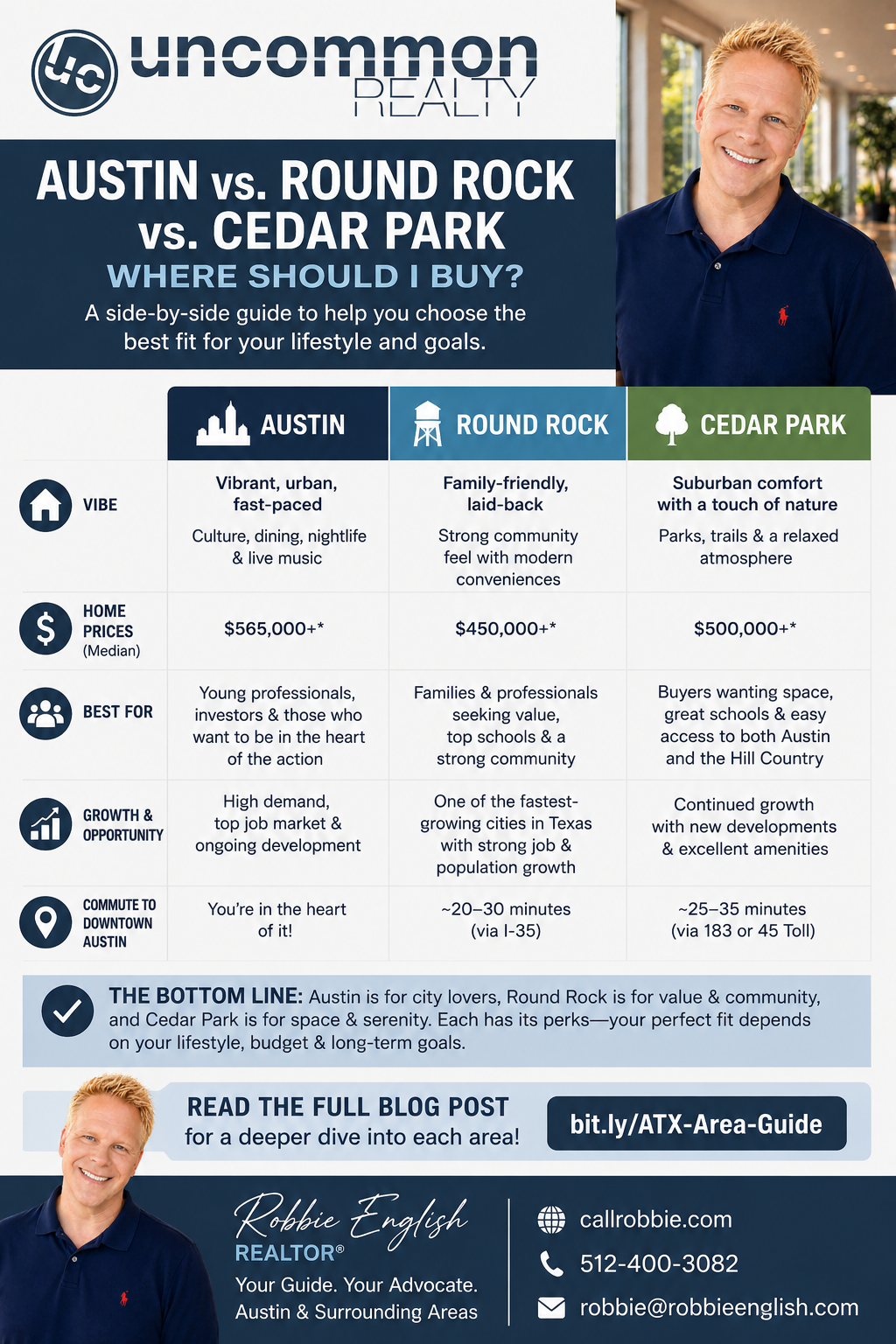
In one breath: Austin gives you the closest-in location and culture at the highest price; Cedar Park offers a newer, family-oriented suburb with strong schools at a middle price; and Round Rock delivers the most space and affordability of the three with a big employment base of its own. Almost every other difference flows from that. Once you know which of those you value most, the decision gets much easier.
The price picture in 2026
Start with the numbers, because they frame everything. The city of Austin's median home price sits around $530,000 in 2026, with the broader metro closer to $440,000, both down meaningfully from the 2022 peak in a market that now favors buyers. Cedar Park generally lands in the high $400s to low $500s. Round Rock tends to run in the low $400s, making it the most affordable of the three on a like-for-like basis. In practical terms, the same budget buys the least space in Austin proper and the most in Round Rock, with Cedar Park in between, and that single fact drives a lot of decisions.
It helps to translate those medians into what they mean for you. Moving from an Austin-city budget to Round Rock can be the difference between a smaller close-in home and a larger, newer house with a real yard and a two-car garage, or between stretching to the top of your approval and buying comfortably below it. That said, price is not the whole cost. Suburban homes often carry HOA dues, and some Williamson County communities add MUD (municipal utility district) taxes to the rate, while a longer commute has its own dollar and time cost. When I compare these places for a buyer, we look at the full monthly picture, not only the purchase price, because the cheapest sticker does not always win once everything is counted.
Austin: location and culture, at a premium
Buying in Austin itself means paying for proximity, walkability, and the cultural core, the music, the food, the lake, the downtown energy, and the shortest commutes to central jobs. The tradeoff is price and, often, older or smaller homes for the money compared to the suburbs. Austin makes the most sense for buyers who prize being close in and are willing to pay for it, and who value location and long-term demand over maximum square footage. If you are weighing the close-in life specifically, I go deeper in my guide on whether Central Austin is a good place to buy a home in 2026, and on the broader city-versus-suburbs question in buying a home in Central Austin versus the suburbs.
Austin's other advantage is the depth and breadth of its housing, from downtown condos to established central neighborhoods to leafy areas farther from the core, so the city can fit very different buyers even at its higher price point. It also concentrates the region's job base, cultural institutions, and nightlife, which keeps demand strong through market cycles. The honest counterpoint is that this demand is exactly what pushes prices up, so an Austin-city budget usually means compromising on size, age, or lot to stay close in, a tradeoff that feels worth it to some buyers and not to others.
Cedar Park: the balanced middle
Cedar Park has become one of the most popular suburbs for a reason: it balances price, space, schools, and access. Most of it falls within the highly regarded Leander ISD, it offers newer homes and master-planned communities, and it connects to the northern tech corridor via the 183A toll road. It also has genuine amenities of its own, the HEB Center with Texas Stars AHL hockey, the 1890 Ranch shopping area, and the growing Bell District redevelopment, plus quick access to Lake Travis and the Hill Country. Cedar Park suits buyers who want more house and yard than Austin proper delivers, strong schools, and a family-oriented feel, without moving as far out as some suburbs require.
What often surprises buyers about Cedar Park is how complete it feels day to day. You are not driving into Austin for basics; the shopping, dining, healthcare, and recreation are already there, and Lake Travis and the Hill Country are close for weekends. That maturity, combined with newer housing than you find close in, is why so many families who start their search in Austin end up choosing Cedar Park once they see what the same budget buys. The main tradeoff is the commute if your work is downtown rather than in the northern corridor, so it rewards buyers whose jobs, or remote-work flexibility, fit its geography.
Round Rock: space, affordability, and its own economy
Round Rock is the value play of the three, generally the most affordable, and it is far more than a bedroom community. It has a substantial employment base of its own, anchored by Dell's headquarters, with Samsung's operations nearby, so many residents work close to home rather than commuting into Austin at all. It is served by the well-regarded Round Rock ISD, offers newer and larger homes for the money, and carries real amenities: the Dell Diamond for Round Rock Express baseball, the Kalahari Resort, the Premium Outlets, and strong highway access via I-35 plus the SH-45 and SH-130 tolls. Round Rock suits buyers who want the most space and the lowest price of the three and either work on the north side or are happy with a longer trip into central Austin.
Schools and commute, the two deciding factors
For many buyers, the decision comes down to schools and commute. On schools, Austin ISD serves the city with quality that varies significantly by attendance zone, while Cedar Park's Leander ISD and Round Rock's Round Rock ISD are both strongly regarded suburban districts, often with newer campuses; in all three, verify the specific attendance zone rather than assuming at the city level. On commute, Austin wins for downtown and central jobs, Cedar Park leans on 183A toward the northern corridor, and Round Rock uses I-35 and the toll network. The honest test is to count your real commute days and weigh them against the space and price you gain by moving farther out, because that tradeoff, more than anything, tends to settle this decision.
Resale and long-term value
How each place holds value is worth weighing at purchase, not only how it lives day to day. Austin's close-in scarcity and fixed location tend to give it a deep, resilient buyer pool that can protect value when the market softens. The suburbs have appreciated strongly during the region's growth, but they also depend more on continued expansion and compete with the next new subdivision going up nearby. Round Rock's independent employment base gives it some insulation that a pure commuter suburb lacks, and Cedar Park's schools and amenities support steady demand. None of this guarantees returns, but if long-term resilience is high on your list, it is a real factor to weigh alongside the upfront price, and your time horizon matters as much as the location: the longer you plan to stay, the more any of these choices has room to work in your favor.
Who each place suits best
To make it concrete: choose Austin if being close in, walkability, and culture top your list and you can carry the higher price. Choose Cedar Park if you want a newer, family-oriented home with strong schools and good northern-corridor access at a middle price. Choose Round Rock if you want the most space and the lowest price of the three, value its own job base and amenities, and either work on the north side or accept a longer trip downtown. Many buyers arrive certain about one and leave choosing another once they have stood in real homes in each with real numbers in hand, which is exactly why touring all three is worth the time.
How to choose between them
The most useful way to resolve this is not to argue it in the abstract but to see all three against your real budget and life. The 2026 market gives buyers more time and negotiating room than a few years ago, so you can tour thoughtfully across all three before committing. Get fully pre-approved so you know your true number, then tour a few homes in each to feel the tradeoff in person, and weigh the full monthly cost, including commute, property tax, and any HOA or MUD, rather than the sticker price alone. If your choice really comes down to the two suburbs, my detailed comparison of Cedar Park versus Round Rock digs into that head-to-head in depth. And remember that in a buyer-friendlier market you have the luxury of taking your time, so there is no need to force the decision before you have genuinely compared all three in person.
How I help
When buyers are torn among Austin, Round Rock, and Cedar Park, my job is to make the tradeoffs concrete: real comparable prices in each, an honest monthly-cost picture, and a clear read on commute, schools, and resale for your specific situation. Then I represent you through the offer, the option period, inspections, and closing wherever you land, with the current market's leverage on your side. My team and I do this across the whole metro, and you can reach the Uncommon Realty team whenever you want to talk it through.
The best first step is to see what your budget buys in each place. Download my app to follow listings across all three in real time and reach me with questions. When you are ready to decide, I am here to help you make the call with clear eyes and real numbers.
Written for buyers and sellers in the Greater Austin, Texas area by Robbie English, REALTOR, Broker at Uncommon Realty.
Categories
- All Blogs (906)
- !!! (51)
- !x (612)
- Austin Real Estate (93)
- Bee Cave Real Estate (1)
- Building A Home (14)
- Buying A Home (134)
- Buying Land (1)
- Cedar Park Real Estate (56)
- Central Austin Real Estate (75)
- Down Payment Assistance Programs (1)
- Downsizing (3)
- Downtown Austin Real Estate (5)
- Dripping Springs Real Estate (61)
- East Austin Real Estate (3)
- Financing and Mortgage (19)
- first-time homebuying (103)
- Georgetown Real Estate (9)
- Hill Country Real Estate (1)
- HOA (2)
- Home Appraisals (12)
- Home For Rent (1)
- Home Inspections (6)
- Home Pricing (4)
- Home Values (11)
- Homeownership (1)
- Homes For Rent (1)
- Homes For Sale (147)
- Hutto Real Estate (5)
- Investing (2)
- Lakeway Real Estate (33)
- Leander Real Estate (58)
- LGBT+ Real Estate (8)
- Luxury Homes For Sale (4)
- Luxury Real Estate (19)
- Market Conditions (15)
- Moving to Austin (2)
- Moving to Texas (4)
- Negotiations (2)
- Neighborhoods (8)
- Northwest Austin Real Estate (94)
- Off Market Listings (7)
- Pflugerville Real Estate (10)
- Private Listings (2)
- Property Management (42)
- Property Tax (1)
- Real Estate (18)
- Reddit Question Answered (80)
- redwrite (63)
- Relocation (2)
- Renting (6)
- Representation (34)
- Round Rock Real Estate (56)
- Selling Your Home (53)
- Westlake Real Estate (3)
Recent Posts