Is Central Austin A Good Place To Buy A Home In 2026

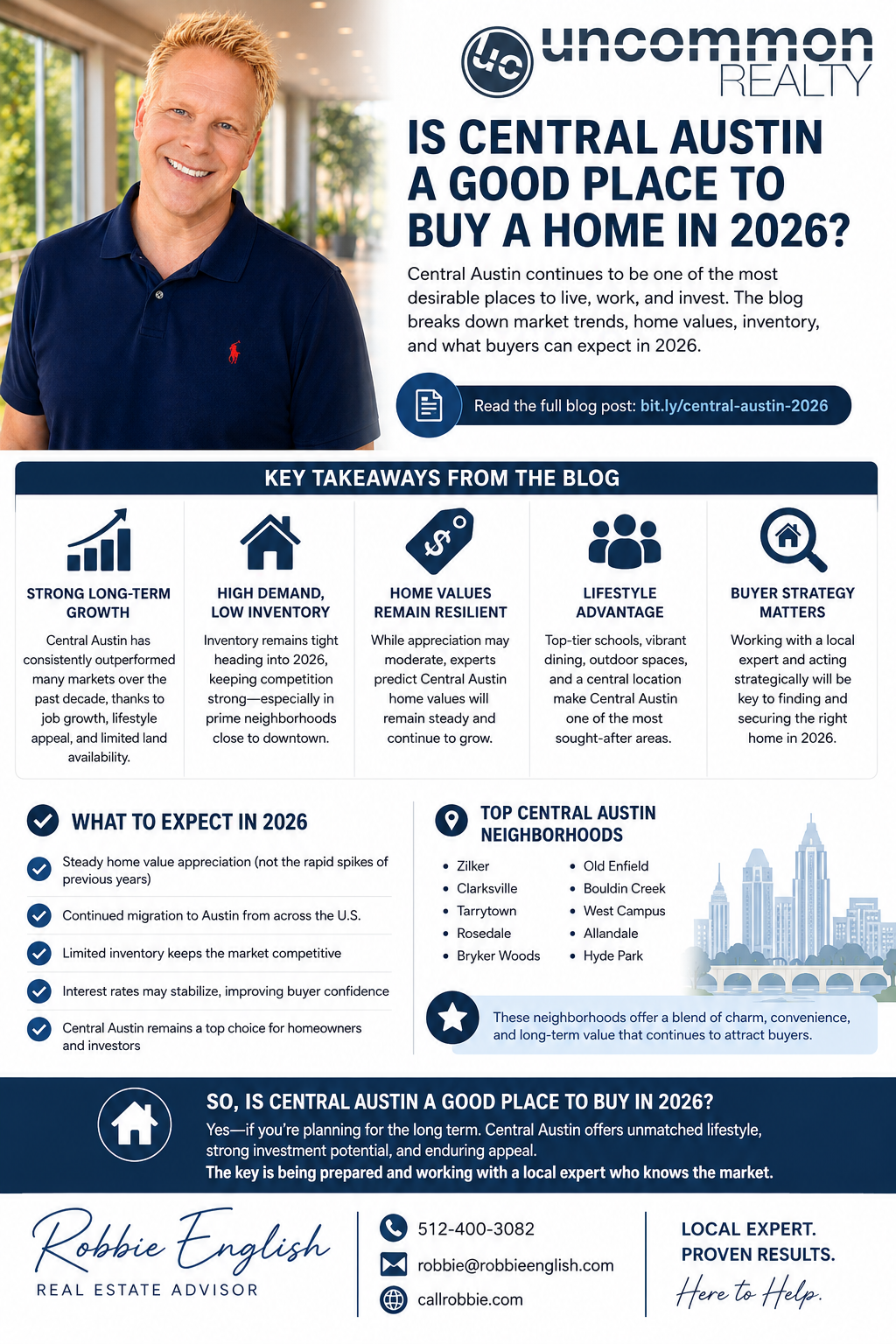
If you are asking whether Central Austin is a good place to buy a home in 2026, you are asking it at a genuinely useful moment. The Austin market has changed a great deal since its 2022 peak, and Central Austin sits in an interesting spot: it is still one of the most desirable places to own in the entire metro, but the frantic, waive-everything conditions of a few years ago have eased. That combination is worth understanding before you decide. I am Robbie English, Broker, REALTOR at Uncommon Realty, and I have represented buyers through this exact decision for years. My goal here is to give you a straight answer grounded in real numbers, not a sales pitch.

The short answer, and the honest version of it
For the right buyer, yes, Central Austin is a good place to buy in 2026, and the timing is more forgiving than it has been in years. But "the right buyer" is doing real work in that sentence. Central Austin is not where you go to get the most square footage for your money, and it is not where you find the newest construction on a large lot. It is where you go for location, walkability, established character, and a level of long-term demand that few other parts of the metro can match. If those things matter more to you than raw space per dollar, this is a strong place to own. If they do not, the suburbs will stretch your budget much further, and I would tell you so directly.
What you are actually paying a premium for
Central Austin commands a premium, and it helps to know why before you decide whether it is worth it to you. The area is essentially built out. There is very little raw land, so most new supply comes from teardowns and infill rather than new subdivisions. That scarcity, combined with proximity to downtown, the University of Texas, major employers, and the city's cultural core, keeps demand structurally high. You are paying for a location that cannot really be reproduced, and for a daily rhythm, short commutes, walkable errands, tree-lined streets, that is genuinely hard to find elsewhere in the metro.
You feel it the moment you drive through Allandale or Tarrytown: character-filled homes, local coffee shops, and a settled-but-still-evolving feel. That feeling is real, and it is a large part of what holds value here over time. The honest caveat is that it costs money, and in 2026 it is worth being clear-eyed about exactly how much.
There is also a resale and liquidity dimension to the premium that buyers often overlook when they are comparing a Central Austin home against a larger suburban one at the same price. Because the land itself is scarce and the location is fixed, Central Austin homes tend to draw a deeper pool of future buyers when it is time to sell. In a market that softens, breadth of demand is what protects you, and a home three miles from downtown generally has more of it than a comparable home thirty minutes out. That does not mean prices only ever rise here, they do not, but it does mean your eventual exit is usually easier. When I walk buyers through the true cost of a Central Austin purchase, I factor that resilience in rather than looking only at the higher sticker price, because the number that matters is not only what you pay going in but what the home does for you over the years you own it and what it returns when you leave.
The real 2026 numbers
Here is where general Austin market talk can mislead you. The Austin metro median sits around $440,000 in 2026, down roughly 20 to 25 percent from the May 2022 peak, with several months of inventory and a market that clearly favors buyers. Central Austin does not track that metro median, because it runs well above it. To put concrete figures on it, in the three months ending in spring 2026 the 78704 zip code, covering the Zilker, Travis Heights, and South Lamar side, carried a median sale price around $835,000, while 78751, covering Hyde Park and North Loop, sat closer to $619,000. Both were down modestly year over year, which is exactly the softening that gives buyers more room now than they had in 2021 and 2022.
At the same time, well-priced homes in desirable Central Austin pockets still move quickly, with median days on market for the area running in the low 20s. That is the tension you are buying into: it is a buyer-friendlier moment than the recent past, with more negotiating leverage and time to inspect, but the best listings in the best spots do not sit for long. The practical takeaway is that 2026 rewards buyers who are prepared and decisive, and it punishes buyers who assume everything is negotiable and slow. You can follow where the numbers stand at any given time on my Austin market snapshot.
Two more numbers-related points are worth keeping in front of you. First, the price you see is not the whole monthly cost. Texas property taxes run higher than in many states, commonly in the range of 1.8 to a bit over 2 percent of assessed value once you combine city, county, school, and other local rates, and a higher-valued Central Austin home means a higher tax bill in absolute dollars. Budget for that from the start rather than discovering it after you fall in love with a house. Second, mortgage rates in 2026 remain well above the historic lows of a few years ago, which is part of why the market cooled in the first place. That is not a reason to wait indefinitely, because the softer prices and stronger negotiating position are a real offset, but it does mean your buying power is tied closely to the rate you lock, and getting your financing sharp before you shop matters more now than it did in a lower-rate environment.
It is also worth separating the single-family and condo pictures, because they behave differently. Detached homes in the marquee Central Austin neighborhoods carry the highest prices and the deepest demand, while condos and townhomes closer to downtown and the university can offer a lower entry point into the area for buyers who want the location without the maintenance or the single-family price tag. Which one fits depends on how you want to live and how long you plan to stay, and it is one of the first things I help buyers sort out.
Central Austin is not one market, it is many
The single biggest mistake I see buyers make is treating Central Austin as one place with one price. It is a collection of micro-markets, and the right one depends entirely on how you want to live and what you want to spend.
Tarrytown and the west-central pockets are where the highest price points and the most established, architecturally significant homes sit. Crestview and North Shoal Creek tend to blend relative affordability with easy access to major corridors, which is why buyers who feel priced out of the marquee neighborhoods often find their opening there. Mueller offers a planned, newer-build, walkable environment that feels different from the older parts of Central Austin and appeals to buyers who want newer construction without leaving the core. And areas near Zilker Park put you next to green space and the city's outdoor life while keeping you minutes from downtown.
If walkability specifically is what draws you to Central Austin, I have written two companion guides worth reading before you narrow your list: one on the best walkable neighborhoods in Central Austin for quieter, errand-focused living, and one on walkable neighborhoods for buyers who want culture, nightlife, and community. Rather than repeat those neighborhood breakdowns here, I would point you to them once you know Central Austin is the right fit.
Schools and the long-term picture
Most of Central Austin falls within the Austin Independent School District, and campus quality varies meaningfully from attendance zone to attendance zone, so this is something to verify at the specific address rather than assume at the neighborhood level. For buyers weighing long-term value, the combination of school demand, limited supply, and central location is what has historically made Central Austin resilient even when the broader metro cools. That resilience is not a guarantee, but it is a real pattern, and it is a meaningful part of why the premium tends to hold.
Who Central Austin is right for in 2026
Central Austin makes the most sense if you value being close in, want walkability and established character, plan to stay long enough to ride out market cycles, and can comfortably carry the higher price point and the property tax that comes with a higher-valued home. It makes less sense if your top priority is maximum space per dollar, a brand-new build on a big lot, or the lowest possible monthly cost, because the suburbs will simply serve those goals better. There is no wrong answer here, only a right answer for your specific priorities, and part of my job is making sure you are honest with yourself about which one you are.
A useful way to test your own fit is to think about your time horizon. If you expect to stay five years or more, the combination of scarce supply, central location, and steady demand tends to work in your favor, and the transaction costs of buying and eventually selling get spread across enough time to make sense. If you might move again within a year or two, the math is harder anywhere, and it is harder still in a premium market where you are paying up front for a location whose value shows up over the long run. I would rather have that conversation with you before you buy than watch you feel boxed in afterward, and it is one of the reasons I push buyers to be specific about their plans rather than buying on the emotion of a single great showing.
Timing your entry is the other piece. Some buyers try to wait for a perfect bottom, but Central Austin has rarely rewarded that kind of waiting over any meaningful stretch, because the same scarcity that supports the premium also limits how far and how long prices tend to fall. The more productive question in 2026 is not whether prices might dip a little further, it is whether you can buy the right home, in the right micro-market, at a price and payment that work for your life, and then hold it. When those pieces line up, the current market gives you a better shot at it than the frenzy of a few years ago did.
How to approach the purchase the right way
If Central Austin is your target, a few things make the 2026 market work in your favor. Get fully pre-approved before you shop rather than only pre-qualified, because when the right listing appears in a strong micro-market it can still attract competition and you want to move without delay. Use the cooler overall market to your advantage on inspections and negotiation, where buyers now have more leverage than they did a few years ago. And be precise about the micro-market and attendance zone you actually want, because a smart, targeted search beats a broad one every time in an area this varied.
How I help
When I work with buyers in Central Austin, we start by matching your real priorities and budget to the specific micro-market that fits them, then we track inventory closely so you are ready to act when the right home appears, and I represent you through negotiation, inspections, and closing with the current market's leverage on your side. My team and I do this work across the whole area, and you can reach the Uncommon Realty team whenever you want to talk it through.
The best first step is simply to see what is on the market. You can download my app to follow Central Austin listings in real time and reach me directly with questions. When you are ready to talk through whether Central Austin is the right place for your 2026 purchase, I am here to help you make that call with clear eyes and real numbers.
Written for buyers and sellers in the Greater Austin, Texas area by Robbie English, REALTOR, Broker at Uncommon Realty.
Categories
- All Blogs (959)
- !!! (59)
- !x (621)
- Austin Real Estate (106)
- Bee Cave Real Estate (1)
- Building A Home (14)
- Buying A Home (143)
- Buying Land (1)
- Cedar Park Real Estate (57)
- Central Austin Real Estate (75)
- Down Payment Assistance Programs (1)
- Downsizing (3)
- Downtown Austin Real Estate (5)
- Dripping Springs Real Estate (62)
- East Austin Real Estate (3)
- Financing and Mortgage (23)
- first-time homebuying (109)
- Georgetown Real Estate (9)
- Hill Country Real Estate (1)
- HOA (2)
- Home Appraisals (13)
- Home For Rent (1)
- Home Inspections (6)
- Home Pricing (6)
- Home Staging (1)
- Home Values (12)
- Homeownership (1)
- Homes For Rent (1)
- Homes For Sale (147)
- Hutto Real Estate (5)
- Investing (6)
- Investment Properties (4)
- Lakeway Real Estate (33)
- Leander Real Estate (59)
- LGBT+ Real Estate (8)
- Luxury Homes For Sale (5)
- Luxury Real Estate (19)
- Market Conditions (16)
- Moving to Austin (2)
- Moving to Texas (4)
- Negotiations (3)
- Neighborhoods (8)
- Northwest Austin Real Estate (94)
- Off Market Listings (7)
- Pflugerville Real Estate (10)
- Private Listings (2)
- Property Management (42)
- Property Tax (3)
- Real Estate (18)
- Reddit Question Answered (80)
- redwrite (63)
- Relocation (2)
- Renting (6)
- Representation (34)
- Round Rock Real Estate (58)
- Selling Your Home (62)
- South Austin Real Estate (1)
- Westlake Real Estate (3)
Recent Posts