Why Buyers Are Losing Homes In Austin And How To Fix It

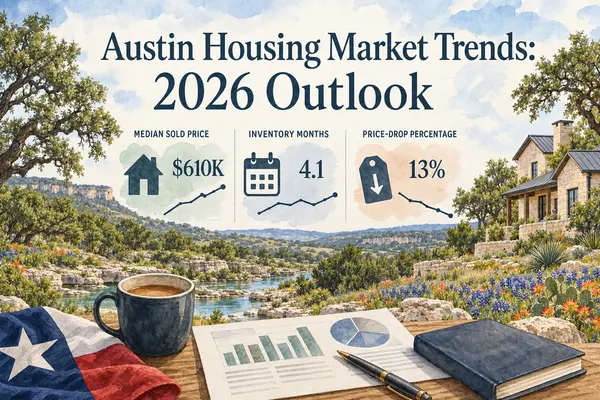
I want to correct something before getting into tactics: Austin's market in 2026 isn't the all-out bidding war environment it was a few years ago. Inventory is sitting around 4.77 months, homes are averaging close to 99% of asking price, and days on market have stretched out. Buyers still lose homes here, but usually not because of citywide frenzy — it's specific, well-priced, move-in-ready listings in popular pockets that still draw real competition, and that's where preparation actually matters.

TLDR: Why Buyers Lose Homes in Austin
- Austin's overall market favors buyers more than it did a few years ago, but the best-priced listings in popular areas still get multiple offers.
- Pre-approval isn't enough anymore in competitive situations — fully underwritten pre-approval carries real weight with sellers.
- Escalation clauses can help in multiple-offer situations, but in Texas they must be drafted by a licensed attorney, not the agent.
- Appraisal gap coverage and flexible closing timelines matter more to sellers than people realize.
- Speed still matters even in a slower market — well-priced homes in good condition can still move in days.
The Market Has Actually Shifted
Austin currently sits around 4.77 months of inventory, and the average home is selling at roughly 99% of asking price rather than meaningfully over it. That's a real shift from the extreme seller's-market conditions of a few years ago, and it means most buyers aren't facing the kind of across-the-board bidding wars that defined 2021 and 2022. The competition that still exists is concentrated: well-priced, move-in-ready homes in in-demand neighborhoods can still sell in 20 to 30 days with multiple offers, while overpriced or dated listings sit. Knowing which category a specific listing falls into changes your entire strategy.
Pre-Approval vs. Fully Underwritten Financing
A standard pre-approval letter carries less weight than it used to in competitive situations. A fully underwritten pre-approval — where your lender has already verified income, assets, and credit rather than just running a quick calculation — signals to a seller that your financing is genuinely solid, not just a preliminary estimate. Ask your lender specifically whether they can get you to fully underwritten status before you're actively competing for a home, not after you've already lost one.
Escalation Clauses: What They Actually Are and Their Limit
An escalation clause automatically increases your offer up to a set ceiling if a seller receives a higher competing offer, and it can be useful in a genuine multiple-offer situation. But in Texas, real estate agents are not permitted to draft escalation clause language themselves under TREC Rule 537.11(b)(5) — because it modifies the contract's legal terms, it has to come from a licensed attorney. If a clause like this makes sense for a specific offer, I'll tell you directly and connect you with an attorney to draft it correctly, rather than handling it in-house, which some agents do without flagging the legal line they're crossing.
Appraisal Gap Coverage
If a home appraises below your offer price, an appraisal gap agreement commits you to covering some or all of that difference in cash rather than renegotiating or walking away. This is a real, meaningful signal to sellers in a competitive situation, but it's also a real financial commitment — know your actual cash reserves and comfort level before offering gap coverage, not just what sounds competitive in the moment.
Flexible Closing and Rent-Back Terms
Price isn't the only lever. A closing timeline that matches a seller's actual moving plans, or a short rent-back period that lets them stay a few extra days after closing, can make your offer more attractive than a higher-priced one with a rigid timeline. Ask what the seller's actual situation is before assuming price alone wins — sometimes flexibility costs you nothing and moves you to the top of the pile.
Texas Option Period Strategy
The option period is a Texas-specific negotiation tool that gives buyers a set number of days to terminate the contract for any reason, in exchange for a small option fee paid directly to the seller. In a competitive situation, a shorter option period signals seriousness without eliminating your ability to inspect the property, while an unusually long one can make an offer look less committed. Talk through the right option period length for a specific situation rather than defaulting to a standard number out of habit.
Personal Letters to Sellers: Handle With Care
Buyer letters to sellers used to be common advice for standing out, and they can occasionally still help. But they also carry real fair housing risk — a letter that reveals details about a buyer's family, religion, or background can put a seller's agent in a position where accepting or rejecting an offer looks like it was influenced by a protected characteristic, even unintentionally. Many listing agents now discourage or outright reject buyer letters for exactly this reason. If you want to include one, keep it focused on the offer terms and your genuine interest in the home, not personal details that could be read as anything else.
What Sellers Actually Weigh Beyond Price
Sellers and their agents are evaluating certainty as much as dollar amount — how likely is this offer to actually close without renegotiation or delay. That's why financing strength, appraisal gap coverage, and a clean, well-structured contract can beat a slightly higher offer that looks shakier on paper. A lower offer with fully underwritten financing and minimal contingencies sometimes beats a higher offer with a standard pre-approval and a long list of conditions attached.
Common Mistakes Beyond Price
Beyond underbidding, the most common mistakes I see are buyers waiting too long to view a well-priced new listing, submitting an offer without having toured comparable recent sales first, and treating every listing as equally competitive when some genuinely aren't. Overbidding on a home that wasn't actually going to draw multiple offers wastes money just as surely as losing a genuinely competitive one through hesitation — knowing which situation you're actually in is half the strategy.
Speed Still Matters
Even in a more balanced market, the best-priced homes in good condition move fast — often within the 20-to-30-day range from listing to contract, sometimes faster. Real-time listing alerts matter more here than a daily email digest. My mobile app connects directly to MLS data, so you see new listings as they hit the market, and you can message me directly through it when you want a same-day read on whether a listing is worth moving quickly on.
Local Market Differences
Austin isn't one market — what drives competition in Central Austin looks different than what drives it in Dripping Springs, Cedar Park, or Northwest Hills. Pricing patterns, typical days on market, and how aggressively sellers negotiate all vary by specific area, so a strategy built for one part of the metro doesn't automatically transfer to another. Ask directly what current competition actually looks like in the specific area and price band you're shopping, rather than assuming citywide headlines apply evenly everywhere.
Working With Someone Who Tells You the Real Situation
I'm Robbie English, Broker, REALTOR at Uncommon Realty, and I'd rather tell you honestly when a listing isn't actually competitive than help you overbid unnecessarily in a market that's shifted more in buyers' favor. When a home genuinely is competitive, I'll walk you through the real tools — fully underwritten financing, appraisal gap coverage, flexible terms, and properly attorney-drafted escalation language when it applies — rather than vague reassurance. That honesty is what actually helps you win the homes worth winning, without overpaying for the ones that were never going to be competitive in the first place.
Written for buyers and sellers in the Greater Austin, Texas area by Robbie English, REALTOR, Broker at Uncommon Realty.
Categories
- All Blogs (959)
- !!! (59)
- !x (621)
- Austin Real Estate (106)
- Bee Cave Real Estate (1)
- Building A Home (14)
- Buying A Home (143)
- Buying Land (1)
- Cedar Park Real Estate (57)
- Central Austin Real Estate (75)
- Down Payment Assistance Programs (1)
- Downsizing (3)
- Downtown Austin Real Estate (5)
- Dripping Springs Real Estate (62)
- East Austin Real Estate (3)
- Financing and Mortgage (23)
- first-time homebuying (109)
- Georgetown Real Estate (9)
- Hill Country Real Estate (1)
- HOA (2)
- Home Appraisals (13)
- Home For Rent (1)
- Home Inspections (6)
- Home Pricing (6)
- Home Staging (1)
- Home Values (12)
- Homeownership (1)
- Homes For Rent (1)
- Homes For Sale (147)
- Hutto Real Estate (5)
- Investing (6)
- Investment Properties (4)
- Lakeway Real Estate (33)
- Leander Real Estate (59)
- LGBT+ Real Estate (8)
- Luxury Homes For Sale (5)
- Luxury Real Estate (19)
- Market Conditions (16)
- Moving to Austin (2)
- Moving to Texas (4)
- Negotiations (3)
- Neighborhoods (8)
- Northwest Austin Real Estate (94)
- Off Market Listings (7)
- Pflugerville Real Estate (10)
- Private Listings (2)
- Property Management (42)
- Property Tax (3)
- Real Estate (18)
- Reddit Question Answered (80)
- redwrite (63)
- Relocation (2)
- Renting (6)
- Representation (34)
- Round Rock Real Estate (58)
- Selling Your Home (62)
- South Austin Real Estate (1)
- Westlake Real Estate (3)
Recent Posts