
Austin Short Term Rental Regulations Explained
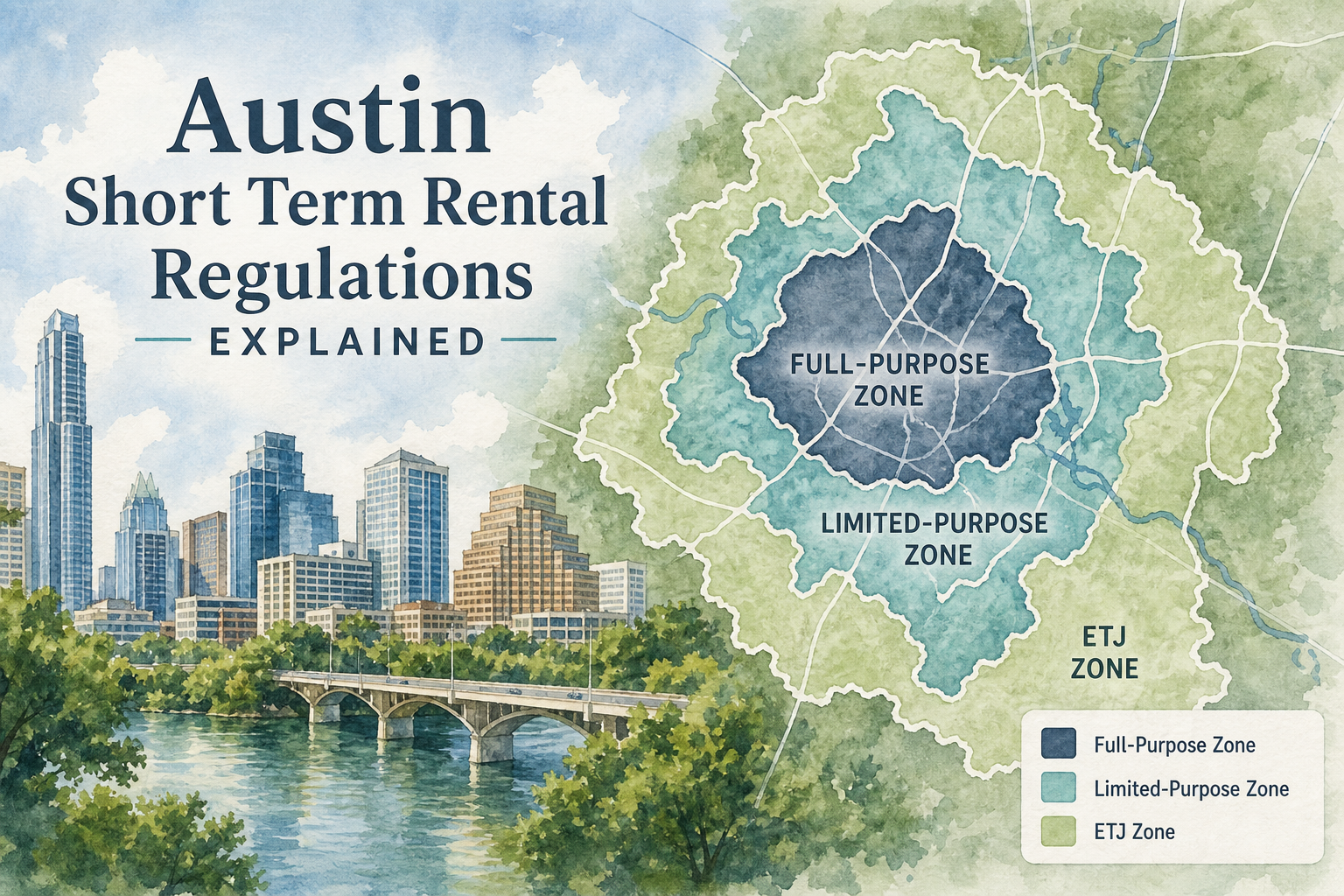
Thinking about renting out a home in Austin for a few weeks? The city’s rules look simple, but hidden fines and jurisdiction quirks catch many hosts off guard. Below I break down the key pieces you need to stay compliant.
What Counts as a Short-Term Rental in Austin?
A short‑term rental (STR) is any residential unit rented for less than 30 consecutive days, whether it’s a single‑family house, condo, or a mixed‑use loft. For quick reference, see Wikipedia.
All STRs must hold an annual operating license issued by Austin Development Services. New applicants pay $836.30; renewals cost $385.30. Licenses are non‑transferable, so a new owner needs a fresh permit.
Notice: If you let a guest stay longer than 30 days, the rental is no longer an STR and falls under a different set of landlord‑tenant rules.
Full Purpose, Limited Purpose, and ETJ: Why Location Changes the Rules
Austin splits its land into three zones that affect which rules apply. In the Full‑Purpose Jurisdiction (the city core), you need a license and must file the required hotel-occupancy tax (HOT) reports. In the Limited‑Purpose zone, you still need a license but are exempt from city HOT. The Extra Territorial Jurisdiction (ETJ) lies outside the city limits; there you neither need a license nor pay local HOT.
Understanding where your property sits saves you money and paperwork. Use the city’s jurisdiction map to verify the status before you apply.
| Jurisdiction | License Required? | HOT Required? |
|---|---|---|
| Full‑Purpose | Yes | Yes |
| Limited‑Purpose | Yes | No city HOT |
| ETJ | No | No |
Operating Requirements: Local Contacts, Information Packets, and License Status
Every STR licensee must name a local contact who lives in the Austin metro area. If the contact changes, you have three business days to update the city in writing.
The city also mandates an information packet for guests. Place it in a common area where renters can easily see it. The packet lists safety rules, noise limits, and emergency procedures.
License status is tracked online. When you renew, the city emails a notice that includes the local‑contact details for nearby neighbors. Those notices are paid for by the license holder.
Notice: The local‑contact rule applies only if you don’t reside in Austin yourself. If you live on‑site, you can skip the contact designation.

Hotel Occupancy Tax: Who Collects It and What Owners Still Report
The city levies an 11 % hotel‑occupancy tax (9 % standard + 2 % venue‑project surcharge). Online platforms like Airbnb and VRBO must collect and remit this tax on your behalf.
If you rent through a non‑online channel, you must collect the HOT yourself and file a quarterly report showing what you collected and what the platform remitted on your behalf. You must file the quarterly report with the city.
Zero‑rental periods still require a report , you file a “zero report” to confirm no activity for that quarter.
Notice: Failing to file a quarterly report can trigger daily fines that climb to $2,000 per day.
What Austin STR Regulations Mean When You Buy or Sell a Property
If you’re buying a home you plan to rent short term, verify the property’s jurisdiction first. A full‑purpose location means you’ll budget for licensing fees and the HOT filing process. A limited‑purpose spot saves you the tax but still requires a license.
During a sale, the seller should disclose whether a valid STR license exists. Because licenses are non‑transferable, the buyer will need a new application, which can delay closing.
Working with a local REALTOR who knows these rules can smooth the transaction. I often point buyers to Why Central Austin Condos Make Strong Rental Investments for examples of properties that already meet the city’s criteria.
On the selling side, I recommend checking Property Management in the Austin Area | Owner's Guide to see how a professional manager can keep the license active and handle quarterly reports.
Finally, for investors weighing multiple markets, Top Austin Real Estate Investment Opportunities 2026 provides a snapshot of neighborhoods where STRs thrive under the current rules.
If short-term rules end up too restrictive for a particular property, it is worth comparing the numbers against a traditional lease — our current Austin-area rental listings are a quick way to see what long-term tenants are paying in the same neighborhoods.
Frequently Asked Questions About Austin Short-Term Rental Regulations
Do I need a license if I rent my home for 30 days or less?
Yes. Any rental of less than 30 consecutive days is considered a short‑term rental and requires an annual operating license from the City of Austin.
What is the hotel‑occupancy tax rate?
The city’s hotel‑occupancy tax is 11 % , 9 % for the standard occupancy tax plus a 2 % venue‑project surcharge.
Can I operate an STR in the ETJ without a license?
Correct. Properties in the Extra Territorial Jurisdiction are exempt from both the city license and the local hotel‑occupancy tax.
How often must I file a HOT report?
STR owners file a quarterly HOT report, even if a booking platform already collected the tax on their behalf.
What happens if I miss a quarterly filing?
Missing a filing can result in daily fines that climb to $2,000 per day until the missing report is submitted.
Staying on top of these requirements keeps your rental legal and your peace of mind intact.
Conclusion
For anyone looking to rent out a home in Austin, the safest route is to get a city license, understand your property’s jurisdiction, and stay on top of quarterly HOT reports. Need help handling the paperwork? Reach out and I’ll walk you through the process.
Ready to put this into practice? My name is Robbie English, REALTOR, with Uncommon Realty and I was built for exactly this.
Categories
- All Blogs (970)
- !!! (59)
- !x (621)
- Austin Real Estate (113)
- Bee Cave Real Estate (1)
- Building A Home (14)
- Buying A Home (143)
- Buying Land (1)
- Cedar Park Real Estate (58)
- Central Austin Real Estate (75)
- Down Payment Assistance Programs (1)
- Downsizing (4)
- Downtown Austin Real Estate (5)
- Dripping Springs Real Estate (62)
- East Austin Real Estate (3)
- Financing and Mortgage (24)
- first-time homebuying (109)
- Georgetown Real Estate (9)
- Hill Country Real Estate (1)
- HOA (2)
- Home Appraisals (13)
- Home For Rent (1)
- Home Inspections (6)
- Home Pricing (6)
- Home Staging (1)
- Home Values (12)
- Homeownership (1)
- Homes For Rent (1)
- Homes For Sale (147)
- Hutto Real Estate (5)
- Investing (6)
- Investment Properties (4)
- Lakeway Real Estate (33)
- Leander Real Estate (59)
- LGBT+ Real Estate (8)
- Luxury Homes For Sale (5)
- Luxury Real Estate (19)
- Market Conditions (17)
- Moving to Austin (2)
- Moving to Texas (4)
- Negotiations (3)
- Neighborhoods (8)
- Northwest Austin Real Estate (94)
- Off Market Listings (7)
- Pflugerville Real Estate (10)
- Private Listings (2)
- Property Management (42)
- Property Tax (3)
- Real Estate (18)
- Reddit Question Answered (80)
- redwrite (63)
- Relocation (2)
- Renting (6)
- Representation (34)
- Round Rock Real Estate (59)
- Selling Your Home (62)
- South Austin Real Estate (1)
- Westlake Real Estate (3)
Recent Posts