
Can a Seller Refuse to Pay a Buyer's Agent?

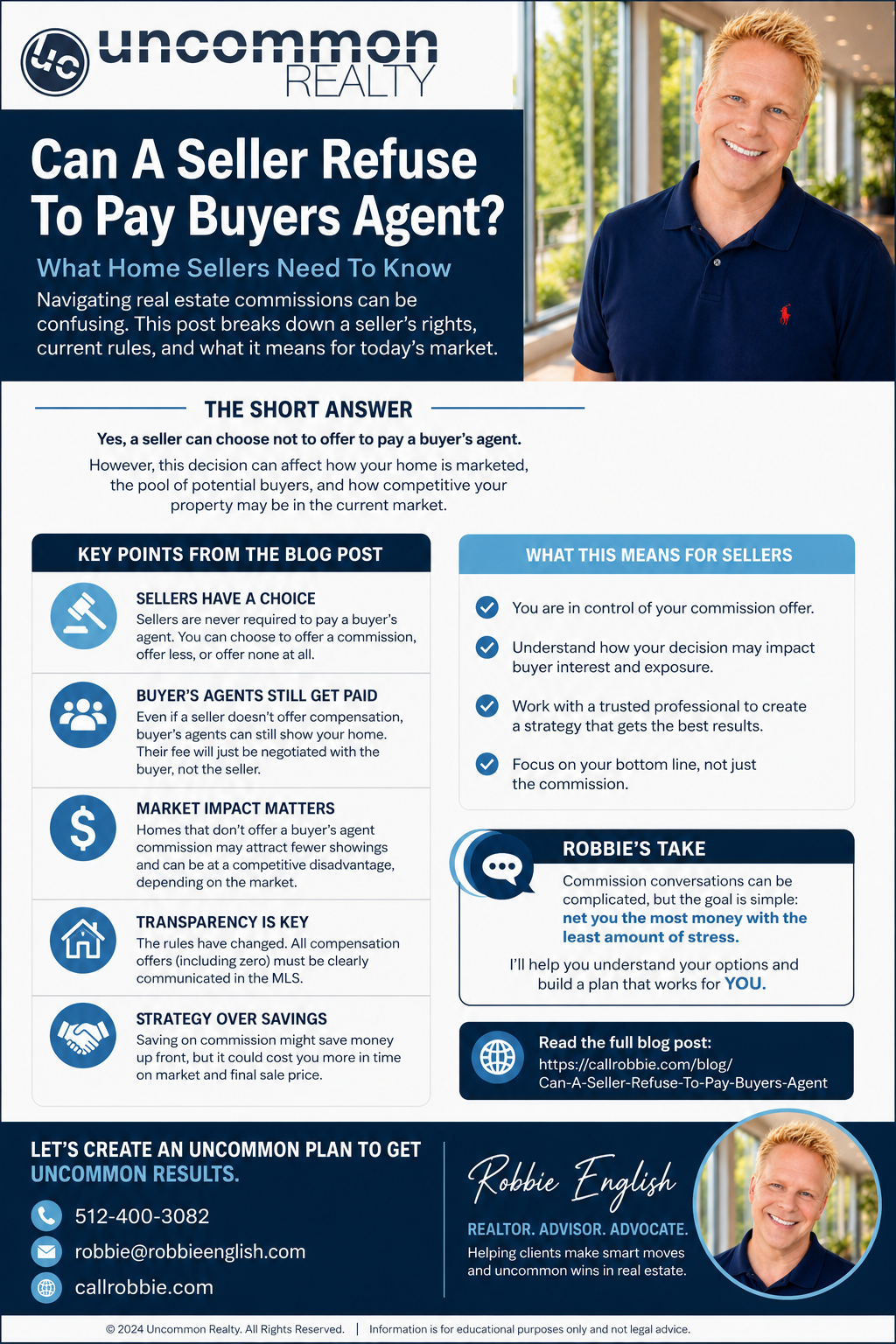
So, can a seller genuinely refuse to pay a buyer's agent? Yes, and since 2024 that specific question comes up far more often than it used to. There's no legal requirement anywhere that a seller offer buyer-agent compensation, and under the current post-settlement framework, it's now a genuine, individual choice made on every listing rather than an unwritten industry default. This guide covers why that changed, what actually happens when a seller declines, and how buyers and sellers should each think through the decision.
I am Robbie English, Broker, REALTOR at Uncommon Realty, and I've personally represented both buyers and sellers through this exact decision many times across Austin. My goal here is to lay out the real mechanics so you can make an informed choice, whichever side of the transaction you're on.

Why This Question Even Exists Now
Before the National Association of Realtors' 2024 settlement, buyer-agent compensation was commonly published directly on the MLS listing itself, which made offering it feel like an industry standard rather than a genuine choice. That's no longer how it works. Compensation offers are no longer published on the MLS, and NAR's 2026 "Multiple Listing Options for Sellers" policy has given sellers even more flexibility in how and when they market a listing. The upshot: a seller genuinely decides, listing by listing, whether to offer any compensation to a buyer's agent, and there's no rule requiring they do.
Why A Seller Might Say No
Sellers decline to offer buyer-agent compensation for a few common reasons. Some simply want to net the highest possible proceeds and see it as an unnecessary cost in a market where buyer demand is strong enough that they don't feel they need the incentive. Others are working with tight equity, maybe a smaller sale price or existing liens, where every dollar of proceeds genuinely matters. Some sellers, particularly in for-sale-by-owner or discount-brokerage arrangements, have structured their entire sale around minimizing commission costs from the start.
None of these reasons are inherently wrong. It's the seller's proceeds and the seller's choice, just as it's now the buyer's choice how they structure their own representation and who pays for it.
What Happens When A Seller Declines
Declining to offer compensation doesn't eliminate the buyer's agent from the transaction, it simply shifts who's responsible for paying them. Since Texas now requires a written buyer-representation agreement before an agent shows a buyer a home, that agreement already spells out compensation terms. If a specific seller isn't offering to cover it, the buyer's agreement determines what happens next: the buyer may need to pay their agent directly, negotiate for the seller to cover it anyway as part of the offer, or, in some cases, the agreement may simply not apply to that specific transaction if it was scoped narrowly enough.
This is exactly why reading your representation agreement's terms before you start touring homes matters. A buyer who understands upfront what happens if a seller doesn't offer compensation can factor that into their search and their offers from the beginning, rather than discovering it partway through a transaction they're already invested in.
Can A Buyer Ask The Seller To Cover It Anyway?
Yes, and this is one of the more useful tools in a buyer's negotiating toolkit right now. Even when a listing doesn't explicitly offer buyer-agent compensation, a buyer can request it as part of their offer, essentially asking the seller to cover some or all of that cost out of proceeds, similar to how a buyer might ask for closing-cost assistance. Whether a seller agrees depends on their own priorities, how motivated they are, how the property has been performing on market, and how the rest of the offer looks.
This request is generally more likely to succeed on a home that's been sitting for a while or in a market favoring buyers, and less likely on a home drawing strong, immediate interest where the seller has other offers to choose from without that concession. It costs nothing to ask, and a knowledgeable buyer's agent will typically build this into the offer structure as a matter of course rather than assuming it's off the table.
The Buyer's Real Options When A Seller Won't Pay
If a seller genuinely won't budge on covering buyer-agent compensation, a buyer has a few real paths forward. They can pay their agent directly out of pocket, which for many buyers means factoring that cost into their overall budget alongside the down payment and closing costs. They can, in some cases, roll a portion of that cost into the loan amount if their lender and loan program allow it, which effectively finances the cost over the life of the mortgage rather than paying it upfront. Or they can simply prioritize other listings where the seller is offering compensation, which remains common, particularly on homes priced to move.
None of these options are inherently better than the others; they depend on the buyer's cash position, financing situation, and how much they specifically want that particular home versus a comparable one elsewhere.
How This Affects A Seller's Own Strategy
Sellers weighing whether to offer compensation should think about it as a genuine competitive positioning decision, beyond simply a cost to minimize. A listing that doesn't offer buyer-agent compensation may see a narrower pool of interested buyers, specifically those willing and able to cover that cost themselves, compared to a similar listing that does offer it. In a market with meaningful competing inventory, that narrower pool can translate into a longer time on market or a weaker negotiating position overall.
The math is worth running concretely rather than assuming either choice is obviously correct. A seller should weigh the cost of offering compensation against the realistic risk of a longer time on market, additional carrying costs, mortgage payments, taxes, insurance, on a home that sits longer without that incentive, and against the possibility of ultimately negotiating a lower sale price to attract a smaller buyer pool.
Does This Vary By Price Point Or Market Conditions?
In practice, yes. In a strong seller's market with limited inventory and high buyer demand, sellers have more room to decline offering compensation without meaningfully hurting their pool of interested buyers, since buyers are more willing to cover the cost themselves to secure a scarce, desirable home. In a more balanced or buyer-favoring market, like much of Austin has seen more recently, declining to offer compensation carries more real risk of narrowing buyer interest, since buyers have more comparable options to choose from and less incentive to absorb an extra cost.
Price point matters too. On lower-priced homes, a buyer-agent fee represents a larger percentage of the buyer's total available cash, which can meaningfully affect how many buyers can realistically afford to cover it themselves. On higher-priced homes, that same fee is often a smaller relative burden, so declining to offer it may narrow the buyer pool less severely in dollar terms.
How This Interacts With Financing
Financing adds another real wrinkle worth understanding. If a buyer wants to roll their agent's compensation into the loan amount rather than paying it out of pocket at closing, that depends entirely on their specific loan program and lender, and not every program allows it. Conventional, FHA, and VA loans each have their own rules around what closing costs can be financed versus what must be paid directly, and a buyer's agent fee isn't automatically treated the same way across all of them. This is exactly the kind of detail worth confirming with a lender early, before you're deep into a specific offer and discover a financing constraint you didn't anticipate.
There's also an appraisal consideration if a seller agrees to cover a buyer's agent fee as a credit within the purchase price itself rather than as a separate line item. Structuring that correctly, so it doesn't inadvertently affect how the transaction is reported or appraised, matters enough that it's worth having an experienced agent and lender coordinate on the paperwork rather than assuming any structure works the same as any other.
How Listing Agents Present This To Sellers
A thoughtful listing agent walks a seller through this decision with real local data rather than a generic recommendation either way. That means looking at how comparable homes in the immediate area and price range have performed recently, both those offering buyer-agent compensation and those that didn't, and giving the seller an honest read on what's actually happening in their specific market segment rather than a one-size-fits-all answer.
It also means revisiting the decision if a listing sits longer than expected. A seller who initially declined to offer compensation isn't locked into that choice for the life of the listing; if a home isn't generating the interest a seller hoped for, adding a compensation offer, or making clear that seller-paid compensation is open to negotiation, is one of several levers available before resorting to a price reduction alone.
What This Means For Negotiating An Offer
Whether you're buying or selling, this dynamic is now a real, explicit line item in negotiation rather than something baked invisibly into how transactions traditionally worked. Buyers should ask directly, before touring, whether a specific listing is offering compensation, and factor that into which homes they prioritize and how they structure their offers. Sellers should decide their position on this deliberately, ideally with input from their listing agent on how it's likely to affect buyer interest in their specific market and price range, rather than defaulting to whatever a template suggests without really thinking it through.
It's also worth understanding that this remains negotiable throughout the process, well beyond the initial listing stage alone. A seller who initially declined to offer compensation can still agree to cover it as part of negotiating a specific offer, and a buyer who assumed they'd need to pay it themselves can still ask. Nothing here is fixed once a listing goes live; it's a negotiating point like any other term in the contract.
A Word On Dual-Sided Transactions
If you're selling a home while also planning to buy your next one, it's worth thinking through both sides of this dynamic at once rather than treating them as unrelated decisions. Whatever you decide as a seller about offering buyer-agent compensation on your current home is a completely separate decision from how you'll handle compensation for your own agent on your next purchase, but the cash flow implications of both transactions together are worth mapping out early, particularly if timing is tight between the sale and the purchase.
Some sellers in this position choose to offer compensation on their outgoing sale specifically to keep the transaction moving quickly, since they need those proceeds to fund their own purchase on a specific timeline. That's a legitimate strategic reason to offer it that goes beyond simply maximizing buyer interest in the abstract.
A Practical Example
Consider a home listed without buyer-agent compensation offered. A buyer working with an agent under a written representation agreement submits an offer that includes a request for the seller to cover the buyer's agent fee as a term of the deal, alongside their proposed price and other conditions. The seller, weighing the overall strength of the offer against how long the home has been on the market, can accept the full request, negotiate a partial concession, or decline and let the buyer decide whether to proceed and cover it themselves. This is functionally similar to negotiating repair credits or closing-cost assistance, it's simply another term on the table rather than a separate, fixed rule outside the negotiation.
Now compare that to a second scenario: the same home, but with multiple offers on the table. In that situation, a buyer requesting seller-paid compensation is effectively asking the seller to net less than a comparable offer without that request, which means the request itself becomes part of how offers are ranked against each other. A buyer's agent who understands this will often advise weighing whether the request is worth the risk of appearing less competitive on price, versus simply covering the cost directly to keep the offer as strong as possible on the terms that matter most to that specific seller.
Bringing It All Together
A seller can absolutely, legally refuse to pay a buyer's agent, that's been true since the 2024 settlement fundamentally reshaped how compensation works nationally, and it's now a genuine, individual choice on every listing rather than an old industry default. For buyers, that means understanding your representation agreement's terms before you start touring, and knowing you can still request seller-paid compensation as part of any offer. For sellers, it means weighing the real tradeoff between cost savings and buyer pool size deliberately, rather than defaulting to either choice without real thought.
Whichever side of this transaction you're currently navigating, I'm glad to walk through the specific numbers and negotiating strategy for your exact situation. You can browse current Austin listings on my website or reach out through my app to talk through your specific transaction.
Written for buyers and sellers in the Greater Austin, Texas area by Robbie English, REALTOR, Broker at Uncommon Realty.
Categories
- All Blogs (970)
- !!! (59)
- !x (621)
- Austin Real Estate (113)
- Bee Cave Real Estate (1)
- Building A Home (14)
- Buying A Home (143)
- Buying Land (1)
- Cedar Park Real Estate (58)
- Central Austin Real Estate (75)
- Down Payment Assistance Programs (1)
- Downsizing (4)
- Downtown Austin Real Estate (5)
- Dripping Springs Real Estate (62)
- East Austin Real Estate (3)
- Financing and Mortgage (24)
- first-time homebuying (109)
- Georgetown Real Estate (9)
- Hill Country Real Estate (1)
- HOA (2)
- Home Appraisals (13)
- Home For Rent (1)
- Home Inspections (6)
- Home Pricing (6)
- Home Staging (1)
- Home Values (12)
- Homeownership (1)
- Homes For Rent (1)
- Homes For Sale (147)
- Hutto Real Estate (5)
- Investing (6)
- Investment Properties (4)
- Lakeway Real Estate (33)
- Leander Real Estate (59)
- LGBT+ Real Estate (8)
- Luxury Homes For Sale (5)
- Luxury Real Estate (19)
- Market Conditions (17)
- Moving to Austin (2)
- Moving to Texas (4)
- Negotiations (3)
- Neighborhoods (8)
- Northwest Austin Real Estate (94)
- Off Market Listings (7)
- Pflugerville Real Estate (10)
- Private Listings (2)
- Property Management (42)
- Property Tax (3)
- Real Estate (18)
- Reddit Question Answered (80)
- redwrite (63)
- Relocation (2)
- Renting (6)
- Representation (34)
- Round Rock Real Estate (59)
- Selling Your Home (62)
- South Austin Real Estate (1)
- Westlake Real Estate (3)
Recent Posts