Custom Luxury Homes in Dripping Springs: What Buyers Need to Know

There is something about driving west into the Texas Hill Country that changes the way folks think about home. The roads begin to roll, the views stretch farther, the oak trees feel a little more established, and the idea of having room to breathe starts sounding mighty appealing. That is a big part of why buyers become interested in custom luxury homes in Dripping Springs.
Luxury in Dripping Springs does not always mean the same thing it means in a downtown condominium or a tightly planned suburban neighborhood. Here, luxury may include acreage, privacy, long-distance views, a resort-style pool, a detached guest house, a workshop, an outdoor kitchen, a wine room, equestrian improvements, or a thoughtfully designed home that settles naturally into the land.
Some buyers are looking for a completed custom residence. Others want to purchase land and build from the ground up. Still others are drawn to newer luxury communities where homes may be highly personalized while still benefiting from neighborhood amenities, architectural standards, maintained common areas, and planned infrastructure.
Every one of those paths can lead to a beautiful home, but each comes with different questions. Buyers need to understand wells, septic systems, drainage, soil, topography, road access, utility availability, water storage, wildfire exposure, construction quality, deed restrictions, homeowners association rules, maintenance, insurance, and the long-term practicality of the property.
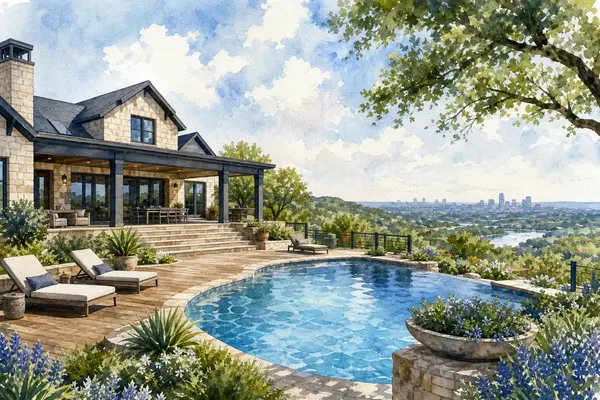
A dramatic home with a wall of glass and an infinity-edge pool may photograph beautifully, but the important questions are often outside the frame. How does water move across the site during heavy rain? What does it cost to maintain the pool, landscaping, private road, gates, guest house, and specialty systems? Can the well support the household and irrigation? Is the septic system properly sized? How far is the property from work, school, groceries, medical care, and emergency services?
I am Robbie English, Broker, REALTOR with Uncommon Realty. I have more than 40 years of real estate experience, and I teach real estate professionals across the country. My approach is simple. I would rather help you understand what you are buying than rush you toward a set of pretty photographs. Custom luxury real estate deserves patience, investigation, and a clear understanding of how the property will support your life after the closing.

TLDR: Custom Luxury Homes in Dripping Springs
- Luxury takes many forms: Buyers may find acreage estates, architect-designed homes, gated properties, modern Hill Country residences, equestrian compounds, and luxury homes in planned communities.
- The land matters as much as the house: Topography, drainage, trees, soil, wells, septic systems, access, and utility availability can significantly affect value and ownership.
- Custom construction requires deeper due diligence: Buyers should investigate architectural plans, permits, engineering, builders, warranties, specialty systems, and the quality of work behind the finishes.
- Commute and convenience vary widely: A property may have a Dripping Springs address while being farther from schools, medical care, groceries, and Austin employment centers than expected.
- Luxury ownership requires realistic budgeting: Pools, acreage, gates, landscaping, private roads, wells, septic systems, guest houses, and complex mechanical equipment all create ongoing maintenance responsibilities.
What Makes a Home Custom and Luxury?
The word custom is used pretty loosely in real estate marketing. A home is not necessarily custom simply because the original buyer selected flooring, countertops, paint colors, or cabinet hardware. A truly custom home is generally designed for a particular site, owner, lifestyle, or architectural vision.
That may involve an architect, residential designer, custom builder, engineers, landscape professionals, interior designers, and specialized trades. The home may be positioned to capture views, preserve trees, respond to the slope of the property, improve privacy, or create a seamless connection between indoor and outdoor living.
Luxury is equally personal. For one buyer, luxury means a large home with extensive entertaining space. For another, it means privacy, natural materials, quiet surroundings, and a modestly sized residence built with extraordinary attention to detail.
Common luxury features may include:
- Expansive Hill Country views
- Large acreage or private natural surroundings
- Architectural design created specifically for the site
- Natural stone, wood, steel, glass, and other high-quality materials
- Large kitchens with professional-grade appliances
- Butler’s pantries, prep kitchens, and oversized storage areas
- Dedicated offices, libraries, studios, or fitness rooms
- Guest suites or detached guest houses
- Resort-style pools, spas, cabanas, and outdoor kitchens
- Whole-home automation, audio, security, and lighting systems
- Wine storage, tasting rooms, media rooms, or game rooms
- Multi-car garages, workshops, motor courts, or recreational vehicle storage
- Equestrian facilities, barns, fenced pastures, or riding areas
- Solar systems, backup generators, water storage, and energy-management systems
- Carefully designed landscaping using native or drought-tolerant plants
The most important thing is not whether the listing calls the property custom or luxury. The real question is whether the design, construction, systems, land, and location justify the description and support the buyer’s needs.
What Is the Atmosphere Like in Dripping Springs?
Dripping Springs blends Hill Country scenery, rural roots, newer development, local businesses, schools, wedding venues, breweries, wineries, restaurants, and residential communities. Depending on the property, the atmosphere can range from private and rural to polished and master-planned.
Some buyers are drawn to established acreage properties with mature trees, winding drives, barns, workshops, and homes that have evolved over time. Others prefer newer luxury communities with underground utilities, planned amenities, architectural controls, paved streets, and a more consistent neighborhood appearance.
The area does not feel uniform, and that is part of its appeal. One property may sit behind a private gate on several acres. Another may be located in Headwaters with access to community trails, gathering spaces, and neighborhood amenities. A different buyer may prefer Caliterra, where the community setting and natural surroundings create another version of Hill Country living.
Buyers should understand that a peaceful atmosphere during a weekday showing may change on weekends or during local events. Properties near wedding venues, tasting rooms, recreation areas, event spaces, or growing commercial corridors may experience traffic, music, deliveries, lighting, or visitor activity.
The word private should also be tested. Acreage does not automatically guarantee privacy. Topography, neighboring homes, road placement, future development, tree cover, and building orientation all affect how private a property truly feels.
What Types of Custom Luxury Homes Are Available?
Custom luxury homes in the area can be divided into several broad categories. These categories overlap, but understanding them helps buyers compare properties more intelligently.
| Property Type | Typical Appeal | Important Buyer Considerations |
|---|---|---|
| Acreage estate | Privacy, views, room for additional structures, outdoor recreation | Well, septic, fencing, road access, maintenance, agricultural use, wildfire exposure |
| Modern Hill Country home | Clean lines, large windows, natural materials, indoor-outdoor living | Solar exposure, window performance, waterproofing, specialized materials, privacy |
| Traditional custom residence | Formal rooms, substantial masonry, larger bedrooms, established landscaping | Age of systems, renovation quality, energy efficiency, maintenance |
| Luxury home in a planned community | Neighborhood amenities, paved roads, design standards, community identity | Association dues, architectural rules, building timelines, lot premiums, future phases |
| Equestrian property | Barns, pastures, riding facilities, animal use, additional storage | Fencing, water, soil, drainage, feed storage, road access, deed restrictions |
| Multi-generational estate | Guest house, separate suite, multiple living areas, privacy for extended family | Permits, utilities, septic capacity, accessibility, shared expenses, resale appeal |
| New custom build | Design control, new systems, site-specific planning, personalized finishes | Builder contract, allowances, financing, construction risk, delays, warranties |
The best category depends on how the buyer plans to live. Someone who wants a turnkey residence may not enjoy managing a lengthy custom build. A buyer who wants horses may find a beautifully finished planned-community home unsuitable because of restrictions. A household seeking privacy may prefer acreage, while another may value community amenities and organized maintenance.
What Architectural Styles Are Common?
The most recognizable architectural style is often called modern Hill Country. These homes may combine limestone, stucco, steel, wood, standing-seam metal roofing, large windows, simple rooflines, and expansive outdoor spaces.
Traditional Hill Country homes may use heavier masonry, pitched roofs, exposed timber, covered porches, fireplaces, and warm interior finishes. Mediterranean-inspired homes, transitional residences, ranch homes, farmhouse designs, contemporary structures, and highly individual architectural concepts can also be found.
Buyers should look beyond style and evaluate function. Large glass walls can create beautiful views but may affect heat gain, privacy, glare, window treatments, and energy use. Flat or low-slope roofs may suit a modern design but require excellent drainage and waterproofing. Natural wood siding can be beautiful but may require ongoing sealing or refinishing.
Stone is often associated with durability, but the installation, flashing, drainage plane, mortar, transitions, and underlying wall system matter. The visible material is only one part of the building assembly.
Architecture should also respond to the site. A home that works beautifully on level land may not function the same way on a steep Hill Country slope. Retaining walls, foundation design, drainage, driveway grade, exterior stairs, and access for emergency vehicles all deserve attention.
How Should Buyers Evaluate Pricing?
Pricing a custom luxury home is more complex than comparing bedroom count and square footage. The value may be influenced by architecture, builder reputation, quality of materials, land size, views, privacy, guest accommodations, pool design, water systems, landscaping, road access, neighborhood, and proximity to services.
Two homes of similar size may carry very different values because one has superior views, better land, more thoughtful architecture, stronger construction documentation, or a more desirable location. Another may include a guest house, extensive outdoor living, a workshop, equestrian improvements, or a professionally designed landscape.
Buyers should be cautious when relying only on price per square foot. That calculation may fail to account for acreage, pools, detached structures, landscaping, hardscape, private utilities, gates, roads, retaining walls, and high-end specialty systems.
Some luxury features are expensive to build but may not return their full original cost at resale. A specialized wine cellar, indoor sports court, elaborate home theater, oversized workshop, or unusual architectural feature may be deeply valuable to the owner who created it but less important to future buyers.
The purchase decision should include more than the mortgage payment. Buyers should estimate:
- Property taxes
- Homeowners insurance
- Possible additional coverage for pools, guest houses, barns, or specialty structures
- Homeowners association dues
- Private road maintenance
- Well inspections, treatment, pumping equipment, and repairs
- Septic inspection, pumping, maintenance, and eventual replacement
- Pool service, repairs, heating, water, and electricity
- Landscaping, tree care, irrigation, and pest control
- Gate, fence, driveway, and exterior lighting maintenance
- Generator, solar, battery, water storage, and smart-home system service
- Guest house, barn, workshop, and outbuilding maintenance
A mortgage calculator can help estimate financing, but luxury buyers should also develop a realistic annual ownership budget. The question is not only whether you can purchase the property. The better question is whether you can comfortably operate and maintain it.
What Should Buyers Know About Acreage?
Acreage can provide privacy, views, room for animals, gardens, trails, workshops, and future improvements. It can also create responsibilities that buyers moving from a city lot may not fully anticipate.
Walk the property rather than viewing it only from the house or driveway. Study the slope, tree cover, rock outcroppings, drainage channels, fences, neighboring uses, utility lines, easements, and road frontage.
Some acreage is highly usable. Other land may be steep, rocky, heavily wooded, flood-prone, difficult to access, or limited by easements and environmental considerations. Ten acres on paper does not necessarily mean ten acres that can be easily used.
Buyers should ask:
- Where are the exact property boundaries?
- Is there a current survey?
- Are there access, utility, drainage, conservation, or pipeline easements?
- How much of the land is level and usable?
- Are fences located on the actual boundary lines?
- Who maintains private roads or shared gates?
- Are there deed restrictions affecting animals, businesses, additional structures, or subdivision?
- Does the property have an agricultural valuation, and what would affect it?
- Are there protected trees or sensitive natural features?
- Could nearby land be developed in the future?
A survey is essential, but it does not replace walking the property with appropriate professionals. Buyers considering construction, horses, agricultural use, or additional structures may need input from engineers, builders, septic professionals, well specialists, land planners, or other qualified experts.
What Should Buyers Know About Wells?
Some custom luxury properties rely on private wells. A well can provide independence from a public water system, but it also places responsibility for water quality, pumping equipment, storage, treatment, maintenance, and repairs on the property owner.
Buyers should not assume that water coming from a faucet means the well is sufficient. A professional well evaluation may include reviewing records, inspecting visible equipment, testing flow, evaluating pressure, checking storage, and testing water quality.
Important questions include:
- How deep is the well?
- When was it drilled?
- What is the known production or flow rate?
- Has production changed over time?
- Is there a storage tank?
- What treatment systems are installed?
- How old are the pump and pressure equipment?
- Does the well serve irrigation, a pool, guest house, barn, or multiple residences?
- Are there shared-well agreements?
- Are maintenance and water-testing records available?
Water quality can vary. Treatment systems may address minerals, hardness, sediment, odor, bacteria, or other conditions. Buyers should understand what the system treats, how often filters or media must be replaced, and what ongoing service costs may be required.
A well should also be evaluated in relation to the property’s demand. A large household, extensive landscaping, pool evaporation, animals, guest accommodations, and outdoor uses can create substantial water needs.
What Should Buyers Know About Septic Systems?
Many acreage and luxury properties use private septic systems. The septic system is not simply a tank in the yard. It is a complete wastewater treatment and dispersal system that must be properly designed, installed, maintained, and matched to the home.
Buyers should determine the type of system, permitted capacity, service history, location, age, maintenance requirements, and whether additions or guest accommodations are included in the approved design.
An aerobic system may require ongoing service, electricity, alarms, treatment components, and spray-field maintenance. A conventional system may have different inspection and maintenance needs. The property’s soil, topography, vegetation, drainage, and available area can affect system design.
Luxury homes with many bedrooms, guest houses, pool bathrooms, or additional living spaces require careful review. An advertised bedroom count does not automatically mean the septic system was designed for that level of occupancy.
Before closing, buyers should obtain appropriate inspections and review available permits and maintenance records. They should also understand where the system is located so they do not unknowingly plan a pool, driveway, addition, sport court, landscaping project, or accessory structure over required components or reserve areas.
How Important Are Drainage and Topography?
Drainage and topography are among the most important issues in Hill Country real estate. A sloped property can create extraordinary views and architectural opportunities, but it can also involve retaining walls, erosion, steep driveways, drainage channels, foundation complexity, and greater construction costs.
Buyers should visit during or after rain when possible. Look for:
- Water moving toward the home
- Erosion around foundations, roads, or landscaping
- Standing water
- Damaged or inadequate gutters and downspouts
- Retaining-wall movement or staining
- Drainage pipes that discharge improperly
- Washouts along gravel or private roads
- Pool-deck movement
- Water intrusion in lower-level rooms
- Moisture beneath pier-and-beam sections
Large retaining walls should be evaluated carefully. Ask for engineering records, permits, construction details, drainage design, and repair history. A wall may look decorative while performing a critical structural function.
Driveways deserve similar attention. A steep driveway may be manageable in dry weather but difficult for low vehicles, trailers, delivery trucks, emergency access, or guests. Curves, drainage crossings, gates, and sight distance can affect daily use.
How Should Buyers Evaluate Construction Quality?
High-end finishes can distract buyers from construction fundamentals. A beautifully staged home with designer lighting and luxury appliances may still have problems with flashing, drainage, insulation, mechanical systems, structural movement, waterproofing, roofing, or window installation.
Custom homes can be more complicated to inspect because they often include unusual designs, multiple rooflines, specialty materials, integrated outdoor spaces, advanced automation, complex pools, and extensive site work.
Buyers should consider inspections and evaluations appropriate to the property, including:
- General home inspection
- Structural or foundation evaluation when concerns exist
- Roof inspection
- Pool and spa inspection
- Well evaluation and water-quality testing
- Septic inspection
- Wood-destroying insect inspection
- Heating, cooling, and indoor air-quality evaluation
- Sewer or drain-line inspection when applicable
- Chimney and fireplace inspection
- Generator, solar, battery, and energy-system review
- Smart-home and security system demonstration
- Elevator inspection when applicable
- Gate, access-control, and intercom evaluation
- Landscape irrigation and water-feature inspection
Buyers should also request plans, permits, engineering reports, builder information, warranties, service records, repair invoices, equipment manuals, and documentation for major improvements.
What Should Buyers Know About New Custom Construction?
Building a custom home can be rewarding, but it is not simply a longer version of buying a completed house. It is a major construction project involving land, design, engineering, budgeting, selections, financing, scheduling, and risk.
The first decision is the site. Buyers should not purchase land based only on views or location. The buildability of the lot can be affected by topography, soil, rock, drainage, access, trees, utility availability, well potential, septic feasibility, setbacks, impervious-cover limits, deed restrictions, and architectural requirements.
Before committing to land, buyers may need preliminary input from:
- A custom builder
- An architect or residential designer
- A civil or structural engineer
- A surveyor
- A geotechnical professional
- A septic designer
- A well specialist
- A utility provider
- A landscape architect
- An insurance professional
- A construction lender
The builder contract deserves careful review. Buyers should understand the base price, allowances, change-order procedures, escalation clauses, construction timeline, payment schedule, warranties, insurance, dispute procedures, site costs, landscaping, utility work, and what is not included.
Allowances can create surprises. A contract may include amounts for flooring, plumbing fixtures, appliances, lighting, cabinets, landscaping, or other selections. If the buyer chooses items above the allowance, the budget can increase quickly.
Site work is another common source of cost. Excavation, rock removal, retaining walls, drainage, long driveways, utility extensions, wells, septic systems, gates, fencing, and landscaping may not be fully known until design and construction are underway.
Buyers should build a contingency into the budget and avoid using every available dollar for the original contract price. Custom construction often includes decisions and changes that increase the final cost.
What Should Buyers Know About Builders?
A builder’s reputation matters, but reputation should be verified. Buyers should evaluate experience with similar homes, financial stability, communication, warranty service, project management, subcontractors, and the quality of completed work.
Ask for references from recent clients and, when possible, clients whose homes are several years old. A newly completed home may look wonderful. Older projects reveal more about long-term performance and warranty response.
Questions for a builder may include:
- How many projects do you manage at one time?
- Who will supervise the site daily?
- How are changes documented and priced?
- How are delays communicated?
- What insurance does the builder carry?
- Who owns the plans?
- What warranties are provided?
- How are warranty requests handled after closing?
- Which subcontractors are used regularly?
- How are draw requests supported?
- What allowances are included?
- What site costs are excluded?
- How are material-price increases handled?
Buyers should also consider independent inspections during construction. Common inspection stages may include foundation preparation, framing and mechanical rough-ins, insulation, final completion, and warranty-period review.
What Is Walkability Like?
Walkability varies widely. A luxury home in a planned community may have access to sidewalks, trails, neighborhood parks, gathering spaces, and amenities. An acreage property may provide private walking paths but require driving for nearly every errand.
Most buyers should expect to use a vehicle for groceries, dining, school, medical appointments, and commuting. Even when a destination appears close on a map, roads may lack sidewalks, shoulders, lighting, or comfortable pedestrian crossings.
Buyers who prioritize urban walkability may prefer Central Austin, Downtown Austin, or established neighborhoods with nearby commercial districts. Buyers choosing Dripping Springs are often prioritizing land, scenery, privacy, outdoor living, or community amenities rather than the ability to walk to every daily destination.
Within a planned neighborhood, walk the route from the home to trails, pools, parks, mailboxes, schools, or gathering areas. Hills, distance, sun exposure, traffic, and construction can affect how often those amenities are realistically used.
What Restaurants and Local Conveniences Are Nearby?
The area includes local restaurants, coffee shops, breweries, wineries, tasting rooms, markets, grocery options, event venues, and everyday services. Some buyers appreciate the local Hill Country character and the ability to enjoy dining and entertainment without driving into central Austin.
Still, convenience depends on the property’s location. A home with a Dripping Springs mailing address may be several miles from the commercial core, schools, medical care, or preferred grocery stores.
Before buying, map the places your household uses regularly:
- Grocery stores
- Pharmacies
- Primary medical care
- Emergency care
- Veterinary services
- Schools and childcare
- Restaurants and coffee shops
- Fitness facilities
- Places of worship
- Workplaces
- Airport routes
- Home-improvement stores
A property can feel wonderfully secluded during a showing, but repeated trips for school, sports, groceries, and appointments may affect daily satisfaction. Luxury should make life better, not create a routine that feels burdensome.
What Parks and Outdoor Activities Are Available?
Outdoor living is one of the area’s strongest attractions. Buyers may enjoy private land, community trails, neighborhood parks, swimming, cycling, hiking, gardening, wildlife viewing, and access to Hill Country recreation.
Luxury homes often include substantial outdoor improvements. These may include:
- Covered patios
- Outdoor kitchens
- Fireplaces and fire pits
- Pools and spas
- Cabanas
- Sport courts
- Putting greens
- Gardens
- Walking trails
- Observation decks
- Guest houses
- Barns and riding areas
Every feature brings maintenance. Buyers should inspect pool equipment, drainage, decking, retaining walls, outdoor appliances, lighting, irrigation, fencing, and landscape systems.
Outdoor kitchens should be evaluated for weather exposure, gas connections, electrical safety, drainage, ventilation, and appliance condition. Fire features should be reviewed in relation to local conditions, nearby vegetation, burn restrictions, and insurance.
Native landscaping can reduce water demand and support the Hill Country setting, but even drought-tolerant landscapes require establishment, maintenance, pruning, and weed control. Extensive turf, gardens, or ornamental landscaping may create substantial water and labor demands.
How Should Buyers Evaluate Schools?
School assignments should be verified for the exact property address. Do not assume every home with a Dripping Springs mailing address is assigned to the same schools or even the same district.
Families should verify attendance zones directly with the appropriate school district and investigate the educational factors that matter to them. Those may include transportation, extracurricular activities, special education services, advanced coursework, arts, athletics, campus location, and future planning.
Online ratings provide limited information and may not reflect a family’s priorities. Buyers should use official resources, visit campuses when permitted, speak with district personnel, and make their own educational decisions.
School travel time also matters. A rural or acreage property may require a longer drive to school, extracurricular activities, childcare, or sports practices. Bus routes, road conditions, and after-school transportation should be considered as part of the location decision.
What Is the Commute Like?
The commute can vary significantly depending on the home’s location and the buyer’s destination. Some properties provide relatively direct access toward Austin. Others may involve winding roads, two-lane routes, school traffic, construction, or longer distances before reaching a major corridor.
Buyers commuting toward Downtown Austin, Southwest Austin, Northwest Austin, or North Austin should test routes during the hours they expect to travel.
Remote and hybrid workers may find the area especially appealing because they can enjoy acreage, views, and privacy without making a daily peak-hour commute. Still, remote workers should confirm internet service, cellular coverage, electrical reliability, backup power, and suitable office space.
| Work Pattern | Potential Advantage | Important Consideration |
|---|---|---|
| Remote work | More flexibility to enjoy privacy and acreage | Internet, power reliability, cellular service, office design |
| Hybrid schedule | Reduced exposure to daily traffic | Test commute on required office days |
| Daily central Austin commute | Hill Country lifestyle outside working hours | Travel time, fuel, school schedules, road congestion |
| Work in Southwest Austin | May provide a more manageable route depending on location | Exact property access and peak traffic |
| Home-based business | Potential space for office, studio, workshop, or storage | Deed restrictions, permits, parking, customer traffic |
| Frequent air travel | Privacy and lifestyle benefits between trips | Airport travel time and route reliability |
Who Is Best Suited for Custom Luxury Living?
Custom luxury properties may be a strong fit for buyers who value privacy, architectural quality, acreage, outdoor living, guest accommodations, home offices, workshops, or room for hobbies and animals.
They may also appeal to executives, entrepreneurs, remote professionals, multi-generational households, retirees, creative professionals, equestrian buyers, and families who want space without giving up access to the Austin area.
Different property types suit different buyers:
| Buyer Profile | Potentially Suitable Property | Possible Tradeoff |
|---|---|---|
| Privacy-focused buyer | Gated acreage estate | Maintenance, commute, private utilities |
| Design-focused buyer | Architect-designed modern home | Specialized materials and maintenance |
| Family seeking amenities | Luxury home in a planned community | Association rules, dues, smaller lot |
| Equestrian buyer | Fenced acreage with barn and water access | Animal care, fencing, land management |
| Multi-generational household | Estate with guest house or private suite | Permits, utilities, accessibility, resale audience |
| Custom-build buyer | Buildable lot with qualified design team | Time, cost uncertainty, construction management |
| Turnkey luxury buyer | Completed newer custom residence | Less control over design and selections |
This lifestyle may be less suitable for buyers who want complete maintenance simplicity, immediate urban walkability, a short commute to every central destination, or predictable utility and landscaping costs.
A buyer who loves the appearance of acreage but dislikes land maintenance may be happier in a planned luxury community. A buyer who wants complete architectural control may find a completed residence too limiting. The best fit comes from being honest about how much responsibility, privacy, customization, and maintenance you truly want.
How Do Planned Luxury Communities Compare With Acreage?
Planned luxury communities and independent acreage estates offer different versions of Hill Country living.
| Feature | Planned Luxury Community | Independent Acreage Estate |
|---|---|---|
| Roads and infrastructure | Often maintained through public entities or an association | May include private roads, shared maintenance, wells, and septic systems |
| Architectural control | Usually governed by design standards | May offer more flexibility, subject to restrictions and regulations |
| Amenities | May include pools, trails, parks, fitness spaces, and gathering areas | Private amenities must be created and maintained by the owner |
| Privacy | Varies by lot size and community design | Potentially greater, depending on land and neighboring uses |
| Maintenance responsibility | Some common areas maintained collectively | Owner generally manages the entire property |
| Future construction | May involve additional neighborhood phases | Nearby land could still be developed unless protected |
| Community interaction | More opportunities for organized neighborhood activity | May feel more private and independent |
Neither option is automatically better. A buyer who wants privacy and flexibility may prefer independent acreage. A household that values trails, neighborhood amenities, paved streets, and a defined community may prefer a planned setting.
What Should Buyers Know About Insurance?
Luxury properties require property-specific insurance research. A standard online estimate may not account for acreage, guest houses, barns, pools, extensive landscaping, specialty materials, home automation, generators, solar systems, private roads, or wildfire exposure.
Buyers should obtain quotes before contractual deadlines and provide the insurer with accurate information about all structures and systems.
Questions may include:
- What replacement-cost assumptions are being used?
- Are detached structures fully covered?
- How are pools, gates, barns, workshops, and guest houses treated?
- Is additional liability coverage appropriate?
- Are specialty roofing or exterior materials covered adequately?
- Does the policy address water backup, equipment breakdown, or service lines?
- Are there wildfire-related requirements?
- Is flood insurance recommended or required?
- How are solar panels, batteries, and generators covered?
- Would a larger umbrella policy be appropriate?
Luxury homeowners may also need to document finishes, appliances, furnishings, art, wine, jewelry, equipment, and other high-value personal property separately.
What Should Buyers Know About Wildfire Risk?
Hill Country vegetation, dry conditions, wind, terrain, and road access can create wildfire concerns. Buyers should not panic, but they should investigate the property carefully.
Evaluate vegetation near the home, access for emergency vehicles, driveway width, water availability, roofing materials, vents, decks, fencing, propane tanks, generators, and the maintenance of nearby land.
Defensible-space planning may include managing vegetation, removing dead material, trimming trees, maintaining access, and selecting appropriate landscaping near structures. Buyers should seek guidance from qualified professionals and local authorities regarding property-specific risk and maintenance.
Insurance availability and requirements should also be investigated early. Do not wait until shortly before closing to discover that coverage is difficult or expensive.
What Should Buyers Know About Pools and Outdoor Living?
A pool can be one of the most appealing features of a luxury property, especially when it is designed around a view. It can also be one of the most expensive systems to repair.
A pool inspection should evaluate:
- Surface condition
- Decking and movement
- Equipment age
- Pumps and filters
- Heaters and chillers
- Automation
- Lighting
- Water features
- Leaks
- Drainage
- Safety barriers
- Infinity-edge or catch-basin systems
- Retaining walls and structural support
Buyers should ask for service records, repair invoices, equipment manuals, warranties, and information about normal operating costs.
Outdoor living spaces should also be evaluated for waterproofing, roof drainage, gas lines, electrical systems, appliance condition, smoke control, lighting, and protection from weather.
What Should Buyers Know About Smart-Home Systems?
Luxury homes may include centralized lighting, audio, climate control, security, shades, pool management, irrigation, access control, and energy monitoring. These systems can be convenient, but they can also become complicated when equipment ages or the original installer is unavailable.
Buyers should request:
- A complete system demonstration
- All usernames, passwords, licenses, and transfer instructions
- Installer and service-provider information
- Equipment lists
- Network diagrams when available
- Warranties and service records
- Confirmation that subscriptions can be transferred
- Information about obsolete components
A home may have impressive wall-mounted controls that no longer communicate properly with the underlying system. Test the features rather than assuming they work because they appear in the listing.
What Is the Long-Term Appreciation Potential?
No real estate professional can guarantee appreciation. Luxury properties are influenced by employment, financing conditions, buyer demand, insurance, taxes, construction costs, infrastructure, schools, local services, land availability, and broader economic conditions.
Custom luxury homes may benefit from features that are difficult to reproduce, including exceptional views, usable acreage, privacy, thoughtful architecture, mature landscaping, guest accommodations, quality construction, and convenient access.
However, highly specialized properties can have a narrower resale audience. A home designed around one owner’s unusual preferences may take longer to match with a future buyer. Extremely large homes, unconventional layouts, specialized hobby spaces, remote locations, or maintenance-intensive improvements may limit demand.
Properties with functional layouts, strong construction documentation, quality materials, manageable systems, useful outdoor space, reliable water, practical access, and broad lifestyle appeal may be easier for future buyers to understand.
Buy because the property fits your budget and life. Treat appreciation as a potential long-term benefit, not a promise.
Common Buyer Mistakes
- Falling in love with the view before evaluating the land: Topography, drainage, access, retaining walls, and usable acreage may matter more than the photograph.
- Assuming luxury finishes equal quality construction: Designer materials cannot compensate for poor waterproofing, drainage, structural work, or mechanical installation.
- Skipping well and septic inspections: Private systems require independent evaluation, records, and long-term maintenance planning.
- Underestimating annual maintenance: Pools, acreage, landscaping, gates, roads, barns, guest houses, and automation systems create ongoing costs.
- Failing to test the commute: A peaceful drive during a weekend showing may be very different on a weekday morning.
- Ignoring internet and cellular service: Remote work, security, smart-home systems, and emergency communication may depend on reliable connectivity.
- Assuming acreage can be divided or developed: Restrictions, access, utilities, septic requirements, topography, and regulations may limit future plans.
- Not reviewing construction records: Buyers should request permits, plans, engineering reports, warranties, repair invoices, and equipment documentation.
- Buying land before confirming buildability: Views do not guarantee that the intended home can be built within the buyer’s budget.
- Underestimating site costs: Rock excavation, retaining walls, driveways, utilities, drainage, wells, septic systems, and landscaping can add substantial expense.
- Failing to investigate nearby uses: Wedding venues, commercial development, subdivisions, roads, and event spaces may affect traffic, noise, and privacy.
- Assuming new construction does not need inspection: New custom homes should be inspected during appropriate stages and before closing.
- Using all available cash for the purchase: Buyers should preserve reserves for repairs, maintenance, furnishings, landscaping, and unexpected expenses.
- Relying only on price per square foot: Land, views, architecture, detached structures, pools, systems, and construction quality require deeper analysis.
- Buying for predicted appreciation: A custom luxury property should make financial and lifestyle sense under changing market conditions.
What Due Diligence Should Buyers Complete?
- Review the seller’s disclosure and all available repair documentation.
- Obtain a current survey and understand boundaries, easements, access, and encroachments.
- Hire inspectors experienced with custom and acreage properties.
- Evaluate the foundation, roof, drainage, retaining walls, plumbing, electrical system, and heating and cooling equipment.
- Inspect the well and test water quality when applicable.
- Inspect the septic system and review permits and maintenance records.
- Evaluate pools, spas, outdoor kitchens, fireplaces, and water features.
- Review guest houses, barns, workshops, and additional structures.
- Obtain property-specific insurance quotes.
- Investigate flood, drainage, wildfire, and environmental considerations.
- Review deed restrictions and homeowners association documents.
- Confirm utility providers, internet service, cellular coverage, and backup systems.
- Review permits, plans, engineering reports, warranties, and service records.
- Verify school assignments directly with the school district.
- Test commute routes during normal travel hours.
- Research nearby development, road projects, event venues, and commercial uses.
- Evaluate landscaping, trees, irrigation, fencing, and land-maintenance needs.
- Confirm the ownership and transfer of smart-home systems, subscriptions, and equipment.
- Review agricultural valuation requirements when applicable.
- Consult qualified professionals before relying on future renovation, subdivision, or construction plans.
How Should Buyers Prepare Financially?
Luxury buyers should begin with a complete financial picture. A lender’s approval is only one part of the decision. Buyers should consider liquidity, reserves, future improvements, maintenance, furnishings, insurance, and the cost of operating the property.
Those seeking financing can learn more about how to get preapproved. Buyers planning a custom build should also investigate construction lending, draw schedules, interest reserves, appraisal procedures, contingency requirements, and the transition to permanent financing.
Before making an offer, prepare estimates for:
- Down payment
- Closing costs
- Inspections and professional evaluations
- Immediate repairs
- Furniture and window treatments
- Landscaping or fencing
- Pool or outdoor improvements
- Technology upgrades
- Generator or water-storage improvements
- Annual maintenance reserves
A luxury home should enhance the buyer’s life. It should not create constant financial pressure because the operating costs were underestimated.
How Should Buyers Search for the Right Property?
Start with lifestyle, not finishes. Determine how much land you want, how private the property must be, how far you are willing to commute, whether you want a neighborhood association, and how much maintenance you can manage.
Separate requirements from preferences. Requirements may include one-story living, a guest house, school access, a home office, a workshop, reliable internet, or room for horses. Preferences may include a wine room, dramatic pool, designer appliances, or a specific architectural style.
Buyers can use the home search to monitor available properties and review the broader Dripping Springs real estate page. Buyers may also explore Off Market representation when appropriate, although private opportunities are never guaranteed.
The Closely app can help buyers stay connected to property information and the transaction process.
When a promising property appears, evaluate both the residence and the site. Luxury buyers should not feel rushed into overlooking private utilities, land conditions, construction records, insurance, or long-term maintenance.
Frequently Asked Questions About Custom Luxury Homes
What qualifies as a custom luxury home in Dripping Springs?
A custom luxury home is generally designed for a particular site, owner, or architectural vision rather than built from a standard production plan. Luxury may include acreage, privacy, views, high-quality materials, guest accommodations, extensive outdoor living, specialty rooms, and advanced home systems.
Are most luxury homes on acreage?
No. Buyers may find acreage estates as well as luxury homes in planned communities. Planned neighborhoods may offer trails, pools, gathering spaces, maintained common areas, and architectural standards, while independent acreage may provide more privacy and flexibility.
Do custom homes require different inspections?
Custom homes often benefit from broader inspections because they may include specialized architecture, pools, wells, septic systems, retaining walls, guest houses, barns, generators, solar systems, automation, and other complex features.
Should I inspect a brand-new custom home?
Yes. New construction can still have structural, drainage, roofing, electrical, plumbing, insulation, waterproofing, mechanical, or finish concerns. Independent inspections during construction and before closing can provide valuable information.
What should I know about buying a home with a well?
Buyers should investigate well depth, age, production, pump equipment, storage, treatment systems, water quality, service history, and whether the well can support the household, landscaping, pool, animals, and additional structures.
What should I know about septic systems?
Review the type, age, permitted capacity, service history, location, maintenance requirements, and whether the system is properly sized for all bedrooms, guest accommodations, and additional living spaces.
How much maintenance does an acreage estate require?
Maintenance depends on land size, vegetation, fencing, roads, gates, drainage, water systems, pools, barns, guest houses, and landscaping. Buyers should create an annual ownership budget before purchasing.
Can I build a guest house or additional structure?
Possibly, but buyers should verify deed restrictions, association rules, setbacks, utilities, septic capacity, access, impervious cover, drainage, permitting, and other property-specific limitations before relying on future construction plans.
Can I keep horses on a luxury property?
That depends on the acreage, fencing, water, soil, barns, deed restrictions, neighborhood rules, access, and suitability of the land. Buyers should confirm animal-use requirements before purchasing.
Is a planned luxury community better than independent acreage?
Neither is automatically better. Planned communities may provide amenities, maintained common areas, paved streets, and architectural standards. Independent acreage may offer more privacy, flexibility, and room for animals or additional structures.
How important is internet service?
Internet service is essential for many remote workers, security systems, smart-home technology, entertainment, and communication. Buyers should confirm available providers, speed, reliability, equipment, and backup options for the exact property.
How should I evaluate a private road?
Review ownership, maintenance agreements, repair responsibilities, gate access, drainage, width, surface condition, emergency access, and whether costs are shared with neighboring owners.
Are luxury homes harder to insure?
Insurance depends on the property’s construction, location, replacement cost, wildfire exposure, pools, detached structures, specialty materials, and other features. Buyers should obtain property-specific quotes early in the transaction.
What should I know about Hill Country drainage?
Buyers should evaluate slopes, runoff, retaining walls, erosion, driveway drainage, roof water management, lower-level spaces, and how water moves across the site during heavy rain.
Can I subdivide an acreage property later?
Subdivision may be limited by deed restrictions, access, utilities, septic requirements, topography, regulations, minimum lot sizes, and other conditions. Buyers should obtain professional guidance before assuming land can be divided.
Are luxury homes in Dripping Springs walkable?
Walkability varies. Planned communities may have trails and neighborhood amenities, while acreage properties generally require driving for groceries, restaurants, schools, medical care, and employment.
How should buyers compare custom luxury properties?
Compare architecture, construction quality, land, views, privacy, utilities, access, detached structures, pools, maintenance, insurance, documentation, commute, and total ownership costs rather than relying only on square footage or price per square foot.
What records should I request from the seller?
Request plans, surveys, permits, engineering reports, warranties, repair invoices, well and septic records, pool records, equipment manuals, builder information, service agreements, and documentation for major systems and improvements.
Does a custom luxury home have strong appreciation potential?
Exceptional land, views, architecture, location, and construction may support future buyer interest, but appreciation is never guaranteed. Highly specialized homes can also have a narrower resale audience.
Should I buy land and build or purchase a completed home?
Building provides greater design control but involves time, budgeting, site risk, construction management, and potential delays. A completed home offers greater certainty and immediate use but may require compromises in design or location.
Is a Custom Luxury Home Right for You?
A custom luxury home can offer a lifestyle that is hard to reproduce. You may have room for family, guests, work, hobbies, animals, gardens, entertaining, and quiet evenings under a Hill Country sky. You may find architecture that responds beautifully to the land and a property that feels personal rather than mass produced.
That lifestyle comes with responsibility. Acreage, wells, septic systems, pools, roads, gates, retaining walls, guest houses, barns, landscaping, and advanced home systems require money, planning, and maintenance.
The right property is not simply the largest home or the most dramatic listing. It is the one that fits your daily routine, finances, maintenance tolerance, commute, design preferences, and long-term plans.
Again, I am Robbie English, Broker, REALTOR with Uncommon Realty. With more than 40 years in real estate and experience teaching professionals nationwide, I believe luxury buyers deserve careful education, thoughtful representation, and enough time to understand the property before making a decision.
When you are ready to explore buying a home in the Hill Country, visit my contact page. We can discuss acreage, communities, builders, architecture, utilities, maintenance, commuting, and the type of luxury lifestyle you want the property to support.
Categories
- All Blogs (970)
- !!! (59)
- !x (621)
- Austin Real Estate (113)
- Bee Cave Real Estate (1)
- Building A Home (14)
- Buying A Home (143)
- Buying Land (1)
- Cedar Park Real Estate (58)
- Central Austin Real Estate (75)
- Down Payment Assistance Programs (1)
- Downsizing (4)
- Downtown Austin Real Estate (5)
- Dripping Springs Real Estate (62)
- East Austin Real Estate (3)
- Financing and Mortgage (24)
- first-time homebuying (109)
- Georgetown Real Estate (9)
- Hill Country Real Estate (1)
- HOA (2)
- Home Appraisals (13)
- Home For Rent (1)
- Home Inspections (6)
- Home Pricing (6)
- Home Staging (1)
- Home Values (12)
- Homeownership (1)
- Homes For Rent (1)
- Homes For Sale (147)
- Hutto Real Estate (5)
- Investing (6)
- Investment Properties (4)
- Lakeway Real Estate (33)
- Leander Real Estate (59)
- LGBT+ Real Estate (8)
- Luxury Homes For Sale (5)
- Luxury Real Estate (19)
- Market Conditions (17)
- Moving to Austin (2)
- Moving to Texas (4)
- Negotiations (3)
- Neighborhoods (8)
- Northwest Austin Real Estate (94)
- Off Market Listings (7)
- Pflugerville Real Estate (10)
- Private Listings (2)
- Property Management (42)
- Property Tax (3)
- Real Estate (18)
- Reddit Question Answered (80)
- redwrite (63)
- Relocation (2)
- Renting (6)
- Representation (34)
- Round Rock Real Estate (59)
- Selling Your Home (62)
- South Austin Real Estate (1)
- Westlake Real Estate (3)
Recent Posts