
Home Buying Process 2026 Step By Step Guide For First-Time Buyers
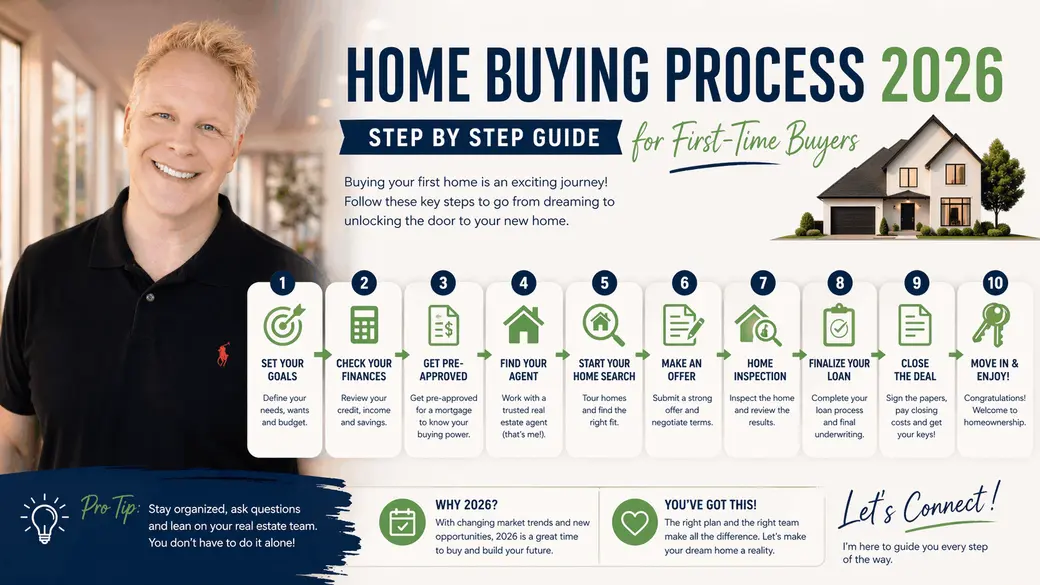
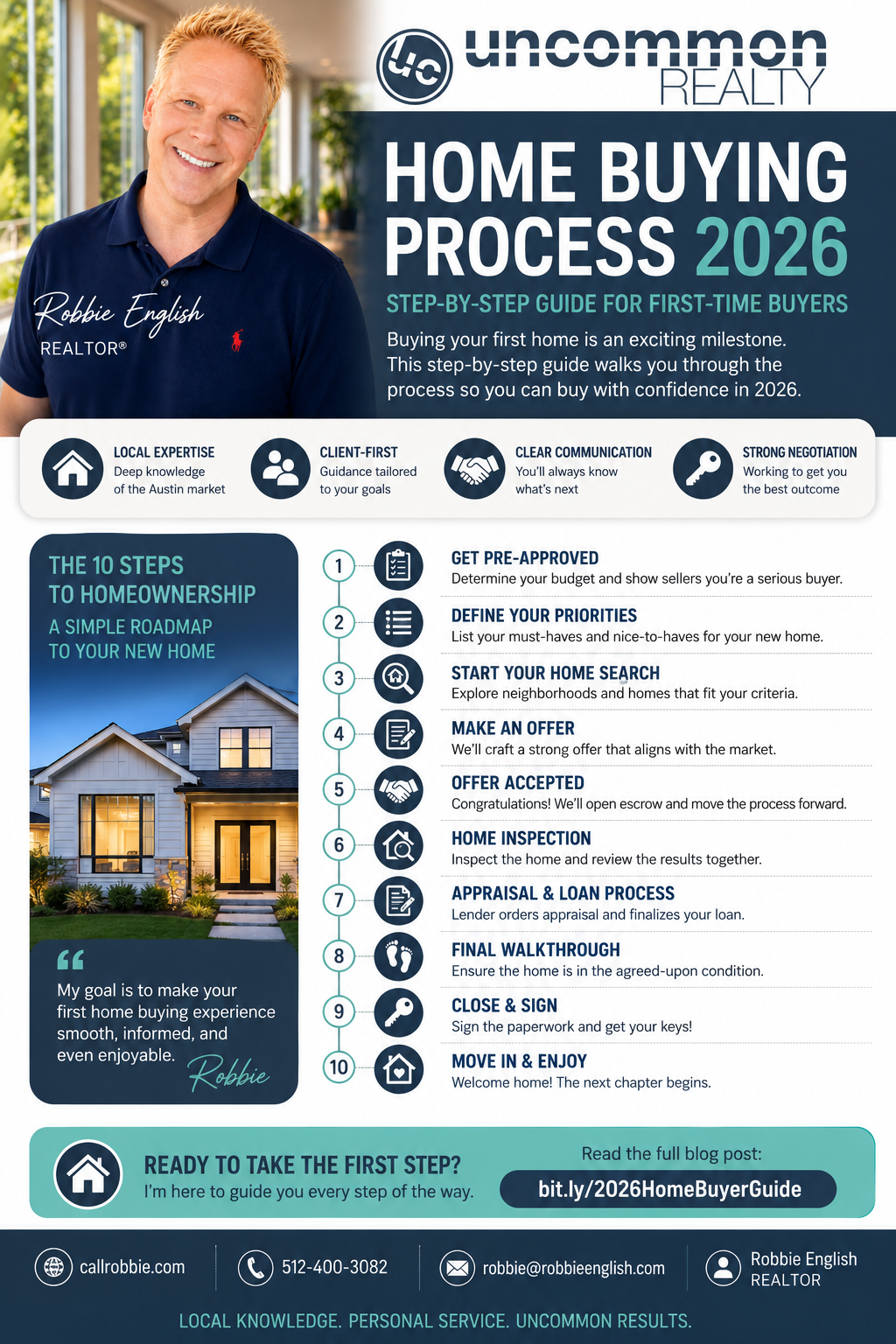
Buying your first home is one of the largest financial decisions you will ever make, and doing it in 2026 comes with its own set of conditions worth understanding. The good news for first-time buyers is that the Austin market has shifted in your favor compared to the frenzy of a few years ago, with more inventory, more time to make decisions, and more room to negotiate. The challenge is that the process itself, from financing to closing, still has real steps that trip up unprepared buyers. This is a straightforward, step-by-step walk through that process, written specifically for people doing it for the first time. I am Robbie English, Broker, REALTOR at Uncommon Realty, and I have guided many first-time buyers through it here in Austin, TX.
If you are at the very beginning and mostly wondering how to take the first step at all, I wrote a companion piece answering exactly that question in how do I start the home buying process as a first-time buyer. This guide picks up from there and takes you through the whole journey.
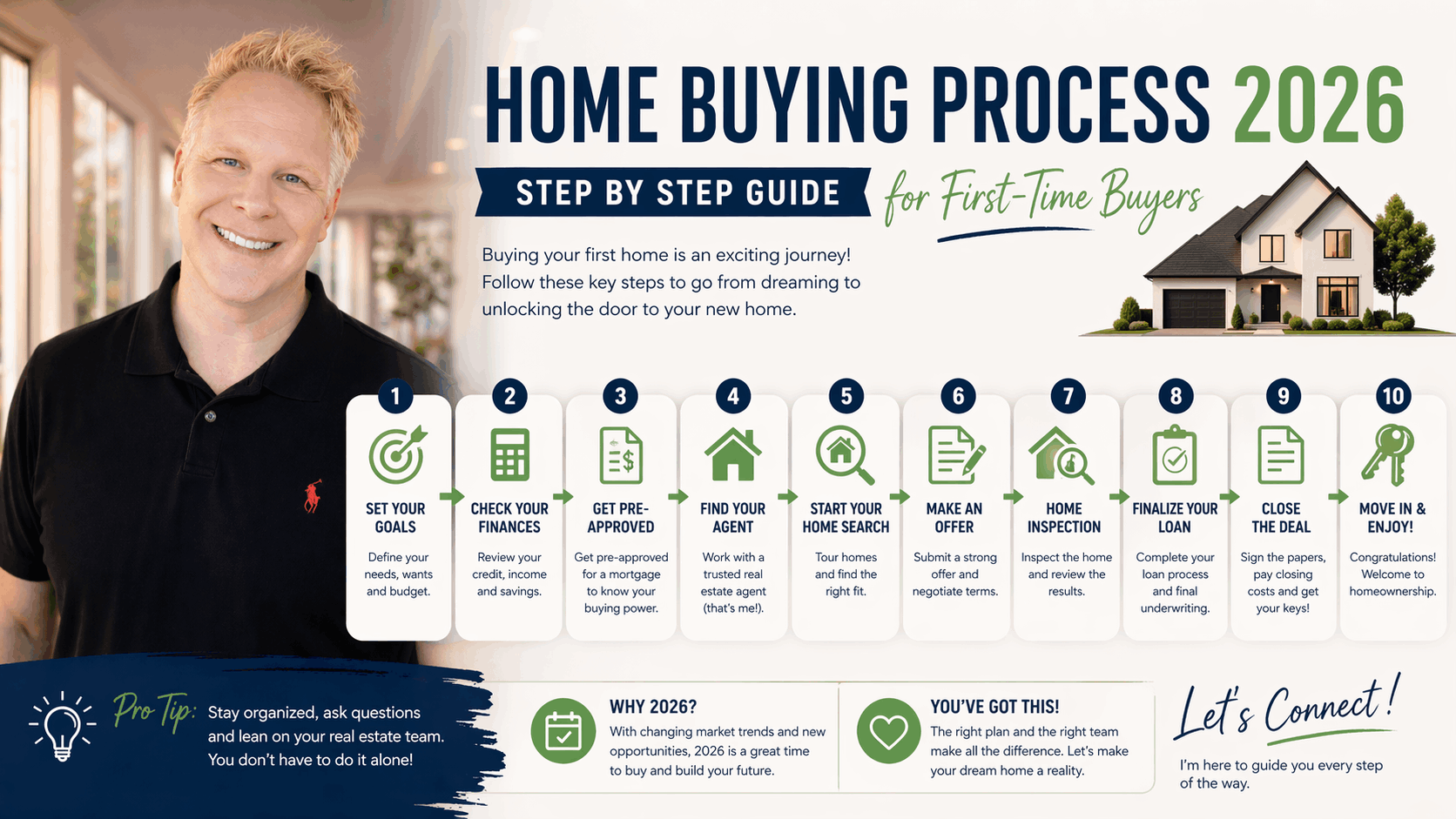
Step 1: Get your financing and pre-approval right
Before you look at a single home, get your financing in order, because everything else depends on it. Pre-approval is different from pre-qualification. A pre-qualification is a rough estimate based on information you tell the lender. A pre-approval means the lender has actually reviewed your income, assets, and credit and is prepared to lend up to a specific amount. In a market where the best listings still attract competition, a strong pre-approval is what lets you act quickly and shows sellers you are serious. You can start that step through my get pre-approved page.
First-time buyers in Texas should also know about the assistance programs that exist, because many people leave real money on the table simply by not asking. For most of these programs, you qualify as a first-time buyer if you have not owned a primary residence in the past three years. The Texas Department of Housing and Community Affairs runs My First Texas Home, which pairs a below-market 30-year fixed mortgage with up to 5 percent of the loan amount in down payment and closing-cost assistance, structured as a deferred, forgivable second lien. The Texas State Affordable Housing Corporation runs two more: Home Sweet Texas, open to eligible buyers generally, and Homes for Texas Heroes, aimed at teachers, first responders, nurses, veterans, and other public servants, both offering up to 5 percent in assistance. Most of these require a minimum credit score around 620 and carry income limits that vary by county. On top of any of them, the Texas Mortgage Credit Certificate can give you an annual federal tax credit worth 15 percent of the mortgage interest you pay, up to $2,000 a year, for as long as you keep the loan and live in the home. A good lender will tell you which of these you qualify for, and it is worth asking directly.
Step 2: Search the 2026 market the smart way
Once you know your number, the search begins, and the 2026 market rewards a focused approach. The Austin metro has cooled meaningfully from its 2022 peak, with several months of inventory and a market that clearly favors buyers, which means you generally have more time to think and more leverage than buyers had a few years ago. Use that to your advantage by being specific about what you actually need rather than chasing every listing. Set a realistic must-have list, separate it from your nice-to-haves, and focus your search on the areas and price points that genuinely fit your pre-approval. You can browse current listings on my site, and if you are still narrowing down where to buy on a first-timer budget, my guide to the best Round Rock neighborhoods for first-time buyers is a useful example of how much your dollar can stretch just outside the core.

Step 3: Tour homes with purpose
When you start touring, treat each showing as research rather than entertainment. Pay attention to the things that are expensive or impossible to change, the location, the lot, the layout, the roof and major systems, and worry less about cosmetic finishes that are easy to update. Take notes and photos, because after your fourth or fifth home they will blur together. It also helps to see a range early on, even homes slightly outside your target, so you calibrate what your budget really buys in the current market. A disciplined touring phase makes the next step, writing an offer, far less stressful, because you will already know a strong fit when you see one. It also helps to visit a neighborhood at different times of day and week before you commit, since a street can feel very different on a quiet weekday morning than it does during a weekend evening or a school-day rush. Pay attention to the commute you would actually drive, the noise, and the everyday conveniences nearby, because those are the details you will live with long after the excitement of the purchase fades.
Step 4: Write an offer that holds up
In Texas, offers are made on the standard one-to-four family residential contract promulgated by the Texas Real Estate Commission, and understanding a few of its moving parts helps you write a competitive but protected offer. Your earnest money is a good-faith deposit that goes toward your purchase and shows the seller you are committed. Just as important is the termination-option period, a negotiated window, often paid for with a small option fee, during which you have an unrestricted right to terminate the contract for any reason and get your earnest money back. That option period is one of the most powerful protections a Texas buyer has, and in a buyer-friendlier market you generally have more room to negotiate a favorable price and terms rather than stripping away your own protections to win. We build your offer around price, the option period, financing and appraisal terms, and closing timeline, all shaped to your situation.
Step 5: Use your option period to inspect and negotiate
Once your offer is accepted and you are under contract, the option period becomes your working window. This is when you order a professional home inspection and, based on what it finds, decide whether to ask the seller for repairs, a price reduction, or a closing-cost credit, or in a worst case, to walk away. Do not skip the inspection to seem more competitive; in the current market you rarely need to, and the cost of an inspection is trivial next to the cost of an undiscovered problem. This is also where having someone who negotiates these situations regularly matters, because the difference between a well-handled repair negotiation and a poorly handled one can be thousands of dollars and, sometimes, whether the deal survives at all.
Step 6: Financing, appraisal, and closing
While your option period runs, your lender moves your loan toward final approval, and the property is appraised to confirm its value supports the loan. Underwriting will verify your documentation one more time, so avoid making big financial moves during this stretch, no new credit cards, no large purchases, no job changes if you can help it, because they can derail your approval at the last minute. A few days before closing you will receive a Closing Disclosure detailing your final numbers, which you should review carefully against your original estimate. From an accepted offer to keys in hand typically runs about 30 to 45 days for a financed purchase. At closing you sign, your funds and loan are disbursed, and the home becomes yours.
Common first-time mistakes to avoid
A few missteps show up again and again with first-time buyers, and all of them are avoidable. The first is shopping before getting pre-approved, which wastes time and leads to heartbreak over homes you cannot actually finance. The second is stretching to the very top of your approval amount and forgetting that the monthly payment also includes Texas property taxes and homeowners insurance, which in this state can add a meaningful amount to your payment; budget for the full picture, not only principal and interest. The third is underestimating closing costs and cash needed at closing beyond the down payment, which is exactly where the assistance programs above can help. The fourth is skipping or rushing the inspection to seem more competitive, when in a buyer-friendlier market you rarely need to give up that protection. And the fifth is making major financial changes while under contract. Knowing these in advance is half the battle, and a good agent will flag them before they become problems.
Who to have on your side
The first-time process has a lot of moving parts, and the value of good representation is that you are never guessing at the next step or negotiating alone. When I work with first-time buyers, we start with your financing and the assistance programs you may qualify for, build a focused search, tour with intention, and then I represent you through the offer, the option period, inspections, and closing, with the current market's leverage working for you rather than against you. My team and I do this every week, and you can reach the Uncommon Realty team whenever you want to talk it through.
A simple first move is to see what is actually out there. Download my app to follow listings in real time and reach me directly with questions, and get your pre-approval started so you are ready to move when the right home appears. When you are ready to begin, I am here to walk you through your first purchase from the first question to the closing table.
Written for buyers and sellers in the Greater Austin, Texas area by Robbie English, REALTOR, Broker at Uncommon Realty.
Categories
- All Blogs (970)
- !!! (59)
- !x (621)
- Austin Real Estate (113)
- Bee Cave Real Estate (1)
- Building A Home (14)
- Buying A Home (143)
- Buying Land (1)
- Cedar Park Real Estate (58)
- Central Austin Real Estate (75)
- Down Payment Assistance Programs (1)
- Downsizing (4)
- Downtown Austin Real Estate (5)
- Dripping Springs Real Estate (62)
- East Austin Real Estate (3)
- Financing and Mortgage (24)
- first-time homebuying (109)
- Georgetown Real Estate (9)
- Hill Country Real Estate (1)
- HOA (2)
- Home Appraisals (13)
- Home For Rent (1)
- Home Inspections (6)
- Home Pricing (6)
- Home Staging (1)
- Home Values (12)
- Homeownership (1)
- Homes For Rent (1)
- Homes For Sale (147)
- Hutto Real Estate (5)
- Investing (6)
- Investment Properties (4)
- Lakeway Real Estate (33)
- Leander Real Estate (59)
- LGBT+ Real Estate (8)
- Luxury Homes For Sale (5)
- Luxury Real Estate (19)
- Market Conditions (17)
- Moving to Austin (2)
- Moving to Texas (4)
- Negotiations (3)
- Neighborhoods (8)
- Northwest Austin Real Estate (94)
- Off Market Listings (7)
- Pflugerville Real Estate (10)
- Private Listings (2)
- Property Management (42)
- Property Tax (3)
- Real Estate (18)
- Reddit Question Answered (80)
- redwrite (63)
- Relocation (2)
- Renting (6)
- Representation (34)
- Round Rock Real Estate (59)
- Selling Your Home (62)
- South Austin Real Estate (1)
- Westlake Real Estate (3)
Recent Posts