Homes Near Tesla Gigafactory: Growth, Land Values, and What's Actually Changing
I get asked a version of the same question a lot these days: is buying near Tesla's Gigafactory a smart long-term move, or just riding a headline? It's a fair question, and the honest answer is that it depends less on Tesla itself and more on what's happening to the land, the infrastructure, and the surrounding communities because Tesla is there. That's the part I want to walk through with you.
TL;DR
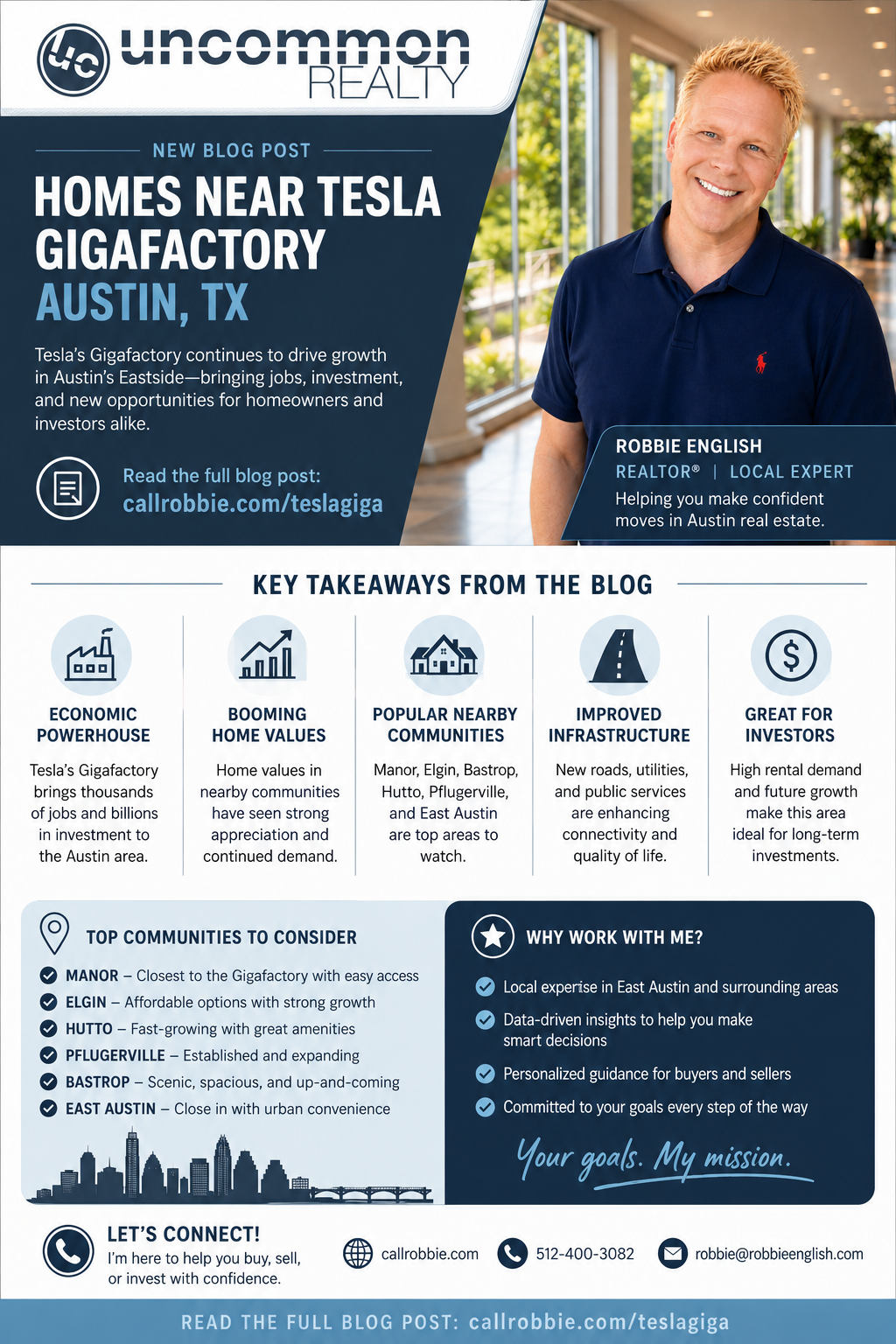
- Tesla Gigafactory Texas sits in southeast Travis County near Del Valle, along the Colorado River, and it's one of the largest single manufacturing investments in the region's history.
- The growth story here isn't just Tesla. It's the suppliers, contractors, and support businesses that follow a facility of that scale.
- Land values and new construction activity in the surrounding area have moved because of this, and that trend has room to continue as development pushes east toward Bastrop.
- Buying here as an investment is a different conversation than buying here to live, and I'd encourage you to be clear with yourself about which one you're actually doing.
- Infrastructure, particularly roads and utilities, is still catching up to the pace of growth in some pockets, and that's worth factoring into any long-term outlook.
Why this area is worth watching as a growth story
Tesla's Gigafactory Texas, located at 1 Tesla Road near Del Valle, is Tesla's global headquarters as well as a major manufacturing hub. A facility of that scale doesn't just bring its own jobs. It pulls in a network of suppliers, logistics companies, and contractors who need to be close to the plant, and that secondary wave of investment is often what actually reshapes a housing market over time. I've watched this pattern play out around other major employer expansions in Central Texas, and the shape of it is usually consistent: first the announcement, then the construction jobs, then the permanent workforce, then the builders and developers responding to demand that didn't exist five years earlier. Southeast Travis County, stretching out toward Del Valle and Bastrop, was a relatively overlooked part of the Austin market for a long time. That's changed. Development is pushing outward along the Colorado River corridor, and land that used to sit quietly is now part of active conversations about zoning, new subdivisions, and commercial buildout.
What "growth" actually looks like on the ground
It's easy to talk about growth in the abstract. In practice, it shows up as new construction communities breaking ground where there used to be open land, as road and utility projects trying to keep pace with rooftops, and as a steady increase in the number of buyers who have this area on their radar for the first time. I'd encourage you not to rely on a headline about Tesla's investment size to tell you what's happening locally. Drive the area. Look at what's actually under construction right now versus what's still planned. Growth stories can move faster or slower than expected, and the only way to really gauge where things stand is to see it yourself.
Buying here as an investment versus buying here to live
These are genuinely different decisions, and I think conflating them is where buyers get into trouble. If you're buying because you want to live near your job at the Gigafactory, your priorities should be the same as anyone buying a home: commute, schools if that matters to you, lot size, and whether the home fits your life. Growth potential is a nice bonus, not the reason to buy. If you're buying primarily as an investment, betting on continued appreciation as the area develops, that's a different risk profile entirely, and worth a real evaluation before you commit. Growth areas can outperform, but they can also move in fits and starts, and infrastructure sometimes lags behind rooftops in a way that affects resale in the short term. I'd never tell a client which approach is right for them. I would tell you to be honest with yourself about which one you're actually doing, because the two calculations lead to different decisions about price, location, and timeline.
Infrastructure is part of the real story
Roads, water, and utility capacity in a fast-growing area don't always arrive on the same timeline as new construction. I'd encourage any buyer looking in this corridor to ask direct questions about planned infrastructure projects near a specific property, not just the ones already completed. A subdivision that looks finished today might still be waiting on a road expansion that changes your commute experience in either direction over the next few years. This isn't a reason to avoid the area. It's a reason to go in with real information instead of assumptions.
Common misconceptions about this market
The biggest one I run into is the assumption that proximity to the Gigafactory alone guarantees appreciation. It doesn't. Location within the broader growth corridor matters, but so does the specific parcel, the flood plain status along the river, access to major roads, and whether a given pocket is actually seeing builder activity or just speculative land banking. The second misconception is that this is purely a Tesla story. It's really a regional growth story that Tesla helped accelerate, and it will keep evolving based on decisions well beyond any single employer.
Practical steps if you're considering this area
Start by getting clear on your own goal, live-in versus investment, since that changes what you should be optimizing for. Look at flood plain maps for any specific property near the river, since that's a real consideration in this corridor. Talk to your agent about which pockets already have committed infrastructure investment versus which are still speculative. And if appreciation is part of your thesis, look at the pace of actual construction activity, not just announcements, since that's a more honest signal of where real momentum is.
Summary
The growth happening around Tesla's Gigafactory is real, and it's reshaping southeast Travis County in ways that will likely continue for years. Whether that makes a specific property a good buy for you depends on your own goals, your timeline, and how carefully you look past the headline into the actual state of infrastructure and development on the ground. I'd rather walk you through what I'm seeing in person than have you make a decision based on a news story alone.
If you're relocating to actually live near the plant rather than invest, see my lifestyle-focused piece on living near Tesla Gigafactory.
Frequently Asked Questions
Is buying near the Tesla Gigafactory a good investment?
It can be, but it depends on the specific property, its location relative to committed infrastructure, and your own timeline. I'd encourage you to separate the investment question from the live-in question, since they lead to different priorities.
How is the area around the Gigafactory changing?
New construction communities, supplier and contractor activity, and road and utility projects are all part of the picture. The pace varies by specific pocket, so it's worth seeing current construction activity in person rather than relying on general reputation.
What should I check before buying near the river in this area?
Flood plain status is a real consideration for properties near the Colorado River corridor. Ask directly about it for any specific property you're considering, and don't assume a home is outside the flood plain without confirming it.
Is this area only attractive because of Tesla?
Tesla accelerated attention on the area, but the broader growth story involves suppliers, contractors, and regional development that goes beyond any single employer. That's part of why I'd encourage buyers to think about the corridor's momentum generally, not just one company's presence.
If you're weighing whether this growth corridor fits your goals, whether you're buying to live or buying as an investment, I'm happy to walk the area with you and talk through what I'm actually seeing on the ground right now.
Written for buyers and sellers in the Greater Austin, Texas area by Robbie English, Broker, REALTOR at Uncommon Realty.
Categories
- All Blogs (970)
- !!! (59)
- !x (621)
- Austin Real Estate (113)
- Bee Cave Real Estate (1)
- Building A Home (14)
- Buying A Home (143)
- Buying Land (1)
- Cedar Park Real Estate (58)
- Central Austin Real Estate (75)
- Down Payment Assistance Programs (1)
- Downsizing (4)
- Downtown Austin Real Estate (5)
- Dripping Springs Real Estate (62)
- East Austin Real Estate (3)
- Financing and Mortgage (24)
- first-time homebuying (109)
- Georgetown Real Estate (9)
- Hill Country Real Estate (1)
- HOA (2)
- Home Appraisals (13)
- Home For Rent (1)
- Home Inspections (6)
- Home Pricing (6)
- Home Staging (1)
- Home Values (12)
- Homeownership (1)
- Homes For Rent (1)
- Homes For Sale (147)
- Hutto Real Estate (5)
- Investing (6)
- Investment Properties (4)
- Lakeway Real Estate (33)
- Leander Real Estate (59)
- LGBT+ Real Estate (8)
- Luxury Homes For Sale (5)
- Luxury Real Estate (19)
- Market Conditions (17)
- Moving to Austin (2)
- Moving to Texas (4)
- Negotiations (3)
- Neighborhoods (8)
- Northwest Austin Real Estate (94)
- Off Market Listings (7)
- Pflugerville Real Estate (10)
- Private Listings (2)
- Property Management (42)
- Property Tax (3)
- Real Estate (18)
- Reddit Question Answered (80)
- redwrite (63)
- Relocation (2)
- Renting (6)
- Representation (34)
- Round Rock Real Estate (59)
- Selling Your Home (62)
- South Austin Real Estate (1)
- Westlake Real Estate (3)
Recent Posts