
House Hacking Calculator: Estimate Monthly Savings
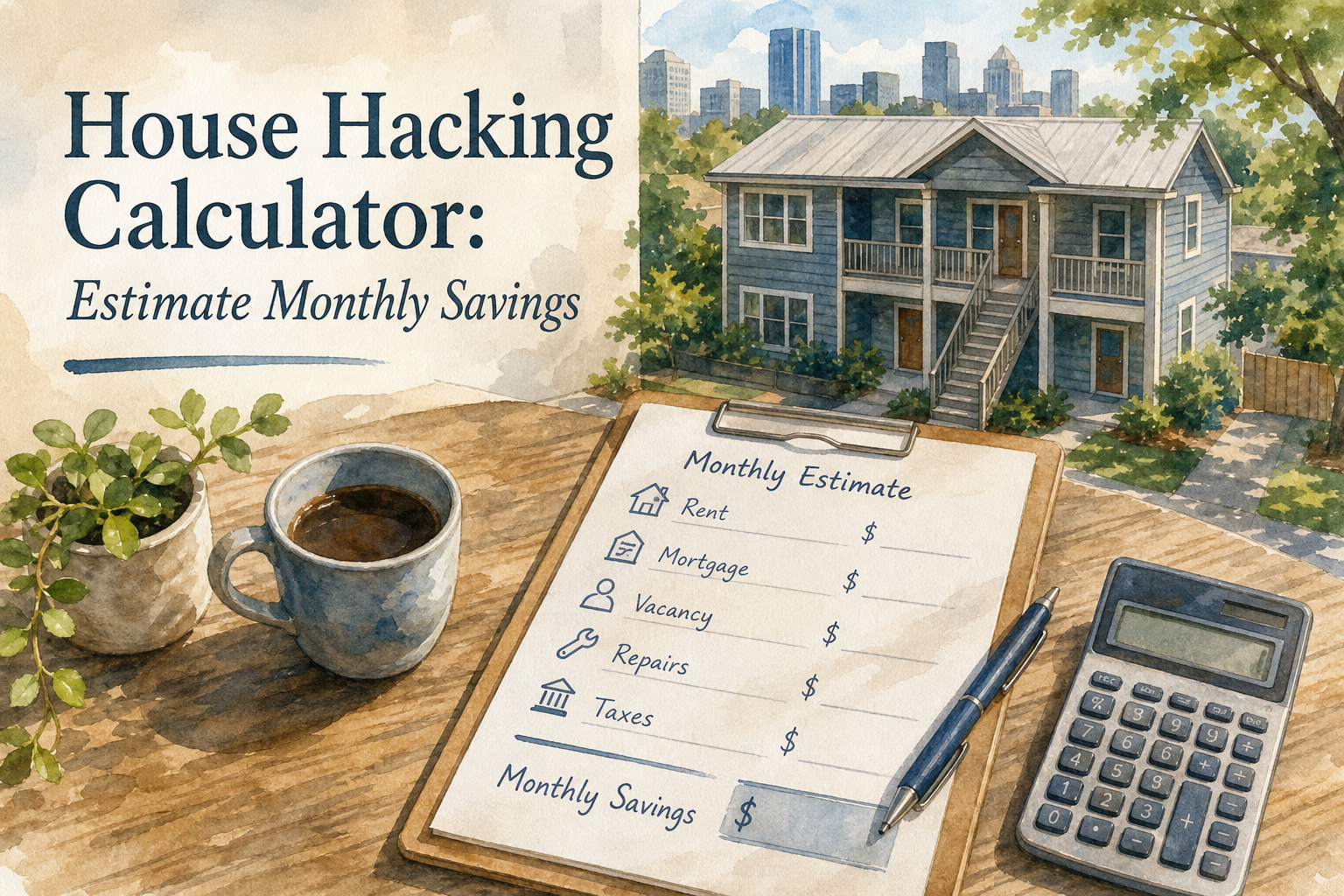
A house hacking calculator can show whether rental income will lower your housing cost or merely make a weak deal look better. The useful result is more than monthly cash flow. You need to see vacancy risk, repairs, taxes, loan costs, and the rent you would pay for your own space. I use the following framework to help Austin buyers test those numbers before they shop. For local examples involving duplexes, ADUs, and room rentals, my guide to house hacking in Austin can help you compare the main property types.
What a House Hacking Calculator Actually Measures
A house hacking calculator compares the full cost of owning a property with the income from rooms or separate units. You live in the home while renting part of it. That may mean a spare bedroom, an accessory dwelling unit, or one side of a duplex.
The first result is usually monthly cash flow. The basic formula is simple:
- Gross rent minus vacancy gives effective rental income.
- Effective rental income minus rental expenses gives rental operating income.
- Rental operating income minus the full mortgage payment shows the property’s cash flow.
That last number needs care. A property can show negative cash flow while still reducing your personal housing cost. If rent covers part of your full monthly ownership cost, your effective housing cost is lower before income taxes and personal utilities.
Some calculators also estimate equity growth. Principal paydown increases your ownership stake, even though it does not put cash in your checking account. I call this the rental equivalent idea: compare your net housing cost with the cost of renting a similar private space.
Appreciation belongs in a separate scenario, not in the base case. A future price increase may help your net worth, but it won't pay next month's mortgage. This live-in landlord model involves an owner occupying the property while renting part of it.
For Austin buyers, the property itself matters as much as the spreadsheet. A duplex may give you more privacy than room rentals. A single-family home may cost less to enter but require more work to make the rental area functional.
The Inputs You Need for a Realistic House Hacking Estimate
A house hacking calculator is only as useful as its inputs. Start with the actual property, not a round number that makes the deal look attractive.
Purchase and loan inputs
Enter the expected purchase price and down payment. Then add the interest rate, loan term, loan type, and estimated closing costs. Low-down financing may reduce the cash needed at closing, but it can raise the monthly payment or add mortgage insurance.
Ask the lender for a payment estimate that includes principal, interest, mortgage insurance, and any required escrow. Don't enter only principal and interest. That creates a clean number with very little use.
Rental income inputs
Use rent supported by nearby homes with similar features. Separate the income by space if the home has more than one rental area.
- Monthly rent for each room or unit
- Expected tenant-paid utilities
- Parking or storage income, if applicable
- Any furnished-rental premium you can support
Do not assume every room rents every month. Add a vacancy factor. Also estimate turnover time, cleaning, advertising, and small repairs between tenants. A unit that turns over twice in a year has a different cost pattern than one with a stable long-term tenant.
Ownership and operating costs
Include property taxes, insurance, HOA dues, utilities, lawn care, pest control, repairs, and capital reserves. A capital reserve covers larger future costs such as a roof, water heater, air conditioner, or exterior work.
Property management may be zero if you handle the rental yourself. That does not make management free. Your time has value, and live-in management can affect privacy. Enter a management cost in one scenario so you can see whether the deal still works if your plans change.
For the tax line, verify the property's record rather than copying the seller's current bill. Exemptions can change after a sale. Eligibility and application rules affect a homeowner's taxable value. An Austin Texas property tax calculator can help you convert the annual estimate into a monthly figure and test the effect of exemptions, but you should still confirm the result against the applicable tax records.
Use three versions of each major input. A base case uses your most supportable estimate. A lower-rent case tests weaker demand. A higher-expense case tests the cost of repairs, insurance, or utilities. The point is not to predict one perfect number. It is to learn which assumptions control the result.
How to Read the Results: Cash Flow, Savings, and Return
A house hacking calculator may show several attractive numbers. They answer different questions. Don't combine them into one vague return figure.
| Result | What it tells you | What it does not tell you |
|---|---|---|
| Effective housing cost | How much of the monthly ownership cost remains after rent | Whether you can handle a vacant unit |
| Monthly cash flow | Whether rental operations produce or consume cash | How much principal the loan pays down |
| Principal paydown | How much loan balance falls through scheduled payments | Cash available for bills |
| Cash-on-cash return | Annual cash flow compared with cash invested | Appreciation or unpaid owner labor |
| Net worth scenario | How equity may change under selected assumptions | A guaranteed future sale price |
Suppose a property costs $3,000 per month to own. Rent reduces that cost by $1,300. Your effective housing cost is lower before personal costs. If repairs average $250 per month over time, the useful comparison is higher. The calculator should show both figures, so reserves don't disappear inside an optimistic cash-flow line.
Now separate cash flow from return. Principal paydown may improve your equity while cash flow stays flat. Appreciation may raise projected net worth while leaving your monthly budget unchanged. Mortgage-interest information also shows why tax treatment depends on how the property and debt are used. A calculator cannot replace tax advice.
Review the result at three points:
- Month one, when you face the full payment and startup costs.
- Month six, when a vacancy or repair may test your reserve.
- Year five, when loan paydown and possible value changes become more visible.
For the five-year view, enter several appreciation cases. A flat-value case is useful because it removes appreciation from the decision. Then add a modest growth case and compare the difference. Avoid using appreciation to rescue negative monthly cash flow.
I also recommend comparing the result with the housing cost you would accept without rental income. A full-payment approach includes taxes, insurance, mortgage insurance, association dues, utilities, and maintenance.
That comparison keeps the decision grounded. If the deal works only when every room rents at the highest estimate, it does not yet work.
Austin and Central Texas Factors That Can Change the Calculation
A house hacking calculator needs local inputs. Austin and nearby Central Texas markets do not share one tax bill, insurance cost, rental rule, or repair profile.
Property taxes and exemptions
Start with the property's taxing entities and taxable value. The listing price is not the same thing as the taxable value. A seller's exemption status may also differ from yours after closing.
Run one case with the current record and another without assumed exemptions. Check the tax record, separate taxable value from market value, and divide an annual bill into a monthly estimate.
Insurance, weather, and repairs
Insurance deserves its own line. Ask for a property-specific quote before you become attached to the projected cash flow. Roof age, wind exposure, plumbing, electrical systems, and prior claims can affect the quote and the reserve you need.
Central Texas heat also affects air-conditioning use and equipment wear. A calculator that uses a generic maintenance percentage may miss the age and condition of the actual systems. Review the inspection report with the reserve line in mind.
Rental use and property layout
Confirm whether the planned rental use fits local rules, deed restrictions, HOA documents, and the property's layout. A bedroom rental has different privacy and access concerns than a separate unit. A garage conversion may need permits, utility work, or life-safety changes.

Look beyond the monthly rent estimate. A lower purchase price may come with more work. A higher-rent unit may require a layout that creates less separation between your home and the tenant's space. Visit several properties and compare access, parking, sound control, and utility meters.
Robbie English, REALTOR can help you review those property-level questions across Austin, Cedar Park, Leander, Round Rock, and nearby areas. You remain free to choose any lender, inspector, insurance provider, or other professional. My role is to help you see the full cost before you commit.
Stress-Test the Number Before You Decide to House Hack
A house hacking calculator should make weak assumptions visible. Stress testing is where the spreadsheet becomes a decision tool.
Run a vacancy test
Remove one month of rent from each rental space. Then test a longer vacancy if the property depends on one large unit. Compare the result with your available cash reserve.
Also include turnover costs. A tenant may leave at an inconvenient time. The room may need paint, cleaning, locks, or a small repair before it can rent again. These costs are easy to omit because they don't arrive every month.
Run an expense test
Raise insurance, taxes, utilities, and repairs in separate scenarios. Don't change every line at once at first. You want to know which cost has the greatest effect.
Then run a combined downside case. Use lower rent, a vacancy, and one larger repair. If that case would force you to use credit or miss other savings goals, the purchase needs a different price, loan structure, or property type.
Compare the Tool with a Spreadsheet
An automated calculator is quick. A spreadsheet is easier to inspect. Use the spreadsheet when you need custom lines for shared utilities, owner labor, staged furnishings, or a planned renovation.
A simple sheet should show each assumption in its own row. Keep one column for the base case and other columns for lower rent, higher costs, and no appreciation. If a number changes, you should see which result moves.
House hacking is one of several ways to approach an income-producing property. A broader discussion of real estate investment strategies for 2026 can help you compare house hacking with other ownership plans, but the right choice still depends on your cash, time, and tolerance for tenant contact.
After more than 40 years in real estate, one lesson remains consistent: the deal is usually decided by the assumptions that get ignored. Before making an offer, have Robbie English, REALTOR review the property, rent evidence, tax record, insurance estimate, and downside case with you.
Frequently Asked Questions About House Hacking Calculators
What is a house hacking calculator?
A house hacking calculator estimates your housing cost after rental income. It combines the purchase price, loan payment, rent, vacancy, taxes, insurance, repairs, and other costs. The result can show monthly cash flow, effective housing cost, equity growth, or a return estimate. Treat each result as an estimate based on your inputs, not a promise.
How do you calculate house hacking cash flow?
House hacking cash flow equals effective rental income minus rental expenses and the mortgage payment assigned to the property. Effective rental income starts with expected rent, then subtracts vacancy and unpaid rent. Add reserves for repairs and turnover. If you live in one unit, also calculate your remaining personal housing cost.
Does principal paydown count as savings?
Principal paydown can count as equity growth, but it is not monthly cash savings. Each payment may reduce your loan balance while your bank account still declines. A house hacking calculator should show principal separately from cash flow. Use it in a long-term net-worth view, not as money available for groceries or repairs.
Should I include property taxes in the calculator?
Yes, include property taxes in every house hacking calculator scenario. Start with the property's tax record, then test the effect of changed taxable value or an exemption that may not apply after closing. Taxes can materially change the monthly result. Confirm the estimate with the county or appraisal record before setting your purchase budget.
Is house hacking worth it in Austin?
House hacking may be worth considering in Austin when the property layout, rent evidence, and full ownership cost support the plan. There is no single answer for every home. Compare a room rental with a duplex or separate unit. Then test vacancy, repairs, taxes, insurance, and your willingness to manage tenants before deciding.
Conclusion
Use a calculator to test a property, not to justify it. Enter documented rent, full ownership costs, vacancy, reserves, and a no-appreciation case before you compare homes. When a property still fits your budget after those tests, ask Robbie English, REALTOR to review the numbers and the home's layout before you write an offer.
Categories
- All Blogs (970)
- !!! (59)
- !x (621)
- Austin Real Estate (113)
- Bee Cave Real Estate (1)
- Building A Home (14)
- Buying A Home (143)
- Buying Land (1)
- Cedar Park Real Estate (58)
- Central Austin Real Estate (75)
- Down Payment Assistance Programs (1)
- Downsizing (4)
- Downtown Austin Real Estate (5)
- Dripping Springs Real Estate (62)
- East Austin Real Estate (3)
- Financing and Mortgage (24)
- first-time homebuying (109)
- Georgetown Real Estate (9)
- Hill Country Real Estate (1)
- HOA (2)
- Home Appraisals (13)
- Home For Rent (1)
- Home Inspections (6)
- Home Pricing (6)
- Home Staging (1)
- Home Values (12)
- Homeownership (1)
- Homes For Rent (1)
- Homes For Sale (147)
- Hutto Real Estate (5)
- Investing (6)
- Investment Properties (4)
- Lakeway Real Estate (33)
- Leander Real Estate (59)
- LGBT+ Real Estate (8)
- Luxury Homes For Sale (5)
- Luxury Real Estate (19)
- Market Conditions (17)
- Moving to Austin (2)
- Moving to Texas (4)
- Negotiations (3)
- Neighborhoods (8)
- Northwest Austin Real Estate (94)
- Off Market Listings (7)
- Pflugerville Real Estate (10)
- Private Listings (2)
- Property Management (42)
- Property Tax (3)
- Real Estate (18)
- Reddit Question Answered (80)
- redwrite (63)
- Relocation (2)
- Renting (6)
- Representation (34)
- Round Rock Real Estate (59)
- Selling Your Home (62)
- South Austin Real Estate (1)
- Westlake Real Estate (3)
Recent Posts