
Unexpected Expenses When Buying A Home

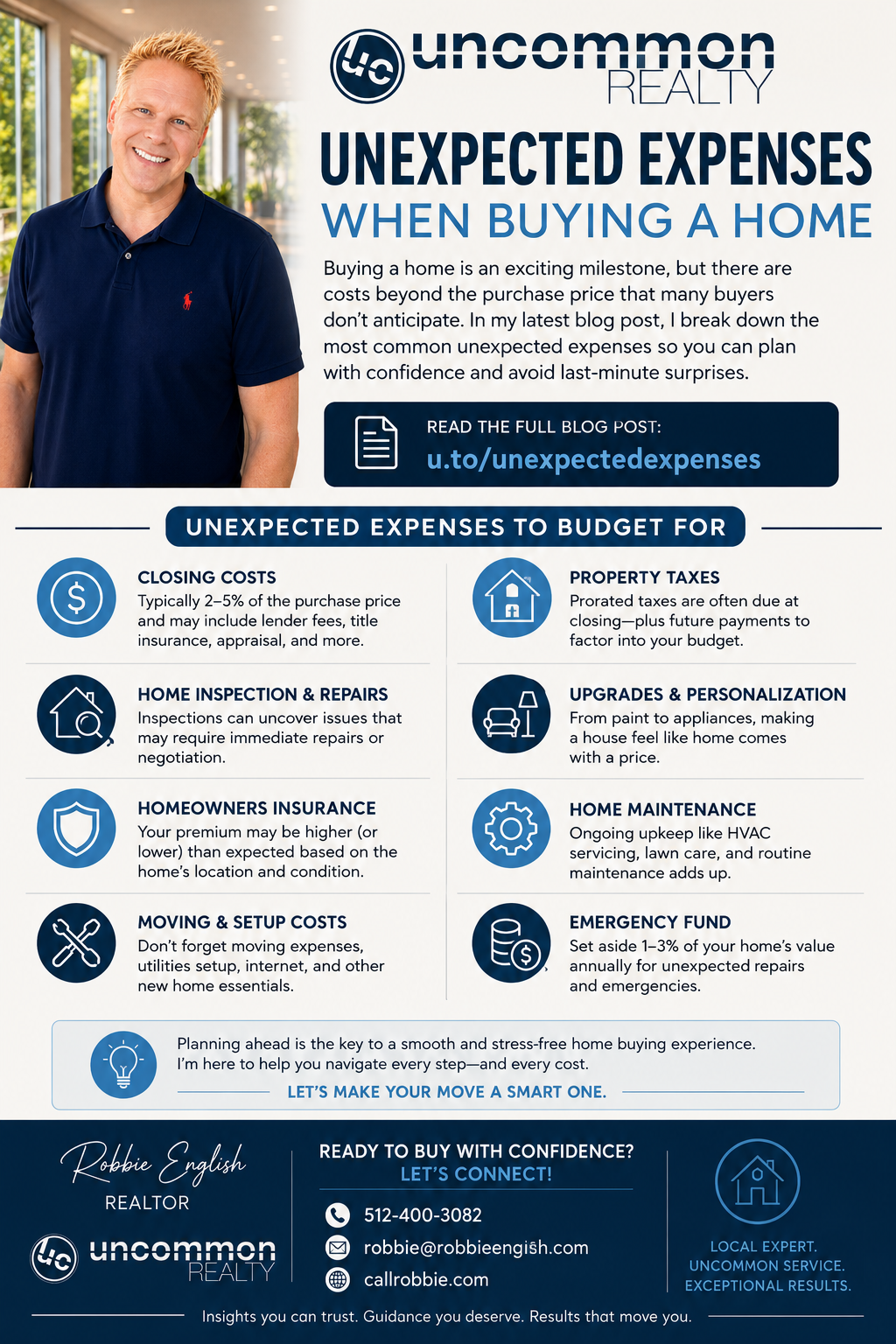
Buying a home genuinely involves more real costs than just the purchase price and down payment, and the unexpected expenses are what catch buyers off guard most often. I have worked with buyers all across Central Texas, from Austin to Cedar Park and Round Rock, and the pattern is consistent: the buyers who budget only for the down payment are the ones who get surprised. This guide walks through the real costs, closing costs, inspection findings, ongoing taxes and insurance, and the expenses that show up after you move in, so you can budget accurately from the start.
I am Robbie English, Broker, REALTOR at Uncommon Realty, and I walk every buyer through a realistic full-cost picture before they write an offer. My goal here is to make sure nothing on this list surprises you.

Why Unexpected Expenses Catch Buyers Off Guard
Most first-time buyers focus almost entirely on the down payment, since that is the number lenders and listing sites emphasize. But a real estate transaction has several other cost categories layered on top, and each one can run into the thousands. None of them are hidden exactly, but they rarely get the same attention as the purchase price, which is why they feel unexpected even though they are entirely predictable if you know to look for them.
The fix is straightforward: build a complete budget before you shop, not after you are under contract. Knowing these categories in advance turns a series of surprises into a manageable, expected part of the process.
It also changes how you shop. Buyers who only budget the down payment often stretch to the very top of what a lender will approve, leaving no room for the costs that follow. Buyers who budget the full picture from the start naturally shop a little below their maximum approval, which gives them breathing room for closing costs, repairs, and the first few months of ownership without feeling stretched the moment they move in.
The True Cost Of Getting To The Closing Table
Closing costs in Texas typically run somewhere in the range of 2 to 5 percent of the purchase price, covering lender fees, title insurance, escrow and settlement fees, recording fees, and prepaid items like the first year of homeowners insurance and prorated property taxes. On a $400,000 home, that can mean $8,000 to $20,000 due at closing, on top of your down payment. Ask your lender for a detailed loan estimate early on so you know your actual real number rather than a rough percentage guess.
Texas buyers also pay an option fee, typically a few hundred dollars, for the right to a Texas option period, the window in which you can inspect the home and negotiate or walk away. It is a small cost that buys real protection, and it is one of the few expenses in this process that is genuinely worth every dollar.
Do not overlook the smaller line items either: a survey if one is not already available, an appraisal fee paid to the lender, recording fees at the county, and, in some transactions, an attorney fee if you choose to have one review the contract. None of these individually breaks a budget, but they add up, and lenders are required to give you a loan estimate that itemizes them, so ask for it early and review it line by line rather than accepting a rough verbal estimate.
What Inspections Often Reveal
A home inspection commonly surfaces items that were not visible in listing photos or during a showing: an aging roof, an HVAC system nearing the end of its life, plumbing or electrical issues, or foundation concerns. In Central Texas specifically, the region's expansive clay soils make foundation movement one of the most common findings, and it is worth budgeting for a structural engineer's opinion if the general inspector flags anything more than minor seasonal movement.
You can negotiate repairs or a price credit for what the inspection finds, but budget some flexibility regardless, since not everything gets resolved through negotiation, and a seller's market or a competitive offer may limit how much you can ask for. Treat the inspection as information you will act on rather than a formality to get through.
Repairs And Upgrades After You Move In
Even a home that passes inspection cleanly often needs something within the first year: a fence repair, appliance replacement, minor plumbing fix, or simply the cost of making the space genuinely yours with paint, window coverings, and basic furnishings for rooms you have not filled yet. Set aside a cushion, often recommended in the range of one to three percent of the home's value annually, specifically for maintenance and unplanned repairs rather than assuming your first year will be expense-free.
Moving costs themselves are also easy to underbudget, whether you are hiring movers or renting a truck and doing it yourself, plus any temporary storage or overlap costs if your timelines do not align perfectly between selling and buying.
Property Taxes And Insurance Realities
Texas has no state income tax, but property taxes are correspondingly high, generally running somewhere around 1.7 to 2.2 percent of assessed value depending on the county and any MUD or PID assessments layered on top in many newer communities. On a $400,000 home, that can mean $7,000 to $9,000 or more per year, an amount many out-of-state buyers underestimate significantly. Filing your homestead exemption promptly after closing reduces your taxable value and is one of the most valuable, and most often forgotten, steps a new Texas homeowner can take.
Homeowners insurance in Texas also runs above the national average, driven by hail and wind risk, and premiums vary meaningfully by roof age, construction type, and location. Get an actual quote for a specific property before you finalize your budget rather than assuming a rough estimate will hold, since the real number can shift your monthly payment more than buyers expect. If a home is in a floodplain or requires additional coverage, factor that into your decision before you fall in love with the property, not after.
HOA Fees And Community Costs
Many newer communities across Leander, Georgetown, and Pflugerville carry HOA dues on top of property taxes, funding amenities and shared maintenance. Dues vary widely, from modest annual fees to significant monthly amounts in amenity-rich master-planned communities, and some communities also carry a separate MUD tax that funds infrastructure. Review the HOA's financial health and any planned special assessments before you buy, since an underfunded association can mean a surprise bill down the road, and factor the full amount into your true monthly payment rather than treating it as an afterthought.
Utility Costs That Shift With The Property
Utility costs vary more than buyers expect based on a home's age, insulation, orientation, and size. Austin summers make cooling costs a real line item, and an older or poorly insulated home can run considerably higher electric bills than a newer, more efficient one. If you can, ask the seller for recent utility bills or check with the provider for average costs at that address before you close, so your monthly budget reflects reality rather than a guess.
Some properties, particularly in unincorporated areas or on acreage further from Horseshoe Bay and similar Hill Country communities, may rely on well water and septic systems rather than city utilities, which come with their own maintenance costs and occasional repair expenses that a buyer coming from a city-utility background may not anticipate.
How To Prepare The Right Way
The best defense against unexpected expenses is a complete budget built before you start touring homes. Get a full pre-approval, then build out your true costs line by line: down payment, closing costs, a maintenance and repair cushion, moving costs, and your realistic ongoing property tax, insurance, and HOA numbers for the specific area and price point you are targeting. Ask for a loan estimate early, request your own inspection with enough time to act on the results, and get real insurance quotes for the specific property rather than rough estimates before you are under a tight deadline.
None of this eliminates surprises entirely, but it shrinks them dramatically, turning a stressful process into a manageable one where you know your real numbers going in.
It also helps to build in a small emergency reserve beyond your moving-in budget, separate from your down payment and closing funds. Something will come up in the first year that you did not plan for, whether it is a small repair, a higher-than-expected utility bill during a hot summer, or simply the cost of settling in. Buyers who keep a modest cushion set aside handle that first surprise calmly; buyers who spent every available dollar getting to closing often find it far more stressful, even when the actual cost is small.
Bringing It All Together
Unexpected expenses when buying a home are rarely truly unexpected once you know exactly where to look for them: closing costs, inspection findings, post-move repairs, property taxes and insurance, HOA dues, and utilities all add up beyond the purchase price you started with. Building a realistic, complete budget before you shop is exactly what separates a confident, prepared buyer from a stressed one who is caught off guard.
I am glad to walk you through a full, honest, itemized cost picture for any specific home or area you are considering, so there are no unwelcome surprises waiting for you at the closing table. You can explore current listings on my website or through my app as you plan your purchase.
Written for buyers and sellers in the Greater Austin, Texas area by Robbie English, REALTOR, Broker at Uncommon Realty.
Categories
- All Blogs (959)
- !!! (59)
- !x (621)
- Austin Real Estate (106)
- Bee Cave Real Estate (1)
- Building A Home (14)
- Buying A Home (143)
- Buying Land (1)
- Cedar Park Real Estate (57)
- Central Austin Real Estate (75)
- Down Payment Assistance Programs (1)
- Downsizing (3)
- Downtown Austin Real Estate (5)
- Dripping Springs Real Estate (62)
- East Austin Real Estate (3)
- Financing and Mortgage (23)
- first-time homebuying (109)
- Georgetown Real Estate (9)
- Hill Country Real Estate (1)
- HOA (2)
- Home Appraisals (13)
- Home For Rent (1)
- Home Inspections (6)
- Home Pricing (6)
- Home Staging (1)
- Home Values (12)
- Homeownership (1)
- Homes For Rent (1)
- Homes For Sale (147)
- Hutto Real Estate (5)
- Investing (6)
- Investment Properties (4)
- Lakeway Real Estate (33)
- Leander Real Estate (59)
- LGBT+ Real Estate (8)
- Luxury Homes For Sale (5)
- Luxury Real Estate (19)
- Market Conditions (16)
- Moving to Austin (2)
- Moving to Texas (4)
- Negotiations (3)
- Neighborhoods (8)
- Northwest Austin Real Estate (94)
- Off Market Listings (7)
- Pflugerville Real Estate (10)
- Private Listings (2)
- Property Management (42)
- Property Tax (3)
- Real Estate (18)
- Reddit Question Answered (80)
- redwrite (63)
- Relocation (2)
- Renting (6)
- Representation (34)
- Round Rock Real Estate (58)
- Selling Your Home (62)
- South Austin Real Estate (1)
- Westlake Real Estate (3)
Recent Posts