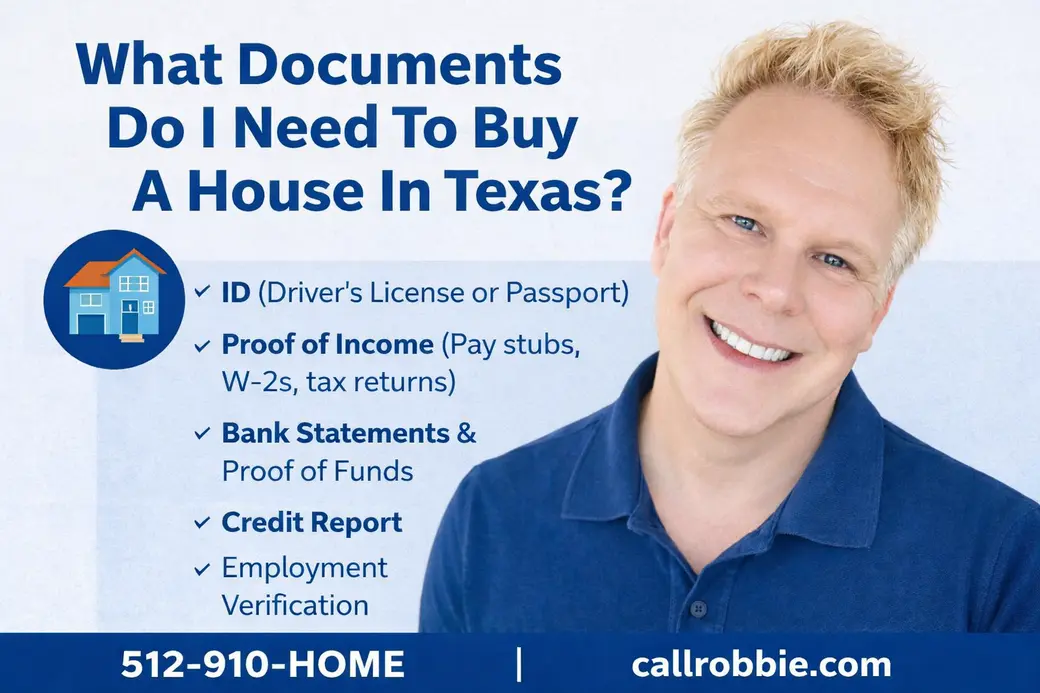
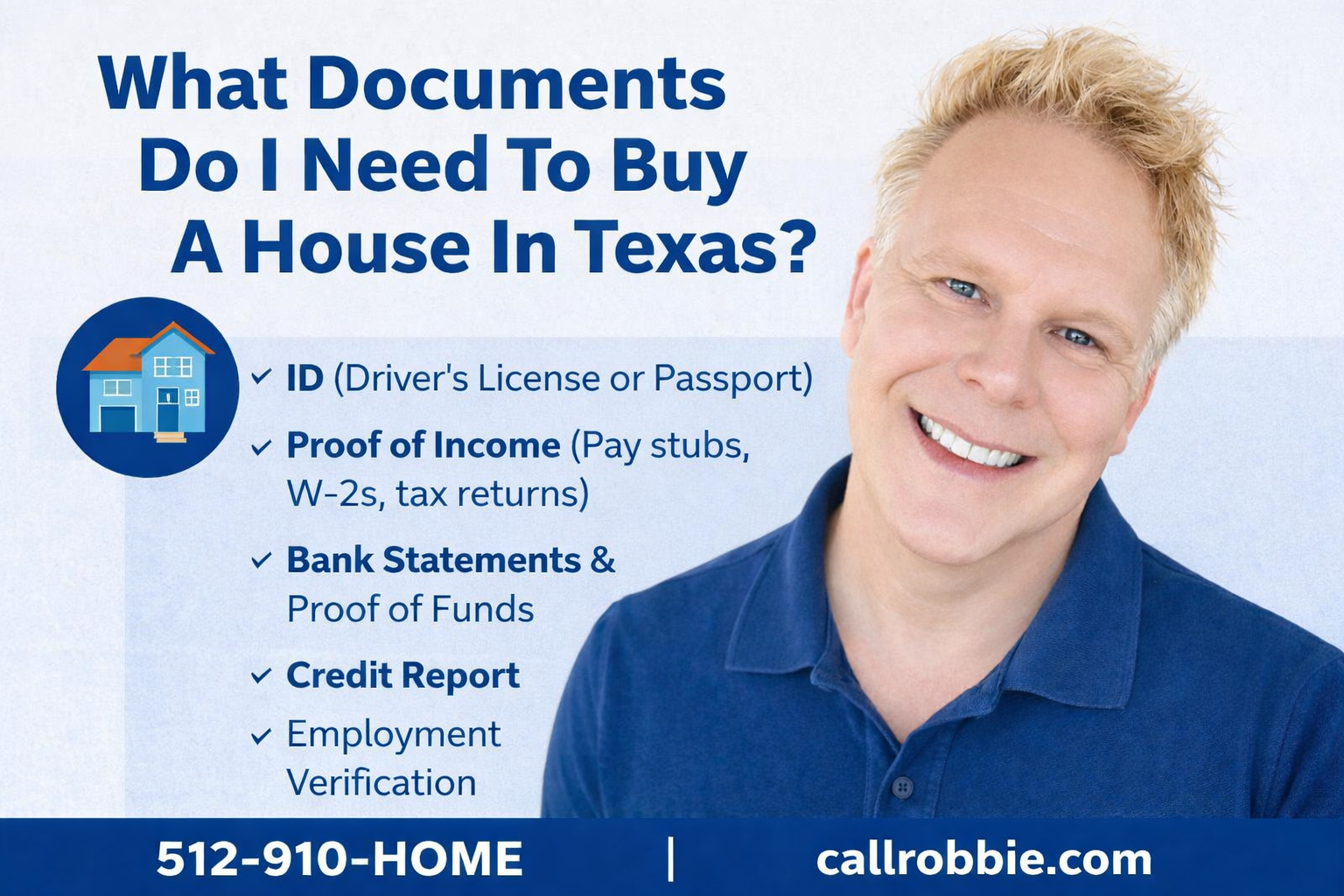
What Documents Do I Need To Buy A House In Texas
I get this question constantly, usually from someone who's about to start touring homes and realizes they have no idea what they'll actually need to hand over. The honest answer is that it's not as complicated as it feels, but it does help to know what's coming before you're scrambling for it at 9pm the night before a deadline.
TL;DR
- You'll need government ID and your Social Security number early, since lenders require both to run credit and verify identity.
- Income documentation varies depending on whether you're a W-2 employee or self-employed, and self-employed buyers should expect to gather more.
- Bank statements showing your down payment and closing funds need to show a clear paper trail, rather than only a balance.
- Once you're under contract, the purchase contract, earnest money receipt, and title documents all become part of your file.
- Getting organized before you start touring homes, not after you find one, is what actually saves you time and stress.
Before you even start looking: identification and financial basics
Every lender is going to need a valid government-issued ID, typically a driver's license or passport, along with your Social Security number so they can pull your credit and verify your identity. This is standard across the board and won't vary by lender. What I'd tell you to actually pay attention to is your ID's expiration date. I've seen closings get delayed because someone's license expired between the offer and the closing table. Check it now, not later.
Income documentation: what you need depends on how you're paid
If you're a W-2 employee, expect to provide recent pay stubs, typically covering the last 30 days, along with W-2 forms from the past two years. Lenders want to see consistent income over time, not only a single recent pay period. If you're self-employed or have significant 1099 income, the documentation gets heavier. Expect to provide two years of full tax returns, including all schedules, and possibly a profit and loss statement for the current year. Lenders evaluate self-employed income differently, generally looking at your net income after deductions rather than gross revenue, which surprises some buyers who expected their approval amount to match their top-line income.
Bank statements and proof of funds
You'll need statements showing your down payment and closing funds, typically the most recent two months across your checking and savings accounts. What matters here isn't just the balance. Lenders look for a clear, explainable paper trail. Large, unexplained deposits close to your purchase can trigger a request for a "letter of explanation," and if a family member is helping with your down payment, that typically needs to be documented as a formal gift letter, rather than an unexplained transfer. If you're relocating and moving funds between accounts or from an out-of-state bank, keep records of those transfers. It's easier to over-document at this stage than to scramble for an explanation later in underwriting.
The pre-approval letter
Before you're seriously touring homes, get a real pre-approval, not only a pre-qualification. Pre-qualification is a rough estimate based on what you've told a lender. Pre-approval involves an actual review of your documentation and gives you, and any seller you make an offer to, a much more reliable number. In a competitive market, a strong pre-approval letter is part of what makes your offer credible.


Once you're under contract: the documents that follow
After you have an accepted offer, a new set of documents comes into play. In Texas, this typically starts with the TREC promulgated contract, the standard purchase agreement used across the state. You'll also have an earnest money receipt once your earnest money is deposited with the title company, and if your contract includes an option period, a separate option fee receipt. As you move through the transaction, expect a title commitment, which shows the property's ownership history and any liens or issues that need to be cleared before closing, and in many cases a current survey of the property. Your lender will issue a loan estimate early and a closing disclosure a few days before closing, which lays out your final loan terms and closing costs. Review that closing disclosure carefully and compare it against your original loan estimate, since discrepancies are worth catching before you're sitting at the closing table.
HOA and insurance documents
If the property is in an HOA, you'll typically receive a resale certificate outlining the association's rules, fees, and financial health. Read it, don't just file it, since HOA rules can affect everything from what color you can paint your front door to whether you can rent the property out later. You'll also need proof of homeowners insurance before closing, since your lender will require an active policy in place at the time you close.
Common misconceptions
The biggest one is assuming pre-qualification and pre-approval are the same thing. They aren't, and the difference matters once you're competing for a home. The second misconception is that self-employed buyers can't get approved as easily as W-2 employees. It's not that it's harder exactly, it's that the documentation requirements are different, and going in prepared makes the process much smoother.
Practical steps to get organized early
Pull together your ID, two years of tax documents, and two months of bank statements before you start touring homes, not after you've found one you love. Get a real pre-approval, not only a pre-qualification. If anyone is gifting part of your down payment, get that documented properly now rather than explaining an unexplained deposit later. And once you're under contract, read every document that comes your way rather than skimming and signing.
Additional considerations
If you're relocating from out of state, ask your lender directly how they handle out-of-state income verification or funds transfers, since it can occasionally add an extra step or two to underwriting. Better to know that upfront than be surprised by it mid-transaction.
Summary
The paperwork behind buying a home in Texas isn't as intimidating as it feels once you know what's actually coming. Get your identification, income documentation, and bank statements organized early, get a real pre-approval before you start touring, and stay attentive once you're under contract, since that's when the volume of documents picks up. Preparation here genuinely does make the rest of the process smoother.
Frequently Asked Questions
What documents do I need to get pre-approved for a mortgage in Texas?
Government-issued ID, your Social Security number, recent pay stubs or tax returns depending on how you're paid, and two months of bank statements showing your available funds.
Do self-employed buyers need different documentation?
Yes. Expect to provide two years of full tax returns with all schedules, and possibly a current profit and loss statement, since lenders evaluate self-employed income based on net income after deductions.
What's the difference between pre-qualification and pre-approval?
Pre-qualification is a rough estimate based on what you've told a lender. Pre-approval involves an actual review of your documentation and carries much more weight with sellers.
What documents come up after I'm under contract?
The purchase contract, an earnest money receipt, a title commitment, a survey, a loan estimate followed by a closing disclosure, and if applicable, an HOA resale certificate and proof of homeowners insurance.
If you're getting ready to buy and want a clear checklist tailored to your specific situation, whether you're W-2 employed, self-employed, or relocating from out of state, I'm happy to walk through exactly what you'll need.
Written for buyers and sellers in the Greater Austin, Texas area. Robbie English, Broker, REALTOR at Uncommon Realty.
For the broader step-by-step process beyond just the paperwork, see my full home-buying process guide.
I'm Robbie English, Broker, REALTOR with Uncommon Realty. If you're getting your documents together and want a second set of eyes before you start touring, or you're ready to search current listings, reach out anytime.
Categories
- All Blogs (970)
- !!! (59)
- !x (621)
- Austin Real Estate (113)
- Bee Cave Real Estate (1)
- Building A Home (14)
- Buying A Home (143)
- Buying Land (1)
- Cedar Park Real Estate (58)
- Central Austin Real Estate (75)
- Down Payment Assistance Programs (1)
- Downsizing (4)
- Downtown Austin Real Estate (5)
- Dripping Springs Real Estate (62)
- East Austin Real Estate (3)
- Financing and Mortgage (24)
- first-time homebuying (109)
- Georgetown Real Estate (9)
- Hill Country Real Estate (1)
- HOA (2)
- Home Appraisals (13)
- Home For Rent (1)
- Home Inspections (6)
- Home Pricing (6)
- Home Staging (1)
- Home Values (12)
- Homeownership (1)
- Homes For Rent (1)
- Homes For Sale (147)
- Hutto Real Estate (5)
- Investing (6)
- Investment Properties (4)
- Lakeway Real Estate (33)
- Leander Real Estate (59)
- LGBT+ Real Estate (8)
- Luxury Homes For Sale (5)
- Luxury Real Estate (19)
- Market Conditions (17)
- Moving to Austin (2)
- Moving to Texas (4)
- Negotiations (3)
- Neighborhoods (8)
- Northwest Austin Real Estate (94)
- Off Market Listings (7)
- Pflugerville Real Estate (10)
- Private Listings (2)
- Property Management (42)
- Property Tax (3)
- Real Estate (18)
- Reddit Question Answered (80)
- redwrite (63)
- Relocation (2)
- Renting (6)
- Representation (34)
- Round Rock Real Estate (59)
- Selling Your Home (62)
- South Austin Real Estate (1)
- Westlake Real Estate (3)
Recent Posts