
Austin HOA Fees Average: Typical Costs and Coverage

You're probably wondering what the Austin HOA fees average looks like and how it will affect your budget. I’m Robbie English, REALTOR, and I’ll walk you through the numbers, what the dues actually pay for, and how to size them up before you sign.
An analysis of 61 YouTube comments about average HOA fees in Austin found that 39% mentioned board overreach and power abuse.
What Is the Average HOA Fee in Austin?
HOA dues in Austin come in many shapes. Most communities bill monthly, and the typical range falls between $50 and $350 per month. That bracket captures the bulk of subdivision fees and mid‑rise condo assessments. A handful of luxury high‑rise towers push the average higher, some charge more than $1,500 a month, which inflates the overall mean.
For a concrete snapshot, published fee data for a few downtown towers helps. Downtown condos such as Fifth & West charge about $0.90 per square foot, which translates to $587‑$2,564 per month. The Independent sits at $0.78 per square foot, or $543‑$2,740 monthly. The Austonian tops the list at $1.12 per square foot, meaning fees run $1,300‑$5,353 per month for its larger floor plans. In the suburbs, average HOA fees across Austin suburbs for master‑planned communities like Teravista, Falconhead, and Sweetwater typically fall between $100 and $350 a month for amenity‑center access, pool upkeep, and trail maintenance.
Key Takeaway: Most Austin HOAs sit in the $50‑$350 range, but luxury towers can more than double that figure.

| Community Type | Fee Basis | Monthly Range | Typical Inclusions |
|---|---|---|---|
| Downtown High‑Rise Condo | Per‑sq‑ft ($0.78‑$1.12) | $543‑$5,353 | Insurance, staffing, amenities |
| Mid‑Rise Condo | Flat rate | $350‑$700 | Common‑area utilities, pool |
| Master‑Planned Subdivision | Flat rate | $100‑$350 | Amenity center, trails, pool |
| Luxury Gated Community | Flat rate | $200‑$800 | Country‑club grounds, security |
| Standard Single‑Family HOA | Flat rate | $50‑$200 | Street lighting, landscaping |
Single‑family neighborhood fees are usually modest, while the condo market pushes the overall average higher.
What Austin HOA Dues Usually Cover
Understanding what you’re paying for is half the battle. Most HOA budgets split into two buckets: operating expenses and reserve funds. Operating money handles day‑to‑day services, landscaping, street lighting, trash pickup, pool cleaning, and the master insurance policy that protects the building’s common areas. Reserve funds sit aside for big‑ticket items like roof replacement, exterior painting, or major equipment upgrades.
In a typical Austin condo, the monthly fee bundles water, trash, and sometimes even a concierge or valet staff. Subdivision HOAs often bundle amenities like a community pool, fitness center, or trail maintenance. Luxury gated communities may add security patrols, clubhouse staffing, and extensive landscaping.
A well-funded reserve can signal a stable HOA, while a poorly funded reserve may hint at upcoming special assessments.
When you look at a resale certificate, you’ll see two line items: the regular monthly assessment and any pending special assessment. The latter is a one‑time charge for capital projects that exceed the regular budget, think roof repairs or elevator upgrades.
A monthly fee paired with a well-funded reserve may be a solid, lower-risk proposition. By contrast, a high fee paired with a poorly funded reserve should raise a red flag.
Why Fees Differ Across Austin Communities
The spread in fees isn’t random; it reflects the building’s size, age, amenities, and insurance costs. Downtown high‑rise towers charge per‑square‑foot rates because the common‑area expenses scale with the building’s footprint. A larger unit naturally pays more, even if the per‑sq‑ft rate stays constant.
That is why the same tower can show a wide monthly range: the rate stays the same, but unit sizes vary a lot.
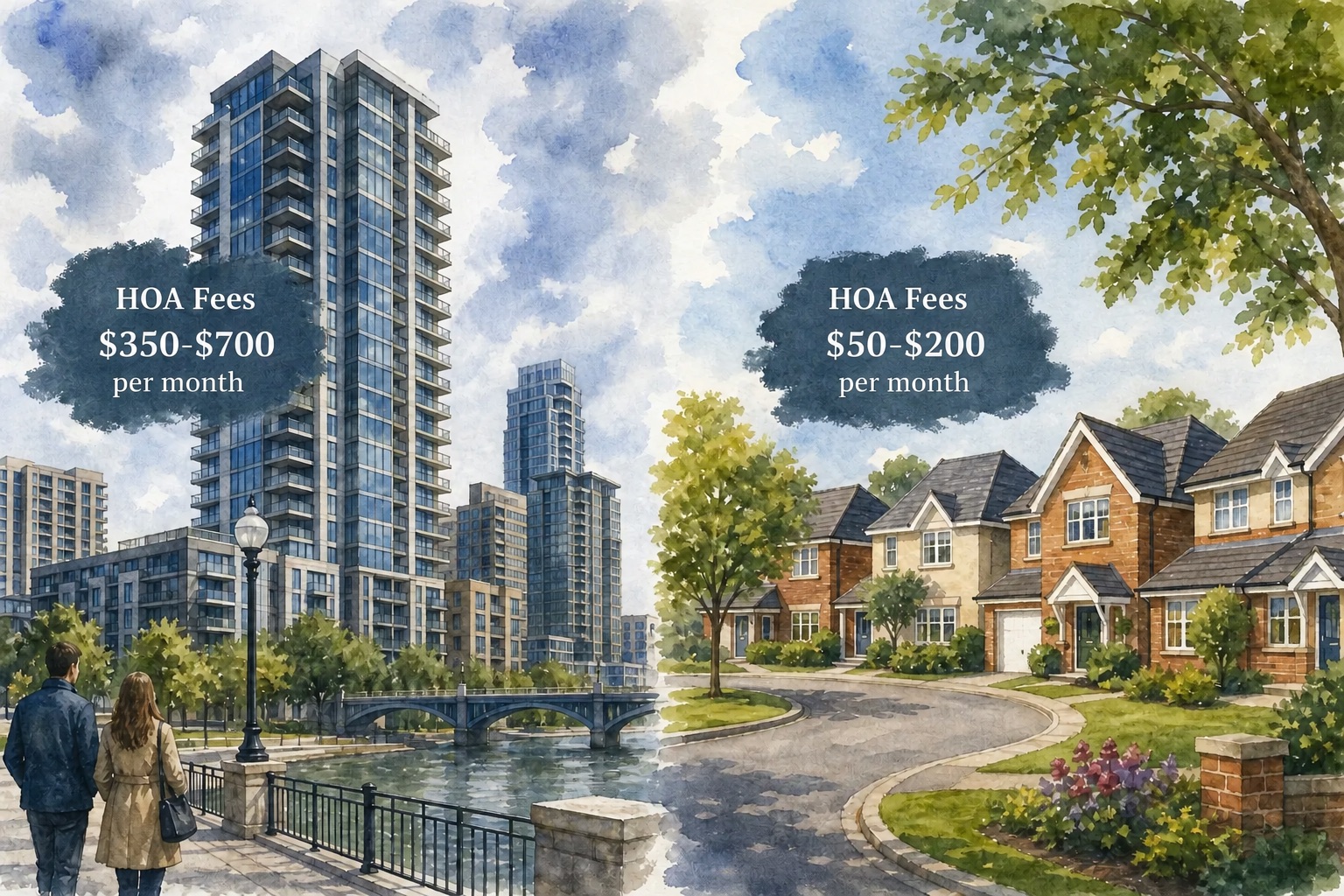
Standard mid‑rise and low‑rise condo communities built in the 2000s‑2010s have fees of $350‑$700 monthly, covering typical condo services. Subdivision HOAs, on the other hand, often keep fees low ($50‑$200) since they maintain common entry features and basic aesthetic standards.
Finally, the presence of a country‑club or private amenities dramatically hikes fees. Keep in mind that club membership dues are usually billed separately from the HOA fee.
Condo fees often reflect the services and amenities a building funds.
How to Judge the Fee Before You Buy
First, ask for the resale certificate and the most recent two‑year financial statements. Those documents reveal the current assessment, any pending special assessments, and the reserve fund balance.
Second, review the reserve funding level and consider whether it appears adequate for the association’s needs. A poorly funded reserve should prompt you to ask whether a price reduction or seller contribution to the reserves is appropriate.
Third, verify what services are bundled. A fee that includes water, trash, and insurance may actually be cheaper than a $200 fee that leaves you paying those utilities separately.
Fourth, check the HOA’s rules on rentals, architectural changes, and pet policies. If you plan to rent the unit or keep a dog, those restrictions can affect your lifestyle and resale value.
Fifth, run the numbers against your mortgage qualification. Lenders treat mandatory HOA dues as part of your housing expense, which can reduce the loan amount you qualify for. Use a mortgage calculator to see how the fee impacts your debt‑to‑income ratio.
Finally, ask your agent to request a copy of the reserve study and any upcoming capital project plans. Knowing whether a pool resurfacing is on the horizon helps you avoid surprise bills later.
For a deeper dive on how HOA fees affect mortgage qualification, see my Austin Condos for Sale guide. It walks through the math step‑by‑step.
Frequently Asked Questions
What is the typical HOA fee range for a single‑family home in Austin?
For newer suburban subdivision HOAs, fees range from $50 to $200 per month. These associations maintain common entry features and basic aesthetic standards.
Do HOA fees count toward my mortgage qualification?
Yes. Lenders add mandatory HOA dues to your housing expense when calculating your debt‑to‑income ratio, which can lower the loan amount you qualify for.
How often do HOA fees increase?
Fees can rise annually or as needed to cover inflation, insurance hikes, or new capital projects. Reviewing the reserve study helps you gauge how likely a big jump is.
What are special assessments?
Special assessments are one‑time charges for major repairs or upgrades that exceed the regular budget, such as roof replacement or elevator modernization.
Can I negotiate HOA fees?
You can ask the seller to adjust the purchase price or provide a credit if the reserve fund is under‑funded or a large special assessment is pending.
Are there any fees for reviewing HOA documents?
Ask the seller about any fees for reviewing HOA documents and request the documents before closing.
Conclusion
If you want a realistic picture of the Austin HOA fees average, start by pulling the resale certificate, checking reserve funding, and matching the fee to the amenities you actually use. Need help handling those documents? Reach out and I’ll walk through the numbers with you. If you are budgeting the whole purchase, my complete Austin closing cost guide covers the rest.
Categories
- All Blogs (978)
- !!! (59)
- !x (621)
- Austin Real Estate (113)
- Bee Cave Real Estate (1)
- Building A Home (14)
- Buying A Home (145)
- Buying Land (1)
- Cedar Park Real Estate (58)
- Central Austin Real Estate (75)
- Down Payment Assistance Programs (1)
- Downsizing (4)
- Downtown Austin Real Estate (5)
- Dripping Springs Real Estate (62)
- East Austin Real Estate (3)
- Financing and Mortgage (24)
- first-time homebuying (109)
- Georgetown Real Estate (9)
- Hill Country Real Estate (1)
- HOA (3)
- Home Appraisals (13)
- Home For Rent (1)
- Home Inspections (6)
- Home Pricing (6)
- Home Staging (1)
- Home Values (12)
- Home Warranties (1)
- Homeownership (1)
- Homes For Rent (1)
- Homes For Sale (147)
- Hutto Real Estate (5)
- Insurance (1)
- Investing (6)
- Investment Properties (4)
- Lakeway Real Estate (33)
- Leander Real Estate (59)
- LGBT+ Real Estate (8)
- Luxury Homes For Sale (5)
- Luxury Real Estate (19)
- Market Conditions (17)
- Moving to Austin (2)
- Moving to Texas (4)
- Negotiations (3)
- Neighborhoods (8)
- Northwest Austin Real Estate (94)
- Off Market Listings (7)
- Pflugerville Real Estate (11)
- Private Listings (2)
- Property Management (42)
- Property Tax (5)
- Real Estate (18)
- Reddit Question Answered (80)
- redwrite (63)
- Relocation (2)
- Renting (6)
- Representation (34)
- Round Rock Real Estate (59)
- Selling Your Home (62)
- South Austin Real Estate (1)
- Westlake Real Estate (3)
Recent Posts