Protecting LGBTQ Homebuyers: Fair Housing, Equality, and Finding Your Safe Space in Austin
Fair housing protections for LGBTQ+ homebuyers are genuinely more complicated right now than they were just a couple of years ago, and getting the current, accurate picture matters more than repeating outdated assumptions in either direction. This guide covers where federal, state, and Austin's own local protections actually stand today, and what LGBTQ+ buyers can do practically to protect themselves and find a genuinely welcoming community.
I am Robbie English, Broker, REALTOR at Uncommon Realty, and I've helped LGBTQ+ buyers navigate the Austin market for years. My goal here is to give you an honest, current, and accurate picture, not outdated reassurance.

What Changed At The Federal Level
Following the Supreme Court's 2020 Bostock decision, HUD announced in 2021 that it would enforce the federal Fair Housing Act's ban on sex discrimination to cover sexual orientation and gender identity. That federal enforcement posture has since been rolled back: HUD stopped enforcing that interpretation in 2025, and has moved to formally revise related rules. This is a genuine, significant shift from where things stood a few years ago, and it means federal protection for LGBTQ+ buyers under the Fair Housing Act is considerably less certain today than it was in 2021 and 2022.
Given how actively this area of federal policy is still shifting, I'd point you to HUD's own current guidance and a fair housing attorney for anything specific to your situation, rather than relying on a blog post to tell you exactly where federal enforcement stands on the day you're reading this.
What The Fair Housing Act Still Covers
It's worth being clear about what hasn't changed alongside what has. The federal Fair Housing Act itself still exists and still prohibits discrimination based on race, color, national origin, religion, sex, familial status, and disability, protections that remain firmly in place regardless of the current uncertainty specifically around sexual orientation and gender identity enforcement. The shift discussed above is specific to how HUD interprets and enforces the law's sex-discrimination provision as it applies to LGBTQ+ buyers, not a wholesale rollback of fair housing law generally.
This distinction matters practically. If you experience housing discrimination that also involves race, religion, familial status, or disability alongside any sexual-orientation or gender-identity component, those other protections remain squarely enforceable at the federal level regardless of how the specific LGBTQ+ enforcement question is currently being handled.
Texas Has No Statewide Protection
Texas has never had a comprehensive statewide law explicitly prohibiting housing discrimination based on sexual orientation or gender identity. This means protection for LGBTQ+ buyers across most of the state depends heavily on federal enforcement, which is currently in flux, and on local city ordinances where they exist, which vary considerably from one Texas city to the next.
Austin's Own Local Ordinance
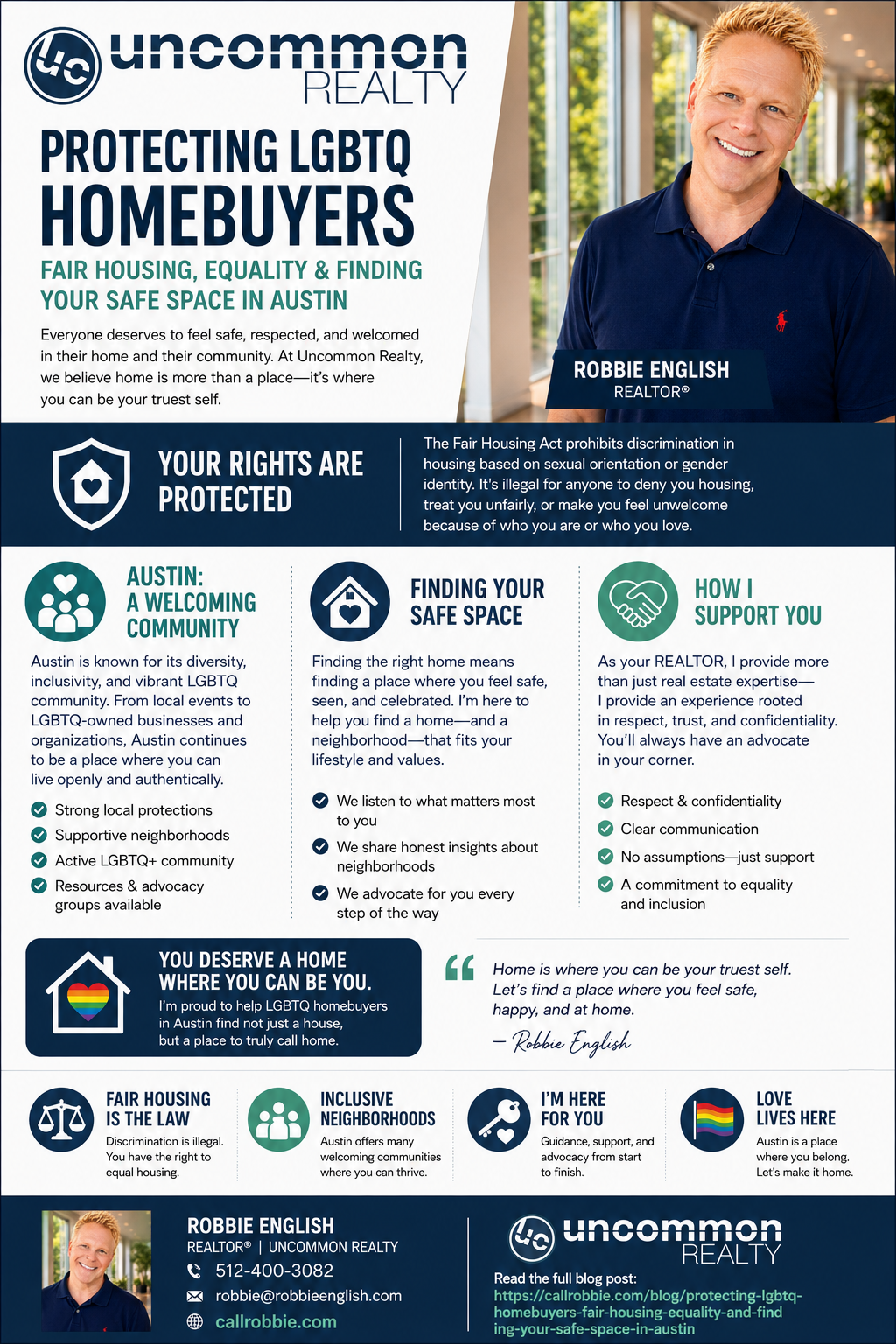
Austin is one of the Texas cities that has adopted its own local nondiscrimination ordinance, and the City of Austin's code explicitly includes protection from housing discrimination based on sexual orientation, transgender status, gender identity, and gender expression. This local protection exists independently of federal enforcement and, as of this writing, remains in place, giving LGBTQ+ buyers a genuine layer of protection within Austin city limits that isn't guaranteed statewide or, currently, at the federal level.
If you believe you've experienced housing discrimination in Austin, the city's Equity and Inclusion office handles enforcement of this local ordinance, and is worth contacting directly alongside, or instead of, federal channels depending on your specific situation.
Other Texas Cities With Local Protections
Austin isn't the only Texas city with a local nondiscrimination ordinance covering housing, though the specific protections and enforcement mechanisms vary from one municipality to the next. If your search extends beyond Austin proper into surrounding suburbs or other Texas cities, it's worth checking that specific city's own ordinance directly rather than assuming it mirrors Austin's, since protections genuinely differ across the metro and the state more broadly. Some surrounding suburbs have no local ordinance at all, which means protection there depends even more heavily on the current, shifting federal landscape.
This patchwork reality is exactly why understanding your specific city's protections, well beyond Texas's overall reputation alone, matters when you're evaluating where to focus your search within the greater Austin area.
Recognizing Housing Discrimination
Discrimination in real estate doesn't always look like an outright refusal. It can show up as being steered toward or away from specific neighborhoods, being given different or delayed information about available listings compared to other buyers, being quoted different terms, or facing unusual scrutiny during financing or negotiation that doesn't match how other buyers are treated in similar circumstances. Documenting specifics, dates, names, what was said, if you suspect any of this is happening is genuinely useful if you decide to pursue a complaint.
An agent's role should never involve steering you toward or away from a neighborhood based on personal characteristics, protected or not; that's illegal fair housing practice regardless of intent. A good agent gives you accurate, complete information about any area you're genuinely interested in and lets you make your own informed decision.
What To Do If You Experience Discrimination
If you believe you've experienced housing discrimination in Austin, document everything as thoroughly and promptly as you can: dates, names, exactly what was said or done, and any related communications, texts, emails, listing correspondence. This documentation matters regardless of which channel you ultimately pursue, since specific, contemporaneous records are considerably more useful than a general recollection compiled weeks or months later.
Within Austin city limits, the city's Equity and Inclusion office handles complaints under the local ordinance, and that avenue is currently more reliable than federal channels given the uncertainty at the HUD level discussed above. You can also consult a fair housing attorney, some work on a contingency basis for viable discrimination claims, to understand your specific options given your specific circumstances and location. Texas fair housing advocacy organizations can also provide guidance on which specific avenue makes the most sense for your situation.
It's worth noting that pursuing a complaint is a personal decision with real time and emotional costs, and there's no single right answer about whether to pursue one in any given situation. Understanding your options clearly, rather than feeling pressured either way, is what actually matters.
Choosing An Agent And Lender Who Get It
Given the current uncertainty at the federal level, working with an agent and lender who are genuinely knowledgeable about LGBTQ+ buyers' specific concerns, and who have real, demonstrated experience serving this community, matters more than ever. Ask directly about their experience, whether they're familiar with Austin's local ordinance, and how they'd handle a situation where you felt you were being treated differently than other buyers.
The same applies to lenders. Ask directly how a lender handles income verification for unmarried co-buyers or same-sex couples, and whether they have specific experience with LGBTQ+ borrowers, since the mechanics of a joint purchase can differ meaningfully depending on marital status and how a lender structures the loan.
Navigating Financing As A Same-Sex Couple Or Unmarried Buyers
Married same-sex couples generally navigate mortgage applications the same way any married couple does, since marriage equality remains federal law nationwide following Obergefell v. Hodges. The more common complexity arises for unmarried couples purchasing together, gay or straight, where lenders evaluate each buyer's income, credit, and assets somewhat differently than they would a married couple's combined household finances.
If you're purchasing with a partner you're not legally married to, ask your lender directly how they'll structure the loan, whether both names will be on the loan and the title, and how they handle a situation where one partner has meaningfully stronger credit or income than the other. These are practical mechanics that apply to any unmarried co-buyers, but they're worth understanding clearly before you're deep into the financing process rather than discovering complications partway through.
Estate Planning And Title Considerations
Beyond the purchase itself, how you hold title, jointly, as tenants in common, or another structure, has real implications for what happens to the property if one partner passes away or if the relationship ends, particularly for unmarried couples who don't have the automatic legal protections that come with marriage. This is genuinely worth discussing with a real estate attorney at the time of purchase, not as an afterthought, since the right structure depends on your specific relationship, financial situation, and long-term plans.
This isn't a uniquely LGBTQ+ concern, any unmarried co-buyers face similar considerations, but it's worth flagging directly here since it's a practical step that's sometimes overlooked amid the broader excitement of a home purchase.
Finding A Genuinely Welcoming Community
Austin has a real, genuinely well-established LGBTQ+ community and hosts one of the larger Pride celebrations in the entire state of Texas, drawing hundreds of thousands of attendees annually to its events. Neighborhood character and community feel are genuinely worth exploring in person, through open houses, local events, and simply spending time in an area at different times, rather than relying solely on a neighborhood's general reputation.
An agent should present this information as one factor among many for you to weigh, not steer your search based on it. The distinction matters both legally and practically: you're the one deciding what community fit means for you, with accurate information rather than assumptions made on your behalf.
It's also worth talking directly to current residents of any neighborhood you're seriously considering, whether through open houses, local community groups, or simply conversations during a showing, rather than relying solely on a neighborhood's broader reputation. Reputation can lag or outpace reality in either direction, and firsthand, current perspective from people actually living there tends to be more reliable than a general impression.
Staying Current On A Genuinely Evolving Area
Given how much has changed at the federal level since 2021, and given that HUD's rules in this specific area continue to be actively revised, treat any specific legal claim, including the ones in this guide, as a starting point rather than a final answer. Check HUD's own current published guidance, Equality Texas's tracking of state and federal policy, and, for anything specific to your own transaction, a qualified fair housing attorney, since blog content, including this one, can become outdated as federal rulemaking continues to develop.
This isn't meant to create unnecessary anxiety, it's meant to be honest about the fact that this specific area of law is genuinely in flux in a way that many other parts of real estate law simply aren't right now, and treating it with that appropriate seriousness serves you better than either false reassurance or unnecessary alarm.
Healthcare And Other Considerations Beyond Housing
If healthcare access, family law considerations, or other legal protections factor into your decision about where to live, these are genuinely worth researching directly through organizations that specialize in them rather than relying on general real estate guidance. Equality Texas tracks current state-level policy and legal protections, and Out Youth is a well-established Austin-based resource, particularly for LGBTQ+ youth and families. Both are better positioned than a real estate guide to give you current, accurate information on rapidly evolving legal questions outside of housing itself.
What This Means Practically For Your Search
Given the current federal uncertainty, leaning on Austin's own local ordinance, working with genuinely knowledgeable professionals, and carefully documenting anything that feels like differential treatment are the most concrete, practical steps genuinely available to you right now. This isn't a reason to avoid buying in Austin or Texas; it's a genuine reason to go in fully informed rather than assuming protections that may not currently apply the same way they did just a few years ago.
None of this should overshadow the fact that Austin remains a genuinely welcoming, well-established community for LGBTQ+ residents in practice, even as the specific legal protections underlying that reality continue to shift. Real community and real legal protection are related but distinct things, and understanding both accurately serves you far better than conflating them.
Bringing It All Together
The fair housing landscape for LGBTQ+ buyers has genuinely and meaningfully shifted at the federal level since 2021, even as Austin's own local ordinance continues to provide real, currently enforceable protection within city limits specifically. Understanding where things actually stand today, rather than relying on outdated assumptions in either direction, is what lets you search with clear eyes and real information. Working with professionals who understand this landscape, documenting anything concerning, and leaning on established organizations like Equality Texas for anything outside of housing itself are the practical steps that matter most right now.
Whatever your specific circumstances or concerns, I'm glad to help you navigate this search with real honesty and genuine care for your specific situation, not a one-size-fits-all script. You can browse current Austin listings on my website or reach out through my app.
Written for buyers and sellers in the Greater Austin, Texas area by Robbie English, REALTOR, Broker at Uncommon Realty.
Categories
- All Blogs (978)
- !!! (59)
- !x (621)
- Austin Real Estate (113)
- Bee Cave Real Estate (1)
- Building A Home (14)
- Buying A Home (145)
- Buying Land (1)
- Cedar Park Real Estate (58)
- Central Austin Real Estate (75)
- Down Payment Assistance Programs (1)
- Downsizing (4)
- Downtown Austin Real Estate (5)
- Dripping Springs Real Estate (62)
- East Austin Real Estate (3)
- Financing and Mortgage (24)
- first-time homebuying (109)
- Georgetown Real Estate (9)
- Hill Country Real Estate (1)
- HOA (3)
- Home Appraisals (13)
- Home For Rent (1)
- Home Inspections (6)
- Home Pricing (6)
- Home Staging (1)
- Home Values (12)
- Home Warranties (1)
- Homeownership (1)
- Homes For Rent (1)
- Homes For Sale (147)
- Hutto Real Estate (5)
- Insurance (1)
- Investing (6)
- Investment Properties (4)
- Lakeway Real Estate (33)
- Leander Real Estate (59)
- LGBT+ Real Estate (8)
- Luxury Homes For Sale (5)
- Luxury Real Estate (19)
- Market Conditions (17)
- Moving to Austin (2)
- Moving to Texas (4)
- Negotiations (3)
- Neighborhoods (8)
- Northwest Austin Real Estate (94)
- Off Market Listings (7)
- Pflugerville Real Estate (11)
- Private Listings (2)
- Property Management (42)
- Property Tax (5)
- Real Estate (18)
- Reddit Question Answered (80)
- redwrite (63)
- Relocation (2)
- Renting (6)
- Representation (34)
- Round Rock Real Estate (59)
- Selling Your Home (62)
- South Austin Real Estate (1)
- Westlake Real Estate (3)
Recent Posts