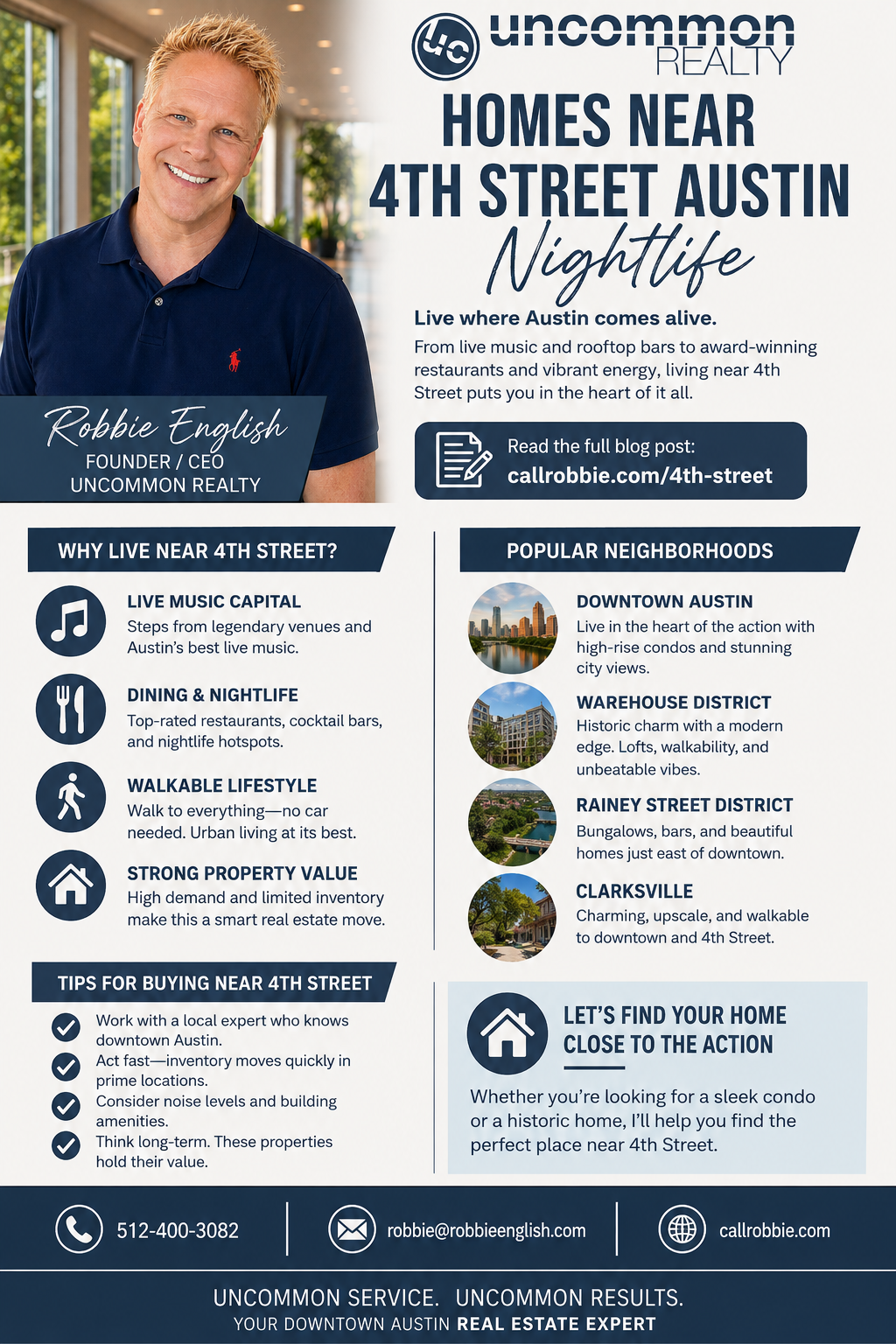
Homes Near 4th Street Austin Nightlife

If you are searching for homes near 4th Street in Austin, you are looking at one of the most energetic, walkable pockets of the entire city, right in the heart of downtown's entertainment district. The first thing to understand is what "homes" means here: near 4th Street, that almost always means a condo or loft in a high-rise or mid-rise building rather than a single-family house, because this is the urban core. Knowing that up front, and understanding what your budget buys and what it costs to own, is what turns an exciting idea into a smart purchase. I am Robbie English, Broker, REALTOR at Uncommon Realty, and I have guided many buyers through this exact search.

What living near 4th Street really means
The 4th Street area sits in downtown Austin's Warehouse District, one of the city's central nightlife and entertainment hubs. Living here puts you within walking distance of bars, restaurants, live music, the 2nd Street District's shopping, Rainey Street, the Red River music scene, and the Lady Bird Lake hike-and-bike trail. For the right person, that walkable, car-optional, always-something-happening lifestyle is the entire point, and it is genuinely hard to replicate anywhere else in Austin. You trade a yard and a garage for stepping out your door into the middle of the action.
Because this is the urban core, the housing stock is overwhelmingly vertical. You will be choosing among high-rise towers, mid-rise buildings, and converted loft spaces, each with its own personality, amenity set, and price tier. There are dozens of residential buildings in and around the 78701 zip code, from sleek luxury high-rises with concierge service to more modest older units, so the building you choose matters as much as the unit itself.
Proximity is the whole value proposition here, and it is worth picturing concretely. From a home near 4th Street you can typically walk to dinner, to a show, to the office, and to the lake trail without ever getting in a car, and a rideshare home from anywhere downtown is a few minutes. That density of options is what draws people who have spent years commuting and are ready to trade the car-dependent life for something more immediate. It also tends to appeal to professionals, empty nesters downsizing from the suburbs, and buyers who travel often and want a lock-and-leave home, more than it appeals to families needing yards and specific school zones.
The price picture in 2026
Downtown Austin condos span a wide range. In 2026, sold prices in the 78701 zip code have run roughly from the $460,000s up past $1 million, with an average downtown condo sale price around $899,000 and a price per square foot commonly in the mid-$500s, higher in premium high-rises. In practical terms, a budget in the mid-$400s to mid-$900s opens up real, varied options near 4th Street, from smaller or older units at the lower end to larger, higher-floor, or more amenity-rich condos as you move up. You are not locked out at this price; you are choosing among genuinely different downtown lifestyles.
What your money buys shifts sharply with the building and the floor. A lower floor in an older building costs far less than a high-floor unit with skyline or lake views in a newer luxury tower, even within the same few blocks. Views, orientation, floor level, and the building's age and amenities drive price as much as square footage does, which is exactly why pricing a downtown condo correctly takes local knowledge rather than a glance at an online estimate.
It also helps to think in price per square foot rather than sticker price alone, because downtown units vary so much in size. A compact, efficient one-bedroom and a sprawling two-bedroom can both fall in this range while offering completely different lifestyles, and the per-square-foot figure, along with what the building includes, tells you far more about relative value than the headline number. Comparing a unit against recent sales in the same building is the most reliable read of all, since two towers a block apart can price very differently based on their age, amenities, and reputation.
The cost that surprises buyers: HOA and the full monthly picture
Here is the single most important thing to understand before buying near 4th Street: the purchase price is only part of the cost. Downtown high-rise condos carry substantial HOA dues, commonly running from around $750 to $1,100 a month for many units and climbing to $1,200 to $1,800 or more for larger units in amenity-rich luxury buildings. Those dues typically cover building amenities, common areas, security, and some utilities, but they are a real, recurring line item that dramatically changes your monthly math. On top of that come Texas property taxes on the unit and, often, separate or limited parking. A downtown condo and a suburban house at the same purchase price can have very different monthly costs once HOA dues are factored in, so budgeting for the complete picture from the start is essential rather than optional.
The lifestyle tradeoffs, honestly
Living in the middle of a nightlife district is a genuine joy for the right buyer and a genuine mismatch for the wrong one, so it is worth being clear-eyed. On the plus side: unmatched walkability, no commute to downtown jobs, building amenities like pools, fitness centers, and concierge service, a lock-and-leave simplicity that suits travelers, and a front-row seat to the city's culture. On the other side: noise is real, especially in units facing the busiest blocks and on weekend nights, parking and guest parking can be limited and costly, there is no private yard, and event weekends bring crowds and congestion. None of this is a dealbreaker for the buyer who wants this life; it simply means the specific building and even the specific unit orientation matter enormously.
A practical example: two units in the same building can offer very different daily experiences depending on which way they face. A unit oriented toward the busiest nightlife blocks will hear more of the weekend energy, which some buyers love and others find wearing, while a unit facing the lake or a quieter side street in the same tower can feel like a completely different home. Higher floors generally trade street-level noise for wind and elevator time, and they usually command a premium for the views. These are the kinds of distinctions that do not show up in a listing photo but shape how much you actually enjoy living there, which is why touring at different times, including a weekend evening, is worth the effort before you commit.
How to evaluate the right building and unit
Near 4th Street, you are buying into a building as much as a home, so the diligence is different from a house. Look closely at the building's financial health: its HOA reserves, budget, and any special assessments, because a poorly funded association can mean surprise costs later. Check for rental caps or restrictions if you might ever lease the unit, and confirm the building is warrantable for financing, since some condo buildings face lending limitations that affect both your purchase and your future resale. Then evaluate the unit itself for noise exposure relative to the nightlife blocks, floor and view, natural light and orientation, and parking. This is where representation earns its keep, because the difference between two similar-looking units, or two nearby buildings, can be significant once you look past the finishes.
Resale is worth thinking about at purchase, too. Downtown condos tend to draw a specific pool of buyers, urban professionals, downsizers, and second-home owners, so the building's reputation, financial health, and financeability all affect how easily you can sell later, not only how you live now. A well-run building in a desirable location holds its appeal to the next buyer; a building with troubled finances or lending restrictions can be harder to exit even in a strong market. Buying with that future sale in mind is part of buying well, and it is a lens I bring to every downtown purchase rather than focusing only on the unit in front of us today.
If you are weighing downtown against other close-in, walkable options, my guide to the best walkable neighborhoods in Central Austin for buyers who want culture, nightlife, and community is worth reading, and for the bigger-picture decision I cover whether Central Austin is a good place to buy a home in 2026.
How to compete in a downtown market
The broader Austin market has cooled from its 2022 peak and now leans toward buyers, which gives you more time and negotiating room than a few years ago, and downtown is no exception. Well-priced, well-located units in desirable buildings still attract interest, so preparation matters. Get fully pre-approved with a lender who understands condo financing and building warrantability, know which buildings fit your budget and lifestyle before you tour, lean on comparable sales within the same or similar buildings rather than list prices, and use the Texas option period to inspect the unit and review the association's documents carefully. A downtown purchase rewards a prepared, decisive buyer who has done the building homework.
How I help
When I work with buyers near 4th Street, we start by matching your budget and lifestyle to the specific buildings that fit, then dig into building financials, HOA realities, and unit-level details like noise and views so you know exactly what you are buying, and I represent you through the offer, the option period, inspections, and closing with the current market's leverage on your side. My team and I do this across downtown and Central Austin, and you can reach Uncommon Realty and my team whenever you want to talk it through.
The best first step is to see what is actually available. Browse current listings on my website, or download my app to follow downtown listings in real time and reach me with questions. When you are ready to find your place near 4th Street, I am here to help you do it with clear eyes and real numbers.
Written for buyers and sellers in the Greater Austin, Texas area by Robbie English, REALTOR, Broker at Uncommon Realty.
Categories
- All Blogs (959)
- !!! (59)
- !x (621)
- Austin Real Estate (106)
- Bee Cave Real Estate (1)
- Building A Home (14)
- Buying A Home (143)
- Buying Land (1)
- Cedar Park Real Estate (57)
- Central Austin Real Estate (75)
- Down Payment Assistance Programs (1)
- Downsizing (3)
- Downtown Austin Real Estate (5)
- Dripping Springs Real Estate (62)
- East Austin Real Estate (3)
- Financing and Mortgage (23)
- first-time homebuying (109)
- Georgetown Real Estate (9)
- Hill Country Real Estate (1)
- HOA (2)
- Home Appraisals (13)
- Home For Rent (1)
- Home Inspections (6)
- Home Pricing (6)
- Home Staging (1)
- Home Values (12)
- Homeownership (1)
- Homes For Rent (1)
- Homes For Sale (147)
- Hutto Real Estate (5)
- Investing (6)
- Investment Properties (4)
- Lakeway Real Estate (33)
- Leander Real Estate (59)
- LGBT+ Real Estate (8)
- Luxury Homes For Sale (5)
- Luxury Real Estate (19)
- Market Conditions (16)
- Moving to Austin (2)
- Moving to Texas (4)
- Negotiations (3)
- Neighborhoods (8)
- Northwest Austin Real Estate (94)
- Off Market Listings (7)
- Pflugerville Real Estate (10)
- Private Listings (2)
- Property Management (42)
- Property Tax (3)
- Real Estate (18)
- Reddit Question Answered (80)
- redwrite (63)
- Relocation (2)
- Renting (6)
- Representation (34)
- Round Rock Real Estate (58)
- Selling Your Home (62)
- South Austin Real Estate (1)
- Westlake Real Estate (3)
Recent Posts