Austin Real Estate Market Conditions

If you are trying to understand Austin real estate market conditions right now, the short version is this: the market in 2026 has shifted decisively toward buyers, cooling from the frenzy of a few years ago into something far more balanced and negotiable. That is good news for buyers and a reality check for sellers, and understanding the specifics is what lets you act well rather than react to headlines. I am Robbie English, Broker, REALTOR at Uncommon Realty, and I read this market for clients every day.

The numbers that define the 2026 market
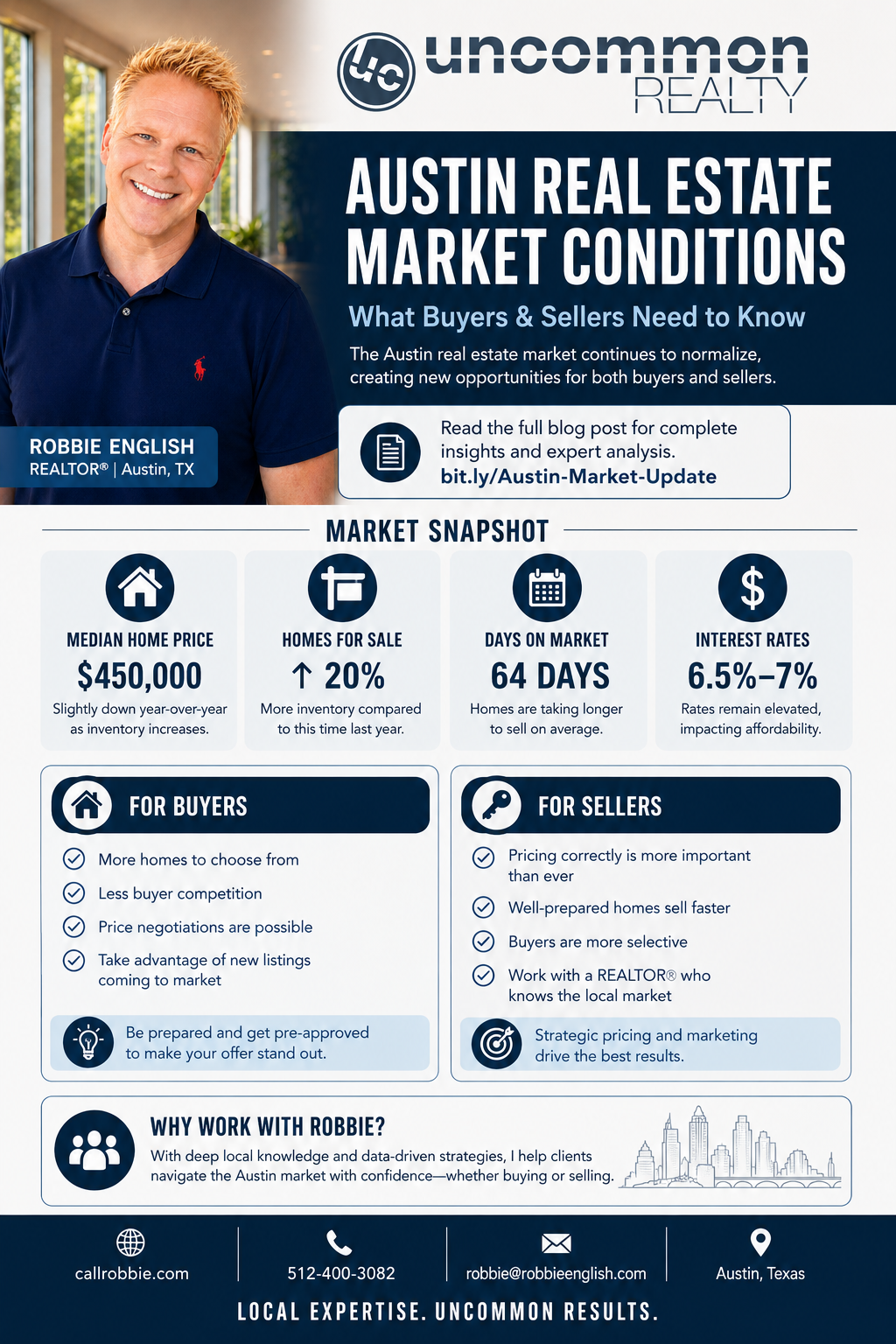
A few figures tell the story. The Austin metro median home price sits around $440,000 in 2026, down roughly 20 to 25 percent from the May 2022 peak. Inventory has climbed to several months of supply, well into buyer's-market territory, homes are taking longer to sell than they did during the boom, and many are closing at or below asking price rather than above it. That is a very different environment from the bidding wars and waived contingencies of 2021 and 2022. You can track where things stand at any time with my live Austin market snapshot and the Austin market data.
The most important caveat is that there is no single Austin market. Conditions vary meaningfully by neighborhood, price point, and property type. Close-in, supply-constrained areas hold up differently than the outer suburbs, well-priced move-in-ready homes still move quickly while overpriced or dated ones sit, and the condo market behaves differently from single-family. So a metro-wide median is a starting point, not the whole answer for the specific home you are buying or selling.
How the market got here
Understanding today's conditions is easier with a little context. During the pandemic, Austin saw an extraordinary surge, prices ran up dramatically into the May 2022 peak on a wave of migration, remote work, and historically low mortgage rates. When rates climbed sharply afterward, affordability tightened, demand cooled, and the market began working off that overheated peak. At the same time, a large amount of new construction that had been started during the boom kept arriving, adding to inventory just as demand softened. The result is the rebalanced market of 2026: prices well off the peak, inventory replenished, and negotiating power back in buyers' hands. Seen this way, the current market is a return toward normal after an abnormal few years, not a sign of collapse.
Mortgage rates are a big part of the picture and worth watching. Rates in 2026 remain well above the historic lows that fueled the 2021 boom, which is a major reason the market cooled and why affordability, not a lack of desire to live here, is the main constraint on demand. For a buyer, that means your purchasing power is closely tied to the rate you lock, and it makes getting your financing sharp before you shop more important than it was in a low-rate world. The softer prices and stronger negotiating position are a real offset to higher rates, which is why waiting indefinitely for a perfect moment often costs more than it saves.
What today's market means for buyers
For buyers, 2026 is the most favorable environment in years. You generally have more inventory to choose from, more time to make a considered decision, and real leverage to negotiate on price, on repairs after inspection, and on terms, rather than stripping away your own protections to win. That does not mean you can be passive: the best-priced homes in the most desirable areas still attract interest and can move quickly, so preparation matters. Get fully pre-approved before you shop, lean on comparable sales rather than list prices to gauge value, and use the Texas option period to inspect thoroughly and negotiate from a position of information. The buyers who do best in this market are prepared and decisive, not the ones who assume everything will wait for them.
The leverage shows up in concrete ways worth using. Sellers are more open to price reductions and to covering closing costs than they were a few years ago. After an inspection, asking for repairs or a credit is normal again rather than a way to lose the deal. And you can include the contingencies that protect you, financing, appraisal, and the option period, without feeling pressured to waive them to compete. For a buyer who was priced out or outbid during the frenzy, this is a genuinely different and more humane market to shop in, and a good agent helps you press that advantage without overreaching on a home that will still draw competition.
What today's market means for sellers
For sellers, the message is realism, not alarm. Homes are still selling, but the days of naming a price and watching offers pour in are over for now. Pricing correctly from the start is the single most important decision, because an overpriced home in a buyer's market sits, accrues days on market, and often ends up selling for less than a well-priced home would have. Condition and presentation matter more than they did when buyers had no choice; move-in-ready, well-staged homes still command attention and strong offers. And be prepared to negotiate on repairs and terms, since buyers now have the leverage to ask. A home priced and prepared to the current market still sells well; one priced to the last market does not.
Timing and strategy matter for sellers too. The first two weeks a home is on the market are when it draws the most attention, so launching at the right price rather than testing a high number and cutting later is what protects your outcome. It also helps to understand your buyer: in this market they are more cautious, more likely to negotiate, and more sensitive to condition and to how the monthly payment pencils out at current rates. Pricing with real, recent comparable sales, not last year's peak numbers or an online estimate, and presenting the home well are the two levers most within your control, and together they make the difference between a clean sale and a listing that lingers.
Why Austin still attracts demand
Even in a cooler market, the fundamentals that drew people to Austin remain intact, which is why this is a rebalancing rather than a collapse. The region still has a deep technology and employer base, from Apple, Tesla, and Samsung to Dell, Oracle, Google, and Meta, Texas still has no state income tax, and the lifestyle, weather, and culture that made Austin a magnet have not changed. Migration into the metro continues, if at a more sustainable pace than the pandemic surge, with buyers still arriving from higher-cost states drawn by the combination of jobs, tax treatment, and lifestyle. New employers and expansions keep landing in the region, and the population base that has moved here over the past several years is now itself a source of ongoing move-up and move-around demand. That underlying demand is what supports the market at these levels and is a big part of why close-in, supply-limited areas have held their value even as the metro cooled. It is also worth remembering that a rebalanced market is a healthier one. The extreme conditions of 2021 and 2022 priced out many local buyers and forced risky decisions like waiving inspections; a market with normal inventory and normal negotiating dynamics is more sustainable for everyone and less prone to the kind of overheating that ends in a sharp correction. For long-term owners, that stability is a feature, not a bug, and it is part of why Austin's fundamentals continue to support the market even without the pandemic-era mania.
If you want to see how a specific area is trading, I track hyperlocal conditions like the Domain area, Allandale, and Northwest Hills at the neighborhood level.
How to read the market for your own decision
The headlines about Austin, up or down, are too broad to guide an individual purchase or sale. What matters is how conditions look for your specific price point, neighborhood, and timeline. A first-time buyer at the metro median faces a different market than a luxury seller close in, and a downtown condo owner faces different dynamics than a suburban family home. The useful questions are always local and specific: how much comparable inventory is there, how long are similar homes taking to sell, and where are they landing relative to list. Those answers, not the metro-wide narrative, should drive your decision. This is also why timing the overall market rarely works as well as buying or selling the right property at the right price for your own life; someone waiting for a metro-wide bottom can easily miss the right home in the right neighborhood while watching an average that may not reflect their segment at all. For the bigger-picture question of whether a close-in purchase makes sense right now, I cover that in whether Central Austin is a good place to buy a home in 2026, and for buyers worried about competing, I address that in why buyers are losing homes in Austin and how to fix it.
How I help
Reading this market well is where good representation earns its keep. When I work with clients, we start with the real, hyperlocal data for your exact situation rather than the metro-wide headline, then build a strategy around it, an aggressive but disciplined offer for a buyer, or a pricing and presentation plan for a seller, and I represent you through negotiation, inspections, and closing with the current market's leverage working in your favor. My team and I do this across the whole metro, and you can reach the Uncommon Realty team whenever you want a clear read on your situation.
What I try to give every client is context rather than noise. Market headlines swing between panic and hype, and neither serves you when you are making one of the largest financial decisions of your life. The reality in 2026 is more measured than either extreme: a rebalanced market with genuine opportunity for prepared buyers and solid outcomes for realistic sellers. Understanding where your specific segment sits within that, and acting on real numbers rather than a general mood, is what separates a confident decision from a stressful guess. That clarity is the whole point of working with someone who watches this market closely, day in and day out, across every neighborhood and price point in the metro rather than from a single headline number.
The best first step is to see real data for your area and price point. Check my live market snapshot, or download my app to follow listings and conditions in real time and reach me with questions. When you are ready to make a move in this market, I am here to help you do it with clear eyes and real numbers.
Written for buyers and sellers in the Greater Austin, Texas area by Robbie English, REALTOR, Broker at Uncommon Realty.
Categories
- All Blogs (970)
- !!! (59)
- !x (621)
- Austin Real Estate (113)
- Bee Cave Real Estate (1)
- Building A Home (14)
- Buying A Home (143)
- Buying Land (1)
- Cedar Park Real Estate (58)
- Central Austin Real Estate (75)
- Down Payment Assistance Programs (1)
- Downsizing (4)
- Downtown Austin Real Estate (5)
- Dripping Springs Real Estate (62)
- East Austin Real Estate (3)
- Financing and Mortgage (24)
- first-time homebuying (109)
- Georgetown Real Estate (9)
- Hill Country Real Estate (1)
- HOA (2)
- Home Appraisals (13)
- Home For Rent (1)
- Home Inspections (6)
- Home Pricing (6)
- Home Staging (1)
- Home Values (12)
- Homeownership (1)
- Homes For Rent (1)
- Homes For Sale (147)
- Hutto Real Estate (5)
- Investing (6)
- Investment Properties (4)
- Lakeway Real Estate (33)
- Leander Real Estate (59)
- LGBT+ Real Estate (8)
- Luxury Homes For Sale (5)
- Luxury Real Estate (19)
- Market Conditions (17)
- Moving to Austin (2)
- Moving to Texas (4)
- Negotiations (3)
- Neighborhoods (8)
- Northwest Austin Real Estate (94)
- Off Market Listings (7)
- Pflugerville Real Estate (10)
- Private Listings (2)
- Property Management (42)
- Property Tax (3)
- Real Estate (18)
- Reddit Question Answered (80)
- redwrite (63)
- Relocation (2)
- Renting (6)
- Representation (34)
- Round Rock Real Estate (59)
- Selling Your Home (62)
- South Austin Real Estate (1)
- Westlake Real Estate (3)
Recent Posts