
Why Acreage Living in Dripping Springs Feels Different
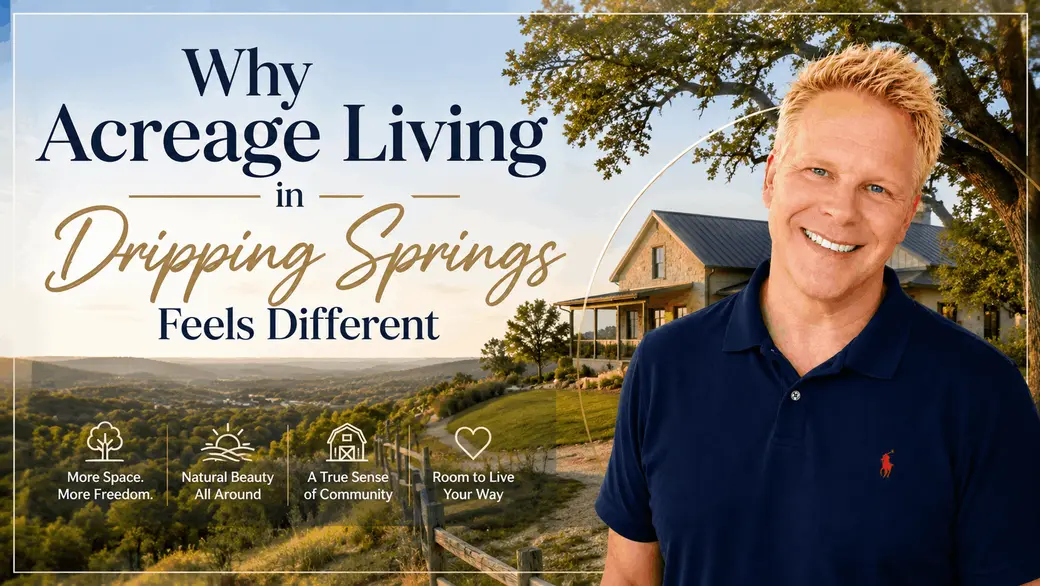
Acreage in Dripping Springs isn't just more square footage of dirt around a house — it changes the legal and financial shape of the purchase, not just the lifestyle. I've written separately about buying raw land here (wells, septic, topography) and about outdoor living features once you're building. This one is about what actually changes day to day, and on your tax bill, once you own several acres instead of a standard lot — the parts of acreage ownership that don't show up in a listing description but shape whether the property actually delivers what you're picturing.
TLDR: Why Acreage Living Feels Different
- An agricultural exemption in Hays County requires a minimum of 5 acres actively used, and can meaningfully lower your annual property tax bill.
- A wildlife management exemption needs 20 acres standalone (or 12.5 as part of a larger managed tract), plus a TPWD-approved plan and prior ag-use history.
- Fencing, gates, and often a private road or shared easement become your responsibility, not the city's.
- Privacy on acreage is a function of lot layout and tree cover, not just total acreage — two 10-acre properties can feel completely different.
- Livestock, guest houses, and outbuildings are usually possible but depend on deed restrictions specific to that parcel.
The Tax Math That Comes With More Land
This is the part that surprises buyers moving from a standard subdivision lot: acreage in Hays County can qualify for meaningfully lower property taxes through an agricultural exemption, but only if you actually meet the requirements. The minimum is 5 acres actively managed for agricultural use — grazing, hay production, or similar — and the exemption has to be applied for by April 30 of the tax year. Beekeeping is a lower-effort path some buyers use specifically to qualify: Hays County's standard is 5 acres with at least 6 colonies.
A wildlife management exemption is a step further and requires more acreage — 20 acres for a standalone tract, or 12.5 acres if the property is part of a larger, jointly managed wildlife area, and the land must have already qualified for 1-d-1 open-space appraisal the prior year under an approved Texas Parks and Wildlife Department plan. None of this happens automatically when you buy acreage; if lowering your tax bill through one of these exemptions is part of your financial plan, confirm the seller's current exemption status and what it would take to maintain or newly qualify before you're under contract, not after you own it.
Fencing, Roads, and Who's Actually Responsible
Inside a standard subdivision, the city or HOA usually handles the street in front of your house and you rarely think about a property-line fence. On acreage, that changes. Many properties sit on a private road or shared easement road maintained by the property owners along it, sometimes formally through a road maintenance agreement and sometimes informally by whoever's willing to grade it. Fencing the perimeter, whether for livestock, privacy, or simply marking the property line, is typically the owner's cost and responsibility, and the condition of existing fencing on a listing is worth inspecting directly rather than assuming it's adequate.
Ask specifically who maintains the road serving a property, whether there's a formal agreement in place, and what condition the perimeter fencing is in before you assume acreage living means fewer maintenance responsibilities than a subdivision home — in some ways it means more, just different ones.
Privacy Depends on Layout, Not Just Acreage
Two properties with the same total acreage can feel completely different depending on where the house sits relative to the property lines, how much tree cover exists between you and neighboring parcels, and the shape of the lot itself. A narrow, elongated 10-acre parcel with neighbors close on two sides can feel less private than a more square 6-acre parcel surrounded by undeveloped land. Walk the actual property and look at what's around it — including what's currently undeveloped and could be built on later — rather than assuming acreage alone guarantees the seclusion you're picturing.
What Neighbors Actually Look Like on Acreage
"Neighbors" on acreage means something different than in a subdivision. You might share a fence line or a private road with one adjacent property owner rather than being surrounded on all sides, and the relationship with that neighbor — over road maintenance, fencing, or livestock — can matter more than it would in a typical neighborhood where an HOA handles disputes. Before buying, it's worth understanding who's actually adjacent to a specific property and what the existing arrangements are for shared roads or boundaries, since that's a relationship you'll likely have for as long as you own the place.
What You Can Actually Do With the Land
Livestock, guest houses, workshops, and additional structures are generally more achievable on acreage than on a standard lot, but "generally" isn't "always." Deed restrictions specific to a parcel or subdivision can still limit structure size, livestock type or number, or additional dwellings, even on several acres. If a specific use — horses, a guest house for family, a workshop for a business — is part of why you want acreage in the first place, confirm it against that property's actual restrictions before you get attached to it, the same diligence I'd recommend on any deed-restriction question in this market.
Utilities and Systems Don't Change Just Because You Have More Land
Acreage doesn't exempt a property from the well, septic, and electricity considerations that come with any non-municipal-utility home in this area — if anything, a larger property can mean more distance between the house and where utilities tie in, which affects cost. I've covered the specific numbers on wells, septic systems, and electric line extension separately in the land-buying guide — the short version is that more acreage sometimes means a longer, more expensive path to get utilities to the actual building site, not a simpler one.
Choosing the Right Amount of Acreage for You
More acreage isn't automatically better — it's more land to maintain, more perimeter to fence, and a higher price tag, and the tax exemptions only kick in at specific thresholds. If you have no interest in an ag or wildlife exemption and just want privacy and space, 2-4 acres with good tree cover and thoughtful layout can deliver that without the maintenance burden of 10-plus acres. If the exemption itself is part of your financial planning, the 5-acre ag minimum or 20-acre wildlife minimum should drive your search from the start, not become an afterthought once you've already found a property you like. Tell me which category you're in early, because it changes which listings are actually worth touring.
Resale Considerations for Acreage Properties
Acreage resells differently than a standard subdivision home. The buyer pool is smaller and more specific — people who want land, not just a house — which can mean a longer time on market even for a well-priced property, but also less direct comparison pressure from a dozen similar listings nearby. An active agricultural or wildlife exemption can be a genuine selling point for the next buyer if it's documented and transferable, so maintaining that status isn't just about your own tax bill; it's part of the property's future value.
Insurance Considerations Specific to Acreage
Homeowners insurance on acreage properties can carry different considerations than a standard subdivision policy — distance from the nearest fire station or hydrant can affect rates, outbuildings and barns typically need to be scheduled separately, and any livestock or agricultural activity may require its own liability coverage beyond a standard homeowners policy. Get an actual quote on a specific property before you assume insurance costs will be comparable to a subdivision home of similar value.
Moving Quickly When the Right Property Comes Up
Acreage inventory that actually delivers privacy, buildable topography, and realistic utility access is genuinely limited in this market. Live MLS search and my mobile app both send real-time alerts rather than a daily digest, and you can message me directly through the app if a new listing comes up and you want a same-day read on its exemption status, road situation, and utility access before you drive out to see it.
Working With Someone Who Checks the Details That Matter
Acreage transactions have more moving pieces than a standard home purchase — exemption status, road agreements, fencing condition, deed restrictions, utility distance — and most of those pieces don't show up in listing photos. I'm Robbie English, Broker, REALTOR at Uncommon Realty, and if you're specifically shopping acreage in Dripping Springs, I'll walk each of these through with you on a specific property rather than treating it like a standard home search, including whether an exemption on a listing is actually documented, transferable, and worth planning your acreage size around.
Written for buyers and sellers in the Greater Austin, Texas area by Robbie English, REALTOR, Broker at Uncommon Realty.
Categories
- All Blogs (970)
- !!! (59)
- !x (621)
- Austin Real Estate (113)
- Bee Cave Real Estate (1)
- Building A Home (14)
- Buying A Home (143)
- Buying Land (1)
- Cedar Park Real Estate (58)
- Central Austin Real Estate (75)
- Down Payment Assistance Programs (1)
- Downsizing (4)
- Downtown Austin Real Estate (5)
- Dripping Springs Real Estate (62)
- East Austin Real Estate (3)
- Financing and Mortgage (24)
- first-time homebuying (109)
- Georgetown Real Estate (9)
- Hill Country Real Estate (1)
- HOA (2)
- Home Appraisals (13)
- Home For Rent (1)
- Home Inspections (6)
- Home Pricing (6)
- Home Staging (1)
- Home Values (12)
- Homeownership (1)
- Homes For Rent (1)
- Homes For Sale (147)
- Hutto Real Estate (5)
- Investing (6)
- Investment Properties (4)
- Lakeway Real Estate (33)
- Leander Real Estate (59)
- LGBT+ Real Estate (8)
- Luxury Homes For Sale (5)
- Luxury Real Estate (19)
- Market Conditions (17)
- Moving to Austin (2)
- Moving to Texas (4)
- Negotiations (3)
- Neighborhoods (8)
- Northwest Austin Real Estate (94)
- Off Market Listings (7)
- Pflugerville Real Estate (10)
- Private Listings (2)
- Property Management (42)
- Property Tax (3)
- Real Estate (18)
- Reddit Question Answered (80)
- redwrite (63)
- Relocation (2)
- Renting (6)
- Representation (34)
- Round Rock Real Estate (59)
- Selling Your Home (62)
- South Austin Real Estate (1)
- Westlake Real Estate (3)
Recent Posts