What Buyers Need to Know Before Buying Land in Dripping Springs

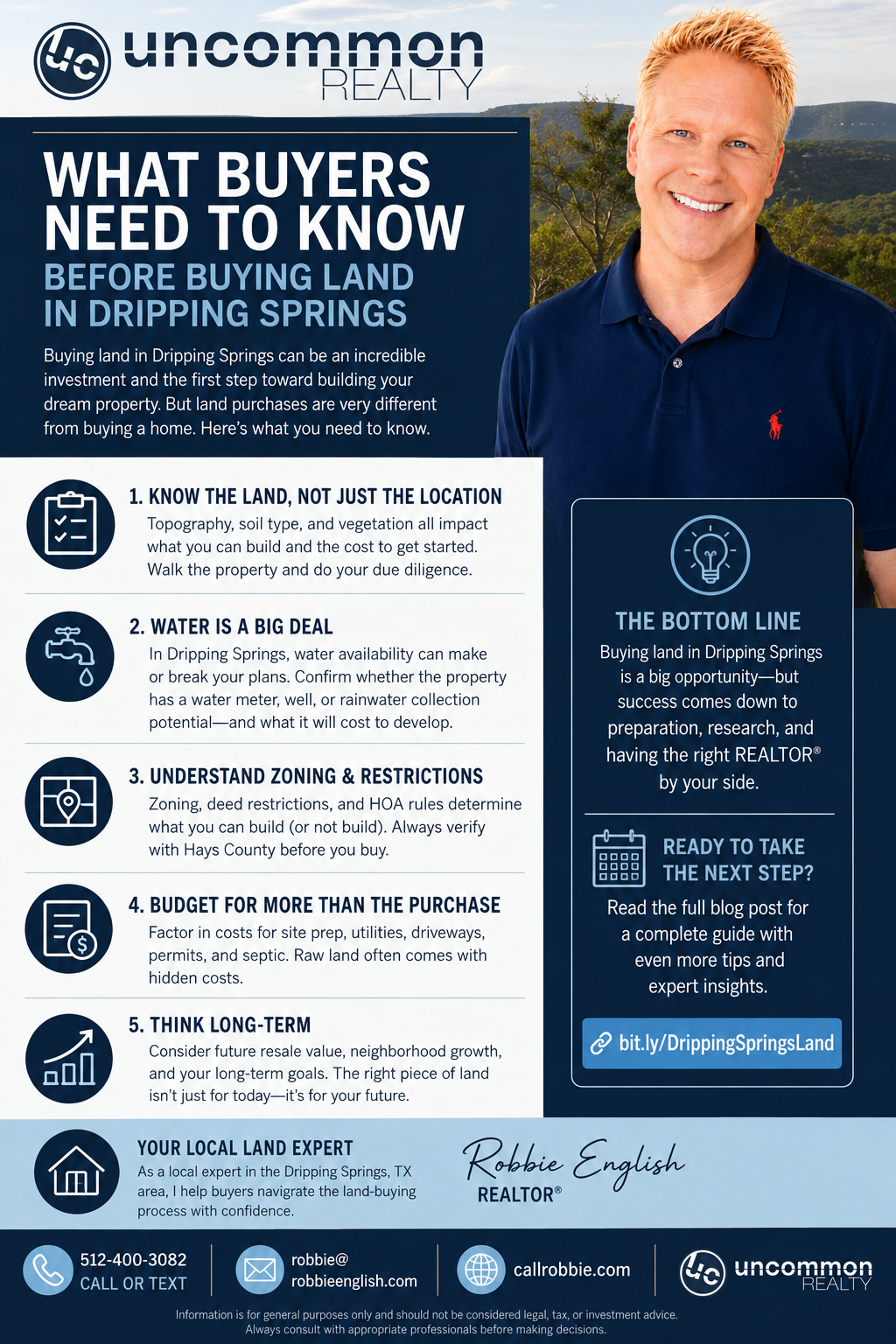
Buying raw or undeveloped land in Dripping Springs is a genuinely different transaction than buying a finished home, and the surprises that trip people up are almost always the same ones: what it actually costs to get water and power to the site, what the soil will let you build, and whether the jurisdiction you're in even allows what you're planning. This covers those specifics with real numbers, not vague reassurance.

TLDR: Buying Land in Dripping Springs
- A complete water well in this area typically runs $12,000-$24,000, with depths of 300-550 feet into the Trinity Aquifer.
- Septic costs range from $9,000-$15,000 for a conventional system to $14,000-$25,000+ for an aerobic system, and much of the area requires aerobic systems due to the Edwards Aquifer recharge zone.
- Limestone bedrock often sits just 6-18 inches below the surface, which drives up excavation costs for both septic systems and foundations.
- Dripping Springs is in Hays County, and whether a parcel sits inside city limits, in the extraterritorial jurisdiction (ETJ), or in unincorporated Hays County changes which rules actually apply.
- A soil and percolation test before you're under contract is the single most important step to avoid a costly surprise.
Water: What a Well Actually Costs Here
Most of Dripping Springs sits over the Trinity Aquifer, and wells in the area typically run 300 to 550 feet deep. Because the bedrock is dense Cretaceous limestone — one of the harder formations to drill in the country — per-foot drilling rates run $35-$65, compared to $22-$50 for sand and clay formations elsewhere. All in, a complete well here typically costs $12,000 to $24,000, and there's no guarantee of exact yield until the well is actually drilled. Get a realistic well-cost estimate for the specific parcel before you assume water access is a minor line item in your budget.
Septic: Why Aerobic Systems Are Often Required, Not Optional
Land in Dripping Springs almost always requires a septic system rather than a municipal sewer connection, and the type of system depends on your soil test results and, in many cases, whether the parcel falls within the Edwards Aquifer recharge zone, where Texas requires aerobic systems specifically to protect groundwater. A conventional system typically runs $9,000-$15,000, but an aerobic system, drip irrigation setup, or a site requiring significant rock excavation can run $14,000-$25,000 or more. You won't know which category your land falls into until a percolation test is done, so get that test done before you're emotionally attached to a specific piece of land.
Electricity: Distance From the Line Drives the Cost
Most of Dripping Springs is served by Pedernales Electric Cooperative (PEC), and how much it costs to bring power to your building site depends almost entirely on how far the site sits from an existing line. Utilities typically cover the first 100-200 feet, then bill $5-$25 per foot beyond that, plus trenching costs of roughly $5-$12 per foot if the run needs to be underground, and $1,200-$5,600 per pole if new poles are required. On a rural parcel, total electrical hookup costs commonly land somewhere between $2,500 and $12,500, but a site set far back from the road can run well beyond that. Get a firm quote from PEC for the specific building site before assuming power is a minor expense.
The Limestone Problem
Across much of the Hill Country, including Dripping Springs, bedrock sits just 6 to 18 inches below the surface in many areas. That shallow limestone is part of what creates the views and terrain buyers love, but it also means septic installation, foundation work, and even basic grading can require significant rock excavation that a flatter, deeper-soil property elsewhere wouldn't need. This is one of the biggest gaps between a land listing's asking price and its true all-in cost to build, and it's worth having a contractor walk the specific site rather than estimating from photos.
City Limits, ETJ, or Unincorporated Hays County: Why It Matters
Dripping Springs itself covers about 6.4 square miles inside its formal city limits, but its extraterritorial jurisdiction (ETJ) extends well beyond that, bordering Travis County and the City of Austin to the east. Where a specific parcel falls — inside city limits, in the ETJ, or in unincorporated Hays County entirely outside both — determines which subdivision rules, building codes, and permitting processes actually apply. Two parcels that look identical on a map can have meaningfully different rules depending on which side of an ETJ line they sit on, so confirm this specifically for any property you're serious about rather than assuming "Dripping Springs" means one uniform rulebook.
Deed Restrictions and What You're Actually Allowed to Build
Beyond city or county jurisdiction, many parcels carry their own deed restrictions covering minimum home size, architectural style, and whether accessory structures like guest houses or workshops are allowed. These restrictions exist independently of zoning and can be more limiting than the underlying jurisdiction's rules. Read the actual restrictive covenants for a specific parcel before assuming you can build what you're picturing — a beautiful lot with restrictions that don't match your plans isn't a bargain.
Floodplain and Drainage
Hill Country terrain creates real drainage patterns that aren't always obvious on a first walkthrough. Some parcels fall partially within a floodplain, which doesn't automatically disqualify a build but can require an elevated structure or additional engineering. Heavy rain events can also reveal runoff patterns across a property that aren't visible during a dry-season showing, so ask for the FEMA flood map on the specific parcel and, if possible, view it after a rain rather than only on a clear day.
Financing Land Is Different From Financing a Home
A raw land loan typically requires a larger down payment than a standard mortgage — often 20-50% depending on the lender and whether the land is unimproved — and carries a shorter term and higher interest rate than conventional home financing, since land is considered a riskier asset without a structure on it. If your plan is to build within a defined timeline, a construction loan that converts to a permanent mortgage once the home is finished is usually a better fit than a standalone land loan followed by a separate construction loan later. Talk to a lender who specifically handles land and construction financing early in the process, not after you're already under contract.
Internet and Connectivity
Coverage varies significantly parcel to parcel in this area. Some properties have access to fiber or reliable fixed wireless, while others are limited to satellite internet, which has improved substantially in recent years but still isn't equivalent to a wired connection for latency-sensitive work. If remote work is part of why you're buying land here, confirm actual available providers and realistic speeds for the specific parcel before assuming standard broadband will be available.
What to Actually Do Before Writing an Offer
In order, I'd want a percolation test to determine septic type and cost, a rough well-cost estimate specific to the parcel's likely depth, confirmation of which jurisdiction (city, ETJ, or unincorporated county) applies, a review of any recorded deed restrictions, and a check of the FEMA flood map. None of these are optional extras — together they determine whether the land's true all-in cost to build matches what the asking price suggests.
Moving Quickly When the Right Parcel Comes Up
Good land in Dripping Springs doesn't sit long once it's priced right, especially parcels with confirmed water and septic feasibility already established. Live MLS search and my mobile app both send real-time alerts rather than a daily digest, and you can message me directly through the app if a new listing comes up and you want a same-day read on it.
Working With Someone Who Checks These Details Before You're Attached
Land purchases have more moving pieces than a standard home purchase, and most of those pieces — well cost, septic type, jurisdiction, deed restrictions — don't show up in a typical listing. I'm Robbie English, Broker, REALTOR at Uncommon Realty, and if you're seriously considering a parcel in Dripping Springs, I'll help you get the percolation test, well estimate, jurisdiction check, and a firm PEC quote done before you're under contract, not after, so the price you agree to actually reflects what it will cost to build.
Written for buyers and sellers in the Greater Austin, Texas area by Robbie English, REALTOR, Broker at Uncommon Realty.
Categories
- All Blogs (958)
- !!! (59)
- !x (621)
- Austin Real Estate (105)
- Bee Cave Real Estate (1)
- Building A Home (14)
- Buying A Home (143)
- Buying Land (1)
- Cedar Park Real Estate (57)
- Central Austin Real Estate (75)
- Down Payment Assistance Programs (1)
- Downsizing (3)
- Downtown Austin Real Estate (5)
- Dripping Springs Real Estate (62)
- East Austin Real Estate (3)
- Financing and Mortgage (23)
- first-time homebuying (109)
- Georgetown Real Estate (9)
- Hill Country Real Estate (1)
- HOA (2)
- Home Appraisals (13)
- Home For Rent (1)
- Home Inspections (6)
- Home Pricing (6)
- Home Staging (1)
- Home Values (12)
- Homeownership (1)
- Homes For Rent (1)
- Homes For Sale (147)
- Hutto Real Estate (5)
- Investing (6)
- Investment Properties (4)
- Lakeway Real Estate (33)
- Leander Real Estate (59)
- LGBT+ Real Estate (8)
- Luxury Homes For Sale (5)
- Luxury Real Estate (19)
- Market Conditions (16)
- Moving to Austin (2)
- Moving to Texas (4)
- Negotiations (3)
- Neighborhoods (8)
- Northwest Austin Real Estate (94)
- Off Market Listings (7)
- Pflugerville Real Estate (10)
- Private Listings (2)
- Property Management (42)
- Property Tax (3)
- Real Estate (18)
- Reddit Question Answered (80)
- redwrite (63)
- Relocation (2)
- Renting (6)
- Representation (34)
- Round Rock Real Estate (58)
- Selling Your Home (62)
- South Austin Real Estate (1)
- Westlake Real Estate (3)
Recent Posts