The Benefits Of Living In Northwest Austin

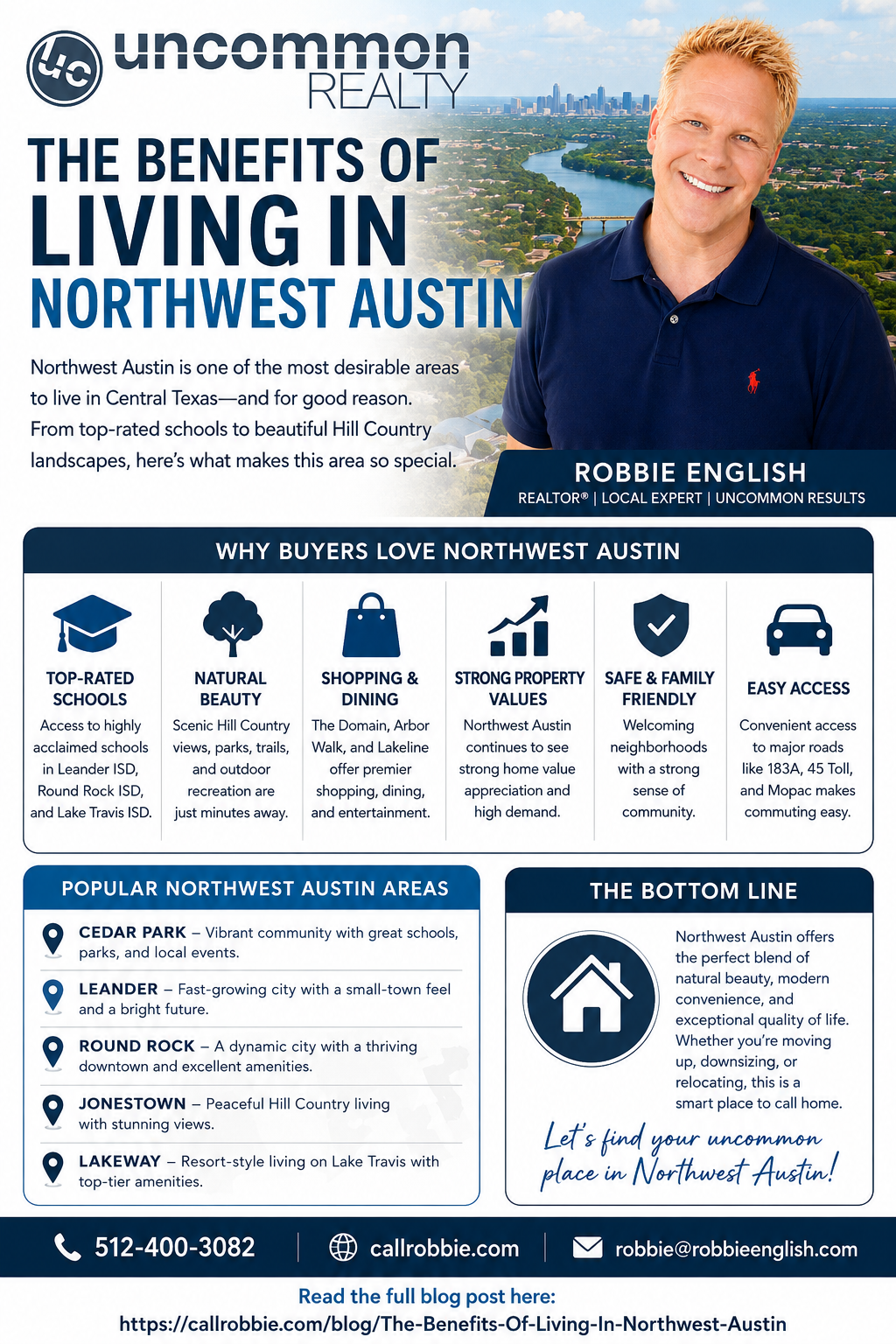
So, Northwest Austin genuinely draws buyers for reasons that consistently hold up under real scrutiny: genuine proximity to major employment centers, mature tree cover and established neighborhoods, strong outdoor recreation access, and a real range of school district options within a relatively compact geographic area. This guide covers the specific, concrete benefits of living here, well beyond the area's general reputation.
I am Robbie English, Broker, REALTOR at Uncommon Realty, and I've helped buyers settle into Northwest Austin for years. My goal here is to lay out clearly what actually makes this specific area work so well for the people who genuinely choose it.

Genuine Commute Advantages
Northwest Austin sits within reasonable commuting distance of several major employment hubs: the Domain and North Austin's broader tech corridor along MoPac and 183, downtown Austin via MoPac, and, for many neighborhoods, a genuinely manageable drive to the Dell campus in Round Rock. This genuinely central positioning within the metro's northern half means residents often have considerably more employer options within an easy commute than they would from a single-direction suburb located further out.
That said, commute time varies meaningfully by specific neighborhood and destination, so it's worth mapping your actual daily route before assuming "Northwest Austin" guarantees a short drive to any particular job. A neighborhood convenient to the Domain isn't necessarily convenient to downtown, and vice versa.
Mature Tree Cover And Established Character
Much of Northwest Austin was developed across the 1970s through 1990s, which means genuinely mature trees, established landscaping, and a settled, lived-in feel that newer suburbs simply haven't had time to develop yet. For buyers who specifically value real shade, real privacy from mature landscaping, and a neighborhood that already has decades of genuine character rather than one still filling in, this is a real and substantial draw.
This maturity comes with a tradeoff worth naming honestly: older housing stock means more variability in system age and condition, so evaluating a specific home's roof, HVAC, and foundation carefully matters more here than it would in a newer-construction suburb where everything is uniformly recent.
Strong Outdoor Recreation Access
Northwest Austin sits close to some of the region's best outdoor recreation, including the Balcones Canyonlands National Wildlife Refuge, Bull Creek District Park with its swimming holes and hiking trails, and easy access to Lake Travis for residents in the area's western neighborhoods. This genuine proximity to hill-country terrain and greenbelt trails is a meaningful lifestyle benefit for buyers who prioritize outdoor recreation without wanting to give up proximity to the city entirely.
Several neighborhoods also back directly onto greenbelt or preserve land, which is worth asking about specifically if privacy, wildlife viewing, or direct trail access from your own backyard matters to you. Not every part of Northwest Austin offers this, so it's a detail worth confirming address by address rather than assuming based on the area's general reputation.
School District Flexibility
Northwest Austin spans multiple school district boundaries, primarily Austin ISD and Round Rock ISD, with Leander ISD reaching into the northern edges, which gives buyers real flexibility to choose a district that fits their specific priorities without leaving the broader area entirely. This is a genuine advantage over more homogeneous suburbs where a single district covers the whole city.
That flexibility comes with a responsibility: district and even specific attendance-zone boundaries don't always follow neighborhood names cleanly, so confirming exact school zoning for any specific address matters more here than in an area with one uniform district.
Genuine Neighborhood Diversity Within A Compact Area
Northwest Austin isn't one uniform neighborhood; it's a collection of genuinely distinct pockets, each with its own character, price point, and typical home age. Anderson Mill offers established ranch-style homes on larger lots near the 183/1431 corridor. Milwood sits closer to the Domain with a mix of housing ages skewing slightly newer. The Spicewood at Bull Creek and Balcones areas offer hillier, more wooded lots with a quieter, more established feel. Canyon Creek and Jester Estates push further toward the lake and RM 2222, appealing to buyers who prioritize the hill-country setting Northwest Austin is known for.
This genuine diversity within a relatively compact geographic area means you can often find meaningfully different lifestyles, lot sizes, and price points without a long drive between them, which is a real advantage for buyers who want options without committing to an entirely different part of the metro.
Healthcare And Everyday Services Access
Northwest Austin's decades of development have brought a genuinely robust network of medical offices, urgent care facilities, and specialty providers into the area, reducing how far residents typically need to travel for routine and even some specialized healthcare needs. This matters more than it might initially seem, particularly for buyers managing ongoing healthcare needs or families with young children who need pediatric care close to home.
The same maturity extends to everyday services more broadly: established banking, dry cleaning, auto repair, and similar routine services are well distributed throughout the area rather than requiring a special trip to a single commercial center.
Proximity To Higher Education And Cultural Amenities
Northwest Austin's central position within the metro puts it within a reasonable drive of the University of Texas at Austin and Austin Community College's various campuses, which matters for families with college-bound students or anyone pursuing continuing education locally. The area also sits within reach of Austin's broader cultural amenities, downtown's museums, live music venues, and event calendar, without requiring residents to live in the higher-density, higher-cost neighborhoods closer to the urban core.
This balance, genuine access to city amenities without downtown's density or price premium, is one of the more understated benefits of choosing Northwest Austin specifically over either a downtown location or a more remote suburb.
A Range Of Housing Ages And Price Points
Because Northwest Austin developed across several decades, it offers a genuinely wider range of home ages, styles, and price points than a suburb built out in a single, more compressed construction era. Buyers can find everything from smaller, original-condition homes on larger lots to fully renovated properties and newer infill construction, often within the same general area. For a detailed look at what specifically clusters under $800K, see my guide on Northwest Austin homes under $800K.
This variety means Northwest Austin can genuinely work across a wider range of buyer budgets and life stages than a more uniform suburb, from a first home to a long-term family property to a downsizing move, without necessarily requiring a change of area.
Established Retail And Everyday Convenience
Decades of development have given Northwest Austin a genuinely mature commercial base: grocery stores, medical offices, restaurants, and everyday services are well distributed throughout the area rather than concentrated in one still-developing town center. This matters more day to day than it might seem on paper, since it means shorter drives for routine errands regardless of which specific neighborhood you're in.
Resale Stability From An Established Track Record
Because Northwest Austin's neighborhoods have decades of sales history behind them, buyers and their agents can pull genuinely deep, reliable comparable-sales data when evaluating a specific home's fair value, something newer, still-developing suburbs simply can't offer yet since they lack years of resale transactions to draw on. This translates into more predictable, better-understood resale dynamics for buyers who care about long-term value stability, beyond their initial purchase price alone.
Established neighborhoods also tend to show more consistent appreciation patterns over time, since demand is driven by proven, durable factors, schools, commute, mature character, rather than the newer, less-tested appeal of a still-under-construction community whose long-term trajectory is less certain.
Community Stability And Long-Term Neighbors
Many Northwest Austin neighborhoods have a meaningfully higher share of long-term residents compared to newer, still-turning-over suburbs, simply because people have lived there for years or even decades. This translates into a more settled sense of community, established neighborhood associations, and a track record of how a specific area actually behaves over time, information that's harder to gather in a neighborhood that's only a year or two old.
For buyers who value getting to know long-term neighbors and a genuine sense of continuity, rather than a neighborhood that's still filling in with new arrivals, this stability is a real, if less quantifiable, benefit worth weighing alongside the more concrete factors like commute and school zoning.
Honest Tradeoffs Worth Knowing
Northwest Austin isn't the newest or most heavily amenitized part of the metro, and buyers specifically wanting brand-new construction with builder-included upgrades will generally find more of that in Cedar Park or Leander further north. Traffic on key corridors like MoPac and 183 during peak commute hours is also a real consideration worth experiencing firsthand at the times you'd actually be driving, rather than assuming based on off-peak touring.
Being honest about these tradeoffs upfront, rather than discovering them after closing, is what makes Northwest Austin work well for the buyers who genuinely fit it and helps other buyers recognize when a different area might serve them better.
A Practical Way To Evaluate Fit
If you're weighing Northwest Austin against other parts of the metro, it helps to tour at the actual times you'd realistically be commuting rather than only during an off-peak weekend showing, since traffic patterns on MoPac and 183 vary considerably by time of day. Spend time in a prospective neighborhood beyond the home itself, walk or drive the surrounding blocks, check the drive to a grocery store you'd actually use, and confirm the exact school zoning for any specific address rather than assuming based on the broader area's reputation.
It's also worth talking directly to an agent who works Northwest Austin regularly about how a specific pocket has trended recently, since even within this established area, demand and pricing can shift meaningfully block to block depending on school-boundary changes, nearby development, or simply which pockets are currently in higher demand.
Who Northwest Austin Fits Best
Northwest Austin genuinely tends to fit buyers who want established, tree-covered neighborhoods with real character, value real flexibility in school district choice, prioritize genuine outdoor recreation access without actually leaving the city, and are comfortable evaluating and potentially updating an older home rather than strictly requiring new construction. It's a strong fit for buyers who want central-metro convenience without downtown's density or price premium.
Bringing It All Together
The real, genuine benefits of living in Northwest Austin, honest commute flexibility to multiple employment hubs, mature tree cover and established character, strong outdoor recreation access, and real school district flexibility, all hold up to genuine scrutiny rather than relying on vague reputation alone. Understanding both these genuine strengths and the honest tradeoffs is what actually helps you know whether this specific area truly fits your own specific priorities.
Whether commute, schools, outdoor access, or established character matters most to you, I'm glad to walk you through the specific Northwest Austin neighborhoods that genuinely fit your priorities. You can browse current listings on Northwest Austin through my website or my app.
Written for buyers and sellers in the Greater Austin, Texas area by Robbie English, REALTOR, Broker at Uncommon Realty.
Categories
- All Blogs (915)
- !!! (59)
- !x (617)
- Austin Real Estate (97)
- Bee Cave Real Estate (1)
- Building A Home (14)
- Buying A Home (135)
- Buying Land (1)
- Cedar Park Real Estate (56)
- Central Austin Real Estate (75)
- Down Payment Assistance Programs (1)
- Downsizing (3)
- Downtown Austin Real Estate (5)
- Dripping Springs Real Estate (61)
- East Austin Real Estate (3)
- Financing and Mortgage (20)
- first-time homebuying (106)
- Georgetown Real Estate (9)
- Hill Country Real Estate (1)
- HOA (2)
- Home Appraisals (12)
- Home For Rent (1)
- Home Inspections (6)
- Home Pricing (4)
- Home Values (11)
- Homeownership (1)
- Homes For Rent (1)
- Homes For Sale (144)
- Hutto Real Estate (5)
- Investing (6)
- Investment Properties (4)
- Lakeway Real Estate (33)
- Leander Real Estate (58)
- LGBT+ Real Estate (8)
- Luxury Homes For Sale (4)
- Luxury Real Estate (19)
- Market Conditions (15)
- Moving to Austin (2)
- Moving to Texas (4)
- Negotiations (2)
- Neighborhoods (8)
- Northwest Austin Real Estate (94)
- Off Market Listings (7)
- Pflugerville Real Estate (10)
- Private Listings (2)
- Property Management (42)
- Property Tax (1)
- Real Estate (18)
- Reddit Question Answered (80)
- redwrite (63)
- Relocation (2)
- Renting (6)
- Representation (34)
- Round Rock Real Estate (56)
- Selling Your Home (54)
- South Austin Real Estate (1)
- Westlake Real Estate (3)
Recent Posts