The Best Dripping Springs Neighborhoods Near Highly Rated Schools

I get some version of this question almost every week: "Robbie, where should we actually be looking in Dripping Springs?" Usually it's a family moving out from Austin, sometimes it's folks relocating from out of state who found the town on a map and liked what they saw. Either way, the honest answer is that Dripping Springs isn't one neighborhood — it's a patchwork of very different communities that happen to share a school district and a zip code.
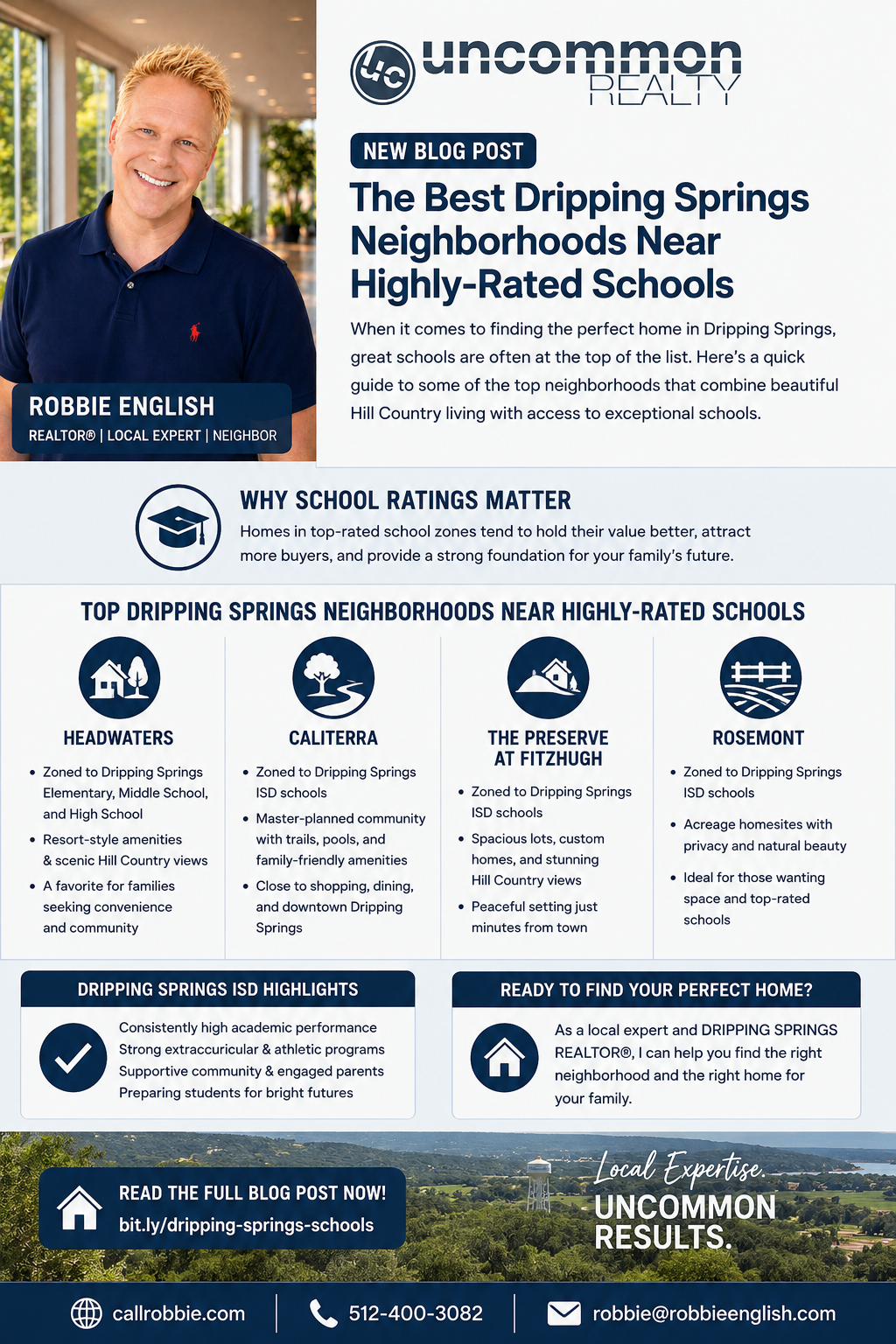
So let's get straight to it. If you're weighing where to land in Dripping Springs, the right neighborhood depends less on "which one is best" and more on what your family actually needs day to day — how close you want to be to town, how much land you want to mow (or not mow), and how much house you're trying to get for the money. Below I'll walk through a handful of communities that represent the real range of what's out there, plus the school situation and how the acreage-vs-in-town decision usually plays out for the families I work with.

The one thing that makes Dripping Springs easier than most Austin suburbs
Before I get into specific neighborhoods, there's a practical point worth making up front: Dripping Springs is served by a single school district, Dripping Springs ISD. That sounds like a small thing, but if you've shopped other fast-growing areas around Austin, you know it's not always the case — sometimes a subdivision on one side of a road feeds into a completely different district than the subdivision across the street. Here, that's not really a concern. Wherever you buy in town, you're in DSISD, home to Dripping Springs High School and Dripping Springs Middle School.
What does change from neighborhood to neighborhood is which elementary or middle school campus a home is zoned to, and how far the drive is to get there. DSISD has grown a lot over the past decade, and the district has added campuses along the way to keep up with that growth. If a specific campus assignment matters to you, that's a detail I always verify directly with the district for the exact address you're considering, since attendance boundaries can shift as new sections get built out. I'd rather tell you to double-check it than guess and have you plan around something that turns out to be wrong.
A few neighborhoods worth knowing, and who they tend to fit
I'm not going to run through every subdivision in Dripping Springs — there are dozens, and most of them blur together on paper. Instead, here are a handful that actually represent the range of what buyers are choosing between, from in-town and walkable to acreage and quiet.
Sunset Canyon is usually my answer for families who want to feel like they're actually in town. It sits close to downtown Dripping Springs, so errands, restaurants, and the Founders Day feel of Mercer Street are a short drive rather than a haul out Highway 290. Lots here tend to be more traditional suburban size rather than sprawling acreage, which suits families who'd rather spend Saturday at a kid's soccer game than on a tractor.
Twin Lake Hills is one of the more established communities in town, and it shows in the way it feels lived-in and settled rather than freshly built. It's close enough to the schools and to town that the commute isn't an issue, but the lots give you a bit more breathing room than a typical in-town subdivision. I show this one a lot to families who want mature trees and a sense of place, not a brand-new slab.
Sawyer Ranch leans toward the acreage side without pulling you far out of town. Homesites here tend to run larger than what you'll find in the newer master-planned sections, which makes it a good fit for a family that wants space for animals, a garden, or just genuine distance between them and the neighbors, while still keeping a reasonable drive to school and the grocery store.
Hamilton Hills is a smaller, quieter community that tends to fly under the radar compared to some of the bigger-name developments. It's a good option for buyers who want a manageable neighborhood feel — sidewalks, a handful of streets, everyone kind of knows everyone — without the scale and amenity fees that come with the larger master-planned communities.
Caliterra is one of the newer master-planned communities, and it's built with families in mind — pools, trails, and green space are part of the deal, and the homes themselves tend to run newer construction with more current floor plans. If you want amenities built into your monthly life rather than something you drive to, this is worth a look.
Headwaters is in the same newer, larger-scale vein — a big master-planned community with resort-style amenities and a wide range of home styles and builders represented. It's grown quickly, which means more new construction inventory and more options if you want to pick finishes rather than buy resale.
Deer Creek Ranch sits further toward the rural end of the spectrum. It's a good example of the acreage-focused communities that make Dripping Springs what it is — more privacy, more land, and a quieter pace, with the trade-off being a longer drive into town and to school pickup lines.
Acreage or in-town: how I actually help families think through it
This is the question that matters more than any single neighborhood name. Do you want land, or do you want proximity? In Dripping Springs, you genuinely get to choose, which is part of why families end up here in the first place.
An in-town neighborhood like Sunset Canyon or Twin Lake Hills means shorter school runs, easier carpools, and neighbors close enough that your kids can ride bikes to a friend's house. An acreage community like Sawyer Ranch or Deer Creek Ranch means more space for the things that don't fit on a standard lot — a real garden, a couple of horses, room for the kids to roam without a fence in sight — but it also means longer drives, and often a well and septic system instead of city utilities, which is a maintenance conversation worth having before you fall in love with a five-acre view.
Neither choice is right or wrong. I've put families in both and watched them thrive. The honest way to figure out which side you land on is to think about your actual week: how many school-year mornings can you tolerate an extra ten or fifteen minutes in the car, and how much do you actually want to maintain outside of the house itself. If you're still torn, browsing Dripping Springs land for sale alongside the in-town listings is a good way to get a feel for what that trade-off looks like in real dollars.
What to expect on price without me making up numbers
I'm not going to throw out specific price figures here, because they change too fast to print and be honest with you at the same time. What I can tell you is the general shape of the market: in-town neighborhoods on smaller lots tend to sit at a more accessible price point than the acreage communities, simply because you're paying for land as much as house once you get out to the larger-lot subdivisions. Newer master-planned communities like Caliterra and Headwaters often land in the middle, since you're paying a bit of a premium for new construction and amenities even though the lots themselves aren't huge.
If you want a real sense of what's currently available and at what price, the most reliable way is to look at live inventory rather than a number I write down today and that's stale by next quarter. I keep pages updated for Dripping Springs homes under $800K and homes under $700K, which tend to be the two ranges most family buyers are working within, and they'll give you a far more accurate read than a guess.
Bringing it back together
If you take one thing away from all this, let it be that Dripping Springs isn't a single decision — it's a series of smaller ones. You're choosing a school situation that's actually pretty simple since it's all one district, a lifestyle between in-town convenience and acreage space, and a neighborhood character that ranges from established and shaded to brand new with a pool down the street. Sunset Canyon and Twin Lake Hills lean in-town and settled. Sawyer Ranch and Deer Creek Ranch lean rural and spacious. Caliterra and Headwaters lean new and amenity-rich. Hamilton Hills sits comfortably in the middle, small and quiet. None of them are the "correct" answer — they're just different answers to different family priorities.
Frequently asked questions
Are all these neighborhoods zoned to the same schools?
They're all in Dripping Springs ISD, so yes, the district is the same. But which specific elementary or middle school campus a home is zoned to can vary by neighborhood and even by section within a neighborhood, especially as the district has added campuses to keep up with growth. I always confirm current attendance zoning directly with the district for any specific address before a family makes a decision based on it.
Is Dripping Springs High School the only high school in the district?
Yes, Dripping Springs ISD is built around one high school, Dripping Springs High School, which is part of why the district feels more unified than some of the other fast-growing areas around Austin where boundaries get split up.
Do I have to choose between acreage and being near good schools?
Not really — that's one of the nicer things about this town. Because it's a single district, you don't have to trade school access for land the way you might elsewhere. The trade-off is more about drive time and daily convenience than about school quality itself.
What if I want land but I'm not ready for well and septic?
That's a fair concern, and it's worth talking through property by property rather than assuming. Some of the acreage communities still tie into community water systems, while others are fully private well and septic. It genuinely varies enough that I'd rather walk you through specific listings than generalize.
Should I look at new construction or an established neighborhood?
It depends on how much you want to customize versus move in and be done. Newer communities like Caliterra and Headwaters give you more say in finishes and floor plan. Established neighborhoods like Twin Lake Hills or Sunset Canyon tend to offer more mature landscaping and a settled feel from day one. Both are valid — it's really about your patience for the building process.
If you're trying to narrow this down for your own family, I'm happy to talk through it with you — no pressure, just a real conversation about what you actually need versus what looks good on a listing photo. Feel free to reach out whenever you're ready, and we'll figure out which of these fits your family best.
Categories
- All Blogs (914)
- !!! (59)
- !x (617)
- Austin Real Estate (96)
- Bee Cave Real Estate (1)
- Building A Home (14)
- Buying A Home (135)
- Buying Land (1)
- Cedar Park Real Estate (56)
- Central Austin Real Estate (75)
- Down Payment Assistance Programs (1)
- Downsizing (3)
- Downtown Austin Real Estate (5)
- Dripping Springs Real Estate (61)
- East Austin Real Estate (3)
- Financing and Mortgage (20)
- first-time homebuying (106)
- Georgetown Real Estate (9)
- Hill Country Real Estate (1)
- HOA (2)
- Home Appraisals (12)
- Home For Rent (1)
- Home Inspections (6)
- Home Pricing (4)
- Home Values (11)
- Homeownership (1)
- Homes For Rent (1)
- Homes For Sale (144)
- Hutto Real Estate (5)
- Investing (6)
- Investment Properties (4)
- Lakeway Real Estate (33)
- Leander Real Estate (58)
- LGBT+ Real Estate (8)
- Luxury Homes For Sale (4)
- Luxury Real Estate (19)
- Market Conditions (15)
- Moving to Austin (2)
- Moving to Texas (4)
- Negotiations (2)
- Neighborhoods (8)
- Northwest Austin Real Estate (94)
- Off Market Listings (7)
- Pflugerville Real Estate (10)
- Private Listings (2)
- Property Management (42)
- Property Tax (1)
- Real Estate (18)
- Reddit Question Answered (80)
- redwrite (63)
- Relocation (2)
- Renting (6)
- Representation (34)
- Round Rock Real Estate (56)
- Selling Your Home (54)
- South Austin Real Estate (1)
- Westlake Real Estate (3)
Recent Posts