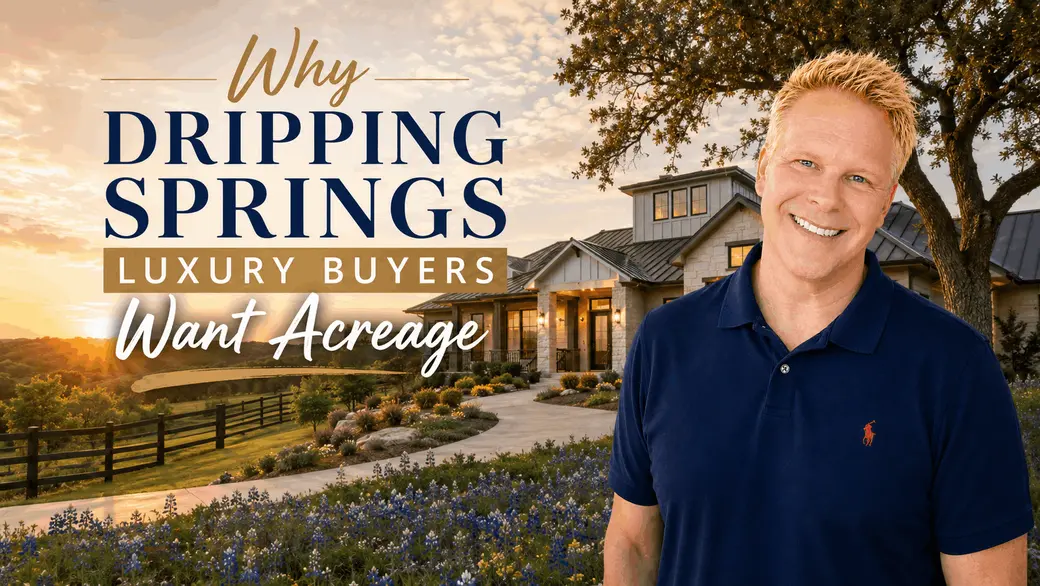
Why Dripping Springs Luxury Buyers Want Acreage
I've already covered the practical side of acreage ownership and the specifics of luxury Hill Country land separately. This piece is about something different: the actual reasons luxury buyers specifically choose acreage over a large lot in a gated subdivision, once budget stops being the constraint and the decision becomes about what the land itself can actually do for them.

TLDR: Why Luxury Buyers Choose Acreage
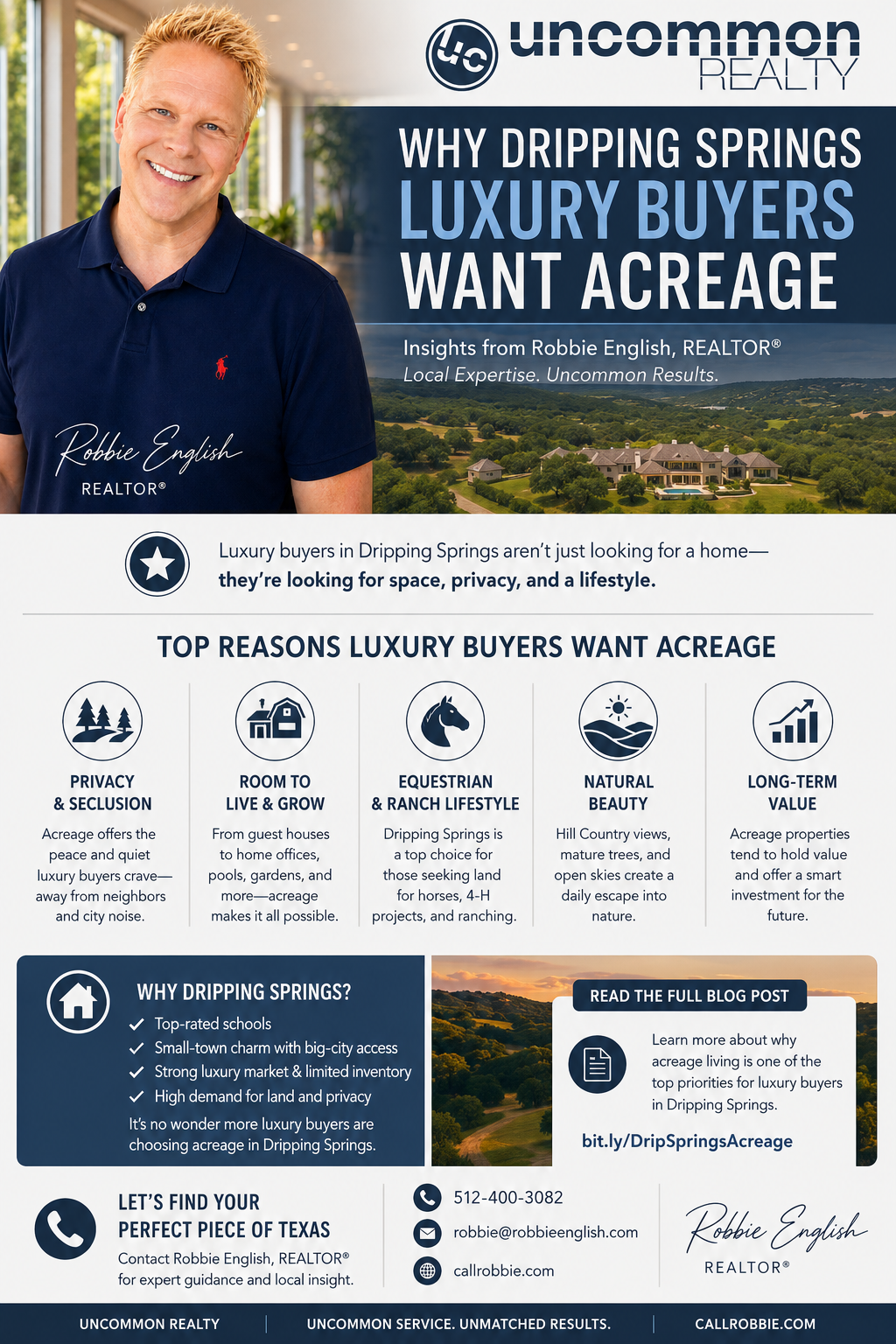
- Estate-scale privacy — guest houses, staff quarters, and multi-generational living — needs real acreage, not just a large lot.
- Equestrian and recreational amenities (arenas, barns, stocked ponds, private trails) are only realistic at scale.
- Large, well-positioned luxury tracts are genuinely scarce in this market, which factors into long-term value.
- Acreage gives room for phased building — a primary home now, a guest house or barn later, without redesigning around a tight lot.
- None of this replaces the practical diligence covered in my other Dripping Springs land posts — it's the "why," not the "how."
Estate-Scale Privacy Is a Different Thing Than Subdivision Privacy
A large lot in a gated community still means neighbors within view and HOA architectural review governing what you build. Real acreage removes both constraints in a way that changes what's actually possible — a guest house for visiting family, separate quarters for household staff, or simply enough distance that a pool party doesn't involve anyone else's yard. For buyers at this price point, that level of control over the property is often the specific thing money is being spent to achieve, more than square footage in the main house itself.
Equestrian and Recreational Use Needs Real Space
Barns, riding arenas, stocked ponds, and private trail systems are realistic ambitions on acreage in a way they simply aren't on a standard large lot. This market has a genuine track record of equestrian estates — properties built specifically around barn and arena facilities, guest quarters for trainers or family, and enough pasture to actually use for horses rather than just view them from a window. If any of this is part of your long-term vision, even if you're not building it immediately, it's worth buying enough acreage now to leave room for it later rather than trying to add it to a tightly bounded lot after the fact. A property that can't accommodate an arena or a proper barn setback today won't magically gain that capacity once you've already built the main house.
Scarcity Is a Real Part of the Value Proposition
Large, well-positioned luxury tracts don't come up often, and they don't get replaced once they're subdivided or built out. That scarcity is part of what supports long-term value in this segment — a 20-plus-acre tract with usable topography and a strong building site is a fundamentally different, rarer asset than a comparably priced large lot in a newer subdivision, where the developer can simply release more inventory. If long-term value matters to your decision, factor in how much of what you're buying is genuinely irreplaceable land versus how much is house.
Multi-Generational and Family Compound Living
A growing number of luxury acreage buyers here aren't just building one house — they're planning for aging parents, adult children, or extended family to eventually share the property in separate structures. That kind of family compound arrangement needs real distance between buildings to work well, both for genuine privacy and for practical reasons like separate utility hookups and septic capacity. It's worth having this conversation with your family before you buy, since retrofitting a second full structure onto a property that wasn't planned for it is a much harder problem than buying enough acreage upfront to leave room for it.
Wildlife and Land as an Amenity in Itself
Beyond any tax consideration, plenty of luxury buyers here simply want the land itself as an amenity — native Hill Country terrain, wildlife on the property, a stocked pond, or land quiet enough that deer and other wildlife move through it regularly. That's a genuinely different motivation than the agricultural or wildlife tax exemption angle, which is about the financial structure of ownership rather than the experience of it. Both can apply to the same property, but it's worth being clear with yourself about which one is actually driving your acreage size, since the exemption thresholds and the experience you're after don't always point to the same number of acres.
Room to Build in Phases
Acreage gives you the option to build a primary home now and add a guest house, barn, or pool house later, without having to redesign around a lot that was already maxed out. That flexibility matters more than buyers initially expect — needs change over a decade of ownership, and a property with room to grow into those changes holds up better than one that was fully built out on day one.
High-Fenced Properties: A Different Kind of Perimeter
Some luxury acreage in this market comes high-fenced — game fencing tall enough to manage deer and other wildlife movement, distinct from the standard perimeter fencing I've covered on a typical acreage purchase. High-fenced properties appeal specifically to buyers who want to manage the wildlife on their land intentionally, whether that's for hunting, conservation, or simply controlling what moves through the property. It's a more significant investment than standard fencing, and it's worth understanding whether a specific property's fencing is already in place and in good condition, since replacing game fencing across dozens of acres is a real cost, not a minor repair.
How This Affects Eventual Resale
Luxury acreage with genuine amenity value — a working arena, an established guest house, mature landscaping around a pond — tends to appeal to a real, if smaller, pool of future buyers who are specifically looking for that lifestyle, not just square footage. A raw, undeveloped luxury tract has more flexibility for the next owner but less to show for the investment already made into it. Neither approach is wrong, but it's worth thinking about whether you're buying primarily for your own use over many years or with resale flexibility as a bigger factor, since that changes how much you should invest in single-purpose amenities like an arena versus leaving land undeveloped for a future owner's own plans.
What This Doesn't Replace
None of this changes the practical diligence that applies to any acreage purchase in this market. I've covered wells, septic, and utility costs separately, the tax exemption and fencing realities of acreage ownership in another piece, and the karst geology and view-corridor considerations specific to luxury builds in a third. This piece answers why buyers want the acreage in the first place — those other three answer what to actually check before you buy it.
Working With Someone Who Understands Both the Why and the How
Luxury acreage buyers usually know why they want the space before they call me — privacy, equestrian plans, room for family. My job is connecting that vision to the practical realities of a specific property: whether it's actually buildable where you want it, whether the tax and utility picture supports your plans, and whether the tract is genuinely as rare as it's priced to suggest. I'm Robbie English, Broker, REALTOR at Uncommon Realty, and if you're shopping luxury acreage in Dripping Springs, I'll walk through both sides with you before you commit to a specific tract, so the property you buy actually delivers the lifestyle you're picturing, not just the acreage total on the listing sheet.
Moving on Rare Inventory
Live MLS search and my mobile app both send real-time alerts rather than a daily digest, which matters in a segment where the right tract genuinely doesn't come up often. You can message me directly through the app if a new luxury acreage listing comes up and you want a same-day read on whether it fits your specific plans.
Written for buyers and sellers in the Greater Austin, Texas area by Robbie English, REALTOR, Broker at Uncommon Realty.
Categories
- All Blogs (909)
- !!! (56)
- !x (614)
- Austin Real Estate (96)
- Bee Cave Real Estate (1)
- Building A Home (14)
- Buying A Home (135)
- Buying Land (1)
- Cedar Park Real Estate (56)
- Central Austin Real Estate (75)
- Down Payment Assistance Programs (1)
- Downsizing (3)
- Downtown Austin Real Estate (5)
- Dripping Springs Real Estate (61)
- East Austin Real Estate (3)
- Financing and Mortgage (19)
- first-time homebuying (104)
- Georgetown Real Estate (9)
- Hill Country Real Estate (1)
- HOA (2)
- Home Appraisals (12)
- Home For Rent (1)
- Home Inspections (6)
- Home Pricing (4)
- Home Values (11)
- Homeownership (1)
- Homes For Rent (1)
- Homes For Sale (144)
- Hutto Real Estate (5)
- Investing (4)
- Investment Properties (2)
- Lakeway Real Estate (33)
- Leander Real Estate (58)
- LGBT+ Real Estate (8)
- Luxury Homes For Sale (4)
- Luxury Real Estate (19)
- Market Conditions (15)
- Moving to Austin (2)
- Moving to Texas (4)
- Negotiations (2)
- Neighborhoods (8)
- Northwest Austin Real Estate (94)
- Off Market Listings (7)
- Pflugerville Real Estate (10)
- Private Listings (2)
- Property Management (42)
- Property Tax (1)
- Real Estate (18)
- Reddit Question Answered (80)
- redwrite (63)
- Relocation (2)
- Renting (6)
- Representation (34)
- Round Rock Real Estate (56)
- Selling Your Home (54)
- South Austin Real Estate (1)
- Westlake Real Estate (3)
Recent Posts