Moving to Austin From California: What to Actually Expect

Moving to Austin from California is one of the most common moves I help clients make, and almost everyone arrives with the same mix of relief and confusion. Relief because the numbers on paper look dramatically better. Confusion because Texas does things differently enough that the numbers alone don't tell you what to actually expect. I want to walk you through both sides of that honestly.
TL;DR: Moving to Austin From California: What to Actually Expect
- Texas has no state income tax, but property taxes run well above the national average, so the savings aren't as simple as "no income tax means everything's cheaper."
- Austin's median home price is roughly a third of San Francisco's and about half of Los Angeles's, based on current Redfin data.
- Texas is a non-disclosure state, meaning actual sale prices aren't public record, which changes how you should shop for comparable homes.
- Where you land in Austin matters more than the fact that you're moving to Austin. Commute, lot size, and school zoning vary block to block.
- Give yourself more lead time than you'd expect for financing and touring if you're buying from out of state.
The Tax Tradeoff, Honestly
California's state income tax tops out at 13.3%, the highest marginal rate in the country, once you include the 1% mental health surcharge on income over $1 million. Texas charges none. For a lot of my clients, especially higher earners, that alone is a meaningful part of the decision to relocate.
But Texas makes up a good chunk of that difference through property tax. There's no state income tax to fund local services, so property tax carries more of the load, and Texas rates run meaningfully above the national average. I always tell clients: don't do the math on income tax savings alone. Run your actual expected property tax bill on the specific home and area you're considering, not a state average, before you compare the two states side by side.
What the Home Prices Actually Look Like
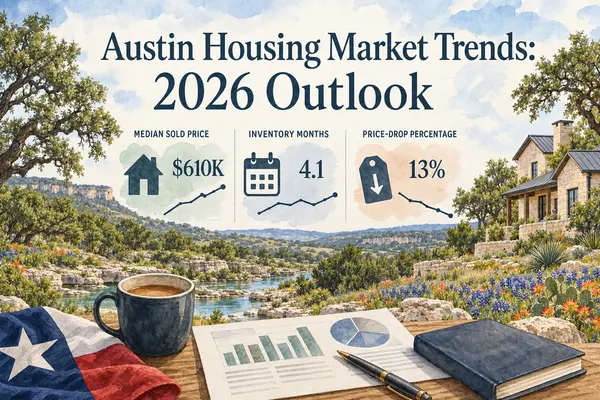
The price gap is real and it's large. Austin's median home price sat around $557,000 over the second quarter of 2026, according to Redfin's Austin market data. Compare that to Los Angeles, where the median was about $1.1 million over the same window, per Redfin's Los Angeles data, and San Francisco, where the median has climbed to roughly $1.7 million according to Redfin's reporting on the San Francisco market.
That means a lot of my California clients are selling a home and buying in Austin with room left over, sometimes enough to buy with a much smaller mortgage or none at all. If that's your situation, it changes your whole approach to financing, and it's worth talking through down payment options even when you don't strictly need them, since a larger down payment shifts your monthly payment and how competitive your offer looks.
Why the List Price Isn't the Whole Story
Texas is a non-disclosure state, which means actual closed sale prices aren't published in public record the way they are in California. If you're used to pulling up recent sales on Zillow or Redfin and trusting the numbers, that habit doesn't translate cleanly here. Third-party estimates in Texas are often built on modeling rather than confirmed closed prices, and I've seen relocating buyers anchor to a number that had no real basis in what actually sold nearby.
This is exactly where having an agent with access to real, closed comparable data matters more than it would back home. It's not just a nice-to-have here, it's the difference between an offer grounded in reality and one based on a guess.
Where to Actually Land
Austin isn't one housing market, it's a lot of smaller ones stitched together, and the differences show up fast once you start touring. Central neighborhoods put you closest to downtown at a higher price per square foot. The Cedar Park, Leander, Round Rock, and Georgetown corridor trades a longer commute for larger lots and newer construction at a lower price point. Dripping Springs and the Hill Country side offer more acreage and a slower pace, with a real tradeoff in commute time.
School zoning is worth checking block by block rather than assuming a whole suburb shares one rating, since district and campus boundaries can split streets that look identical on a map. And if you're weighing several suburbs against each other directly, it's worth comparing Austin's suburbs side by side on the specific factors that matter to you rather than going on reputation alone.

Common Misconceptions I Hear From California Clients
"Texas has basically no property tax." Not true. It's often higher than what Californians pay under Proposition 13, especially in the first few years after a purchase, since Texas doesn't cap assessed value increases the same way. Run the real number before you commit to a price range.
"Everything here is going to feel cheap after California." Housing and groceries generally do feel cheaper. But it depends on your specific spending pattern, and a home price comparison alone doesn't capture your full cost of living.
"I can use my old home's Zillow estimate to gauge what things sell for here." Not reliably, for the non-disclosure reason above. Ask your agent to pull actual closed comparables instead of trusting an automated estimate.

Practical Steps If You're Relocating
Get pre-approved before you book a house-hunting trip, even if you expect to buy largely with proceeds from your current home. Lenders still want to see your full financial picture, and a real pre-approval makes your offer credible once you find something.
If you can't tour in person before making an offer, lean harder on a detailed video walkthrough from your agent and a strong inspection period than you would as a local buyer who can just drive by. And if you're not selling before you buy, it's worth understanding your options for carrying two properties briefly during the transition.
Give yourself more runway than feels necessary. Between financing, remote touring, and coordinating an actual move, out-of-state buyers consistently need more lead time than they initially plan for.
A Realistic Relocation Timeline
Most of my California clients start looking 60 to 90 days before they want to close, and that window is tighter than it sounds once financing and remote touring enter the picture. Pre-approval itself only takes a few days once your documents are in, but if part of your down payment depends on selling your California home first, build in real time for that sale to close and fund before you count on that money.
Plan on two trips to Austin if you can manage it: an early scouting trip to narrow down which suburbs actually fit, and a second, tighter trip once you're under contract or close to it, for the inspection period and final walkthrough. If a second trip isn't realistic, lean harder on a detailed video walkthrough from your agent and a longer option period than you'd use as a local buyer, rather than skipping that diligence.
Closing itself typically runs 30 to 45 days after you're under contract on a conventional loan, and closer to 45 to 60 if you're also timing the close of a California sale around it. None of this needs to be rushed. It does need to be planned for, though — the clients who end up stressed are usually the ones who assumed Austin would move at the same pace as their old market.
Summary
Moving to Austin from California usually pencils out well on paper, and for most of my clients it genuinely does. But the real savings depend on your specific tax situation, the specific property tax bill on the home you buy, and how you shop for comparables in a state that doesn't publish sale prices. Get those three things right and the move tends to go smoothly.
Frequently Asked Questions
Is it actually cheaper to live in Austin than California?
For most people moving from major California metros, yes, particularly on housing. Austin's median home price is roughly a third of San Francisco's and about half of Los Angeles's. Overall cost of living depends on your specific spending, but housing is where the biggest gap shows up.
How much lower are property taxes in Austin compared to California?
They're not necessarily lower. Texas property tax rates often run higher than what Californians pay under Proposition 13, especially since Texas doesn't cap assessed value increases the same way. The income tax savings and property tax difference need to be weighed together, not assumed to both favor Texas.
Do I need to sell my California home before buying in Austin?
Not necessarily. Depending on your equity and financing, some clients buy first and sell after, others sell first and rent short-term. It depends on your specific numbers and risk tolerance, and it's worth talking through both paths before you commit to one.
Can I trust Zillow's price estimates when comparing Austin homes?
Be cautious. Texas is a non-disclosure state, so actual sale prices aren't public record, and third-party estimates are often modeled rather than confirmed. Ask your agent for real closed comparable data instead.
How long does it typically take to relocate from California and buy in Austin?
Give yourself more time than you'd plan for a local move. Between financing, remote or limited in-person touring, and coordinating the actual move, most out-of-state buyers need more lead time than they initially expect.
Let's Talk Through Your Specific Move
Every relocation is different depending on your timeline, whether you're selling first, and what you actually want your day-to-day in Austin to look like. If you're weighing a move from California and want to talk through what it looks like for your specific situation, I'm glad to walk through it with you.
Robbie English, REALTOR, Broker at Uncommon Realty.
Categories
- All Blogs (958)
- !!! (59)
- !x (621)
- Austin Real Estate (105)
- Bee Cave Real Estate (1)
- Building A Home (14)
- Buying A Home (143)
- Buying Land (1)
- Cedar Park Real Estate (57)
- Central Austin Real Estate (75)
- Down Payment Assistance Programs (1)
- Downsizing (3)
- Downtown Austin Real Estate (5)
- Dripping Springs Real Estate (62)
- East Austin Real Estate (3)
- Financing and Mortgage (23)
- first-time homebuying (109)
- Georgetown Real Estate (9)
- Hill Country Real Estate (1)
- HOA (2)
- Home Appraisals (13)
- Home For Rent (1)
- Home Inspections (6)
- Home Pricing (6)
- Home Staging (1)
- Home Values (12)
- Homeownership (1)
- Homes For Rent (1)
- Homes For Sale (147)
- Hutto Real Estate (5)
- Investing (6)
- Investment Properties (4)
- Lakeway Real Estate (33)
- Leander Real Estate (59)
- LGBT+ Real Estate (8)
- Luxury Homes For Sale (5)
- Luxury Real Estate (19)
- Market Conditions (16)
- Moving to Austin (2)
- Moving to Texas (4)
- Negotiations (3)
- Neighborhoods (8)
- Northwest Austin Real Estate (94)
- Off Market Listings (7)
- Pflugerville Real Estate (10)
- Private Listings (2)
- Property Management (42)
- Property Tax (3)
- Real Estate (18)
- Reddit Question Answered (80)
- redwrite (63)
- Relocation (2)
- Renting (6)
- Representation (34)
- Round Rock Real Estate (58)
- Selling Your Home (62)
- South Austin Real Estate (1)
- Westlake Real Estate (3)
Recent Posts