
What To Do Before Buying A Home In Austin

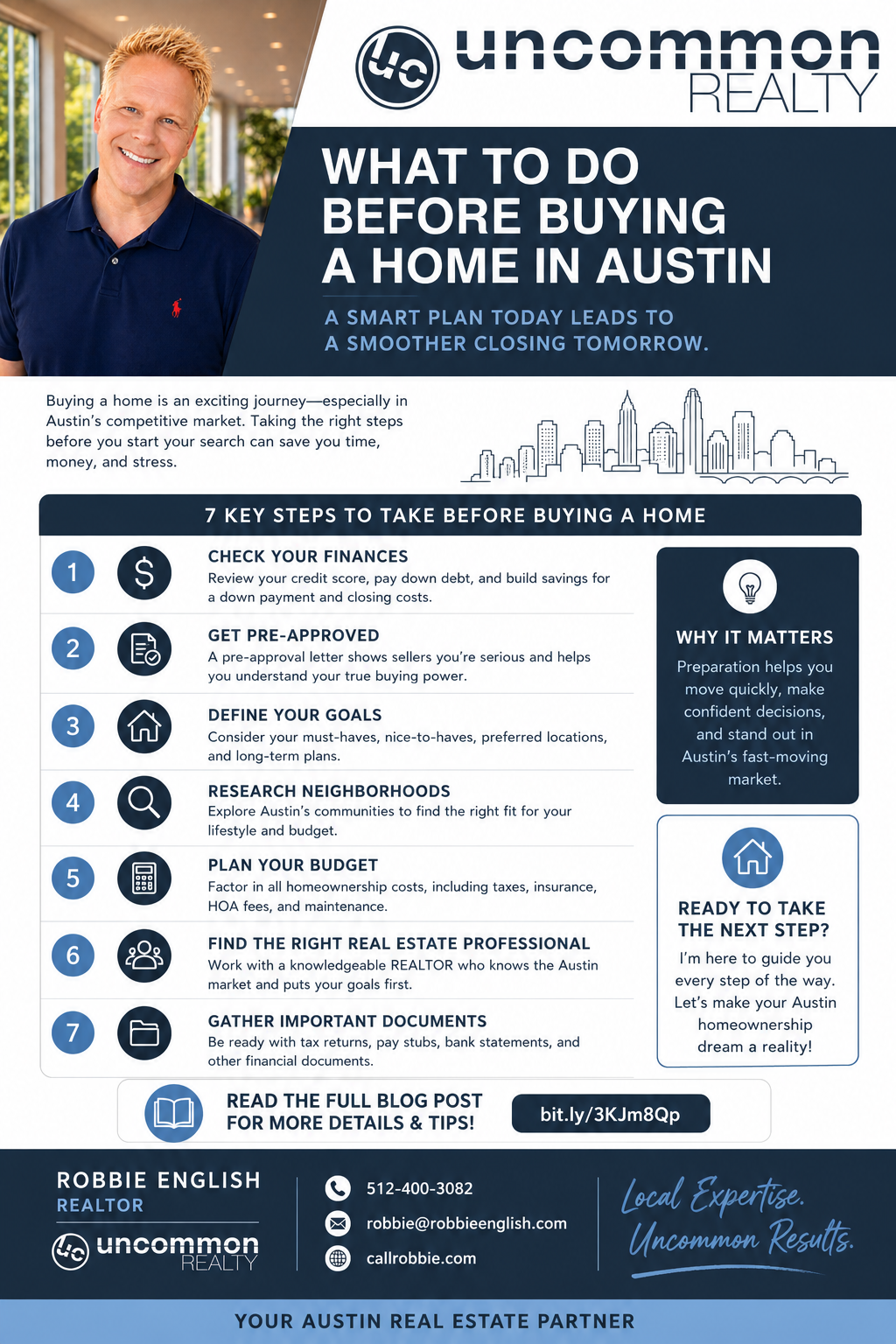
Buying a home in Austin is exciting, but the work you do before you ever tour a house is what determines whether the experience goes smoothly or turns stressful. If you are asking what to do before buying a home in Austin, you are already ahead, because the preparation phase, long before the exciting part of touring homes, is where good outcomes are quietly built. This is a practical, step-by-step guide to those first moves, the ones smart buyers take before they ever start shopping in earnest. I am Robbie English, Broker, REALTOR at Uncommon Realty, and I help buyers get ready to buy well, not merely quickly.

Understand the Austin market before you tour a home
Start by understanding the market you are stepping into, because it shapes your whole strategy. As of 2026, the Austin metro has cooled from its 2022 peak, with the median around $440,000, several months of inventory, and conditions that clearly favor buyers. That means more choice, more time to decide, and real negotiating leverage compared to a few years ago. Knowing this changes how you approach the search: you can be thorough rather than frantic, and you can negotiate rather than waive protections. For a fuller picture of where things stand, I keep an honest read in my guide to Austin real estate market conditions.
Get your finances and credit in order
Before anything else, get your financial house in order, because it determines what you can buy and how strong your offer will be. Check your credit and address any issues early, since your score affects both your approval and your rate. Understand your savings picture: you will need a down payment plus closing costs plus a cushion for moving and immediate repairs, so know those numbers before you fall in love with a price. And avoid big financial moves, new debt, large purchases, or job changes, in the months before you buy, because they can complicate your approval. Getting this foundation right early prevents the most common and most painful surprises later.
It also helps to gather your documentation before you start, because your lender will need it and having it ready keeps everything moving. That typically means recent pay stubs, a couple of years of tax returns and W-2s, recent bank and asset statements, and details on any other debts. If you are self-employed or have variable income, expect a bit more scrutiny and start earlier. The buyers who assemble this ahead of time move through pre-approval quickly and can act fast when the right home appears, while those who wait often lose days scrambling at exactly the moment speed matters most.
Get pre-approved, not merely pre-qualified
Pre-qualification is a rough estimate based on what you tell a lender; pre-approval means the lender has actually verified your income, assets, and credit and is prepared to lend a specific amount. In a market where the best-priced homes still attract interest, a genuine pre-approval is what lets you act decisively and shows sellers you are serious. It also gives you a precise budget to shop within, so you are not wasting time on homes you cannot finance or, worse, falling for one and then discovering you cannot. First-time buyers should also ask their lender about Texas assistance programs, since options through the state exist that many buyers never learn about simply because they do not ask.
Know your true monthly budget, beyond the price
The purchase price is only part of what you will pay, and understanding the full monthly cost before you shop keeps you from stretching too far. In Texas, property taxes are relatively high, commonly running well over one and a half percent of a home's value once you combine city, county, school, and other local rates, which adds a meaningful amount to your payment on top of principal and interest. Factor in homeowners insurance, any HOA or, in some communities, MUD dues, and utilities, which in Central Texas summers are not trivial. A home that looks affordable on the sticker can strain your budget once the full picture is counted, so build that complete number before you set your target price.
A useful exercise is to work backward from a monthly payment you are genuinely comfortable with rather than forward from the maximum a lender will approve. Those two numbers are often quite different, and buying at the top of your approval leaves little room for the property taxes, insurance, and maintenance that come with ownership, let alone life's surprises. In this market you have the luxury of buying comfortably below your ceiling rather than stretching to win, and doing so is one of the best protections against the kind of stress that turns a home into a burden. Deciding your real comfort number up front, and holding to it, keeps the search grounded.
Define what you actually need
With your budget set, get clear on what you truly need versus what would simply be nice. Separate your must-haves, the number of bedrooms, a location that fits your commute, a school zone if that matters, from your preferences, and be honest about which is which. This clarity does more than focus your search; it protects you from being swayed by a beautiful home that does not actually fit your life. It also helps you and your agent filter the market efficiently, which matters even in a buyer's market where there is a lot to look at. The buyers who know their priorities going in are the ones who recognize the right home quickly when it appears.
Research neighborhoods, not only houses
Where you buy shapes your daily life as much as the house itself, so do the area homework before you tour. Austin is really a collection of very different markets, from close-in neighborhoods to the suburbs, each with its own price level, commute, school districts, and feel. Think honestly about your commute, the amenities you want within reach, and how long you plan to stay, since that affects which areas make sense. Visiting neighborhoods at different times of day and week tells you more than any listing photo. The goal is to narrow to the areas that genuinely fit before you invest time touring individual homes.
Part of that homework is being honest about how you will actually live in the area day to day. Where will you buy groceries, how long is the real commute at rush hour rather than midday, what is nearby for the things you do every week, and does the neighborhood's stage of life match yours? Schools deserve special attention if they matter to you, because in Austin quality can vary significantly by attendance zone even within the same district, so verify the specific zone for any home rather than assuming at the city or neighborhood level. Doing this thinking before you tour keeps you from falling for a house in an area that would not actually work for your life.
Line up your agent early
One of the most valuable things you can do before buying is bring in your agent early, not after you have found a home. A good agent helps you refine your budget and priorities, gives you honest, hyperlocal reads on neighborhoods and pricing, sets up a targeted search so you see the right homes first, and prepares you for the offer and negotiation before you are under pressure. In a market with real negotiating room, having someone who knows how to use that leverage on your behalf is a genuine advantage. Bringing representation in at the preparation stage, rather than the offer stage, means every step that follows is smoother.
It is also worth understanding how buyer representation works before you commit, including how your agent is compensated and what the working relationship involves, so there are no surprises. A good agent will walk you through that transparently up front. Choose someone who knows the specific areas you are considering, communicates the way you prefer, and is candid with you, including when a home you like is a bad idea, rather than simply agreeable. That honesty is worth far more than enthusiasm, and it is exactly what you want in your corner when the stakes are this high.
Understand the process before you need it
Knowing how a Texas purchase actually works removes a lot of stress once you are in it. Offers here are made on the standard one-to-four family residential contract, your earnest money is a good-faith deposit that applies to your purchase, and the termination-option period gives you a negotiated window to inspect the home and, if needed, walk away. Understanding these pieces before you write an offer means you can move quickly and confidently when the right home appears. I walk through the entire transaction in detail in my home buying process step-by-step guide, which picks up right where this preparation leaves off.
Prepare to act with a clear head
Finally, prepare yourself mentally. Buying a home is emotional, and even in a calmer market the right home can create urgency. The buyers who do best have already done the work, so they can move decisively without panicking, and they know their limits, so they do not overpay in a moment of excitement. Preparation is what lets you be both decisive and disciplined, which is exactly the combination this market rewards. It also keeps the process from feeling like a series of rushed, high-pressure decisions, and instead turns it into a set of considered steps you have already thought through in advance. When you have your finances ready, your priorities clear, and your team in place, the actual purchase becomes far less daunting.
It also helps to set expectations about the timeline itself. From the day an offer is accepted, a financed purchase typically takes about thirty to forty-five days to close, and the search that precedes it can take weeks or months depending on how specific your needs are and what inventory is available. Knowing that ahead of time keeps you patient during the search and prepared to move efficiently once you are under contract. Rushing rarely helps, and neither does waiting for a mythical perfect moment; the buyers who succeed are simply ready when the right home shows up.
How I help
When buyers come to me at the preparation stage, we lay the groundwork together: clarifying budget and the full monthly cost, connecting you with a solid lender, defining priorities, and targeting the right neighborhoods, so that when you start touring you are ready to act. Then I represent you through the offer, the option period, inspections, and closing with the current market's leverage on your side. My team and I do this across the Austin metro, and you can reach Uncommon Realty whenever you want to talk it through.
The best first step is simply to start. Download my real estate app to follow the market and get a feel for what your budget buys, and reach out whenever you are ready to prepare in earnest. Even a short early conversation can save you weeks later by getting your preparation pointed in the right direction from the start. When you are ready to buy a home in Austin, I am here to help you do it with clear eyes and real numbers.
Written for buyers and sellers in the Greater Austin, Texas area by Robbie English, REALTOR, Broker at Uncommon Realty.
Categories
- All Blogs (959)
- !!! (59)
- !x (621)
- Austin Real Estate (106)
- Bee Cave Real Estate (1)
- Building A Home (14)
- Buying A Home (143)
- Buying Land (1)
- Cedar Park Real Estate (57)
- Central Austin Real Estate (75)
- Down Payment Assistance Programs (1)
- Downsizing (3)
- Downtown Austin Real Estate (5)
- Dripping Springs Real Estate (62)
- East Austin Real Estate (3)
- Financing and Mortgage (23)
- first-time homebuying (109)
- Georgetown Real Estate (9)
- Hill Country Real Estate (1)
- HOA (2)
- Home Appraisals (13)
- Home For Rent (1)
- Home Inspections (6)
- Home Pricing (6)
- Home Staging (1)
- Home Values (12)
- Homeownership (1)
- Homes For Rent (1)
- Homes For Sale (147)
- Hutto Real Estate (5)
- Investing (6)
- Investment Properties (4)
- Lakeway Real Estate (33)
- Leander Real Estate (59)
- LGBT+ Real Estate (8)
- Luxury Homes For Sale (5)
- Luxury Real Estate (19)
- Market Conditions (16)
- Moving to Austin (2)
- Moving to Texas (4)
- Negotiations (3)
- Neighborhoods (8)
- Northwest Austin Real Estate (94)
- Off Market Listings (7)
- Pflugerville Real Estate (10)
- Private Listings (2)
- Property Management (42)
- Property Tax (3)
- Real Estate (18)
- Reddit Question Answered (80)
- redwrite (63)
- Relocation (2)
- Renting (6)
- Representation (34)
- Round Rock Real Estate (58)
- Selling Your Home (62)
- South Austin Real Estate (1)
- Westlake Real Estate (3)
Recent Posts