Homes With Pools For Sale

Searching for homes with pools for sale in Central Texas is about more than a nice photo. A pool shapes how you use a home, what it costs to own, and how it resells, so it pays to understand the real tradeoffs before you buy. This guide covers what a pool actually costs to build versus buy, whether pools add value in Texas, the ongoing expenses, what to inspect on an existing pool, and where to find pool homes across the Austin area.
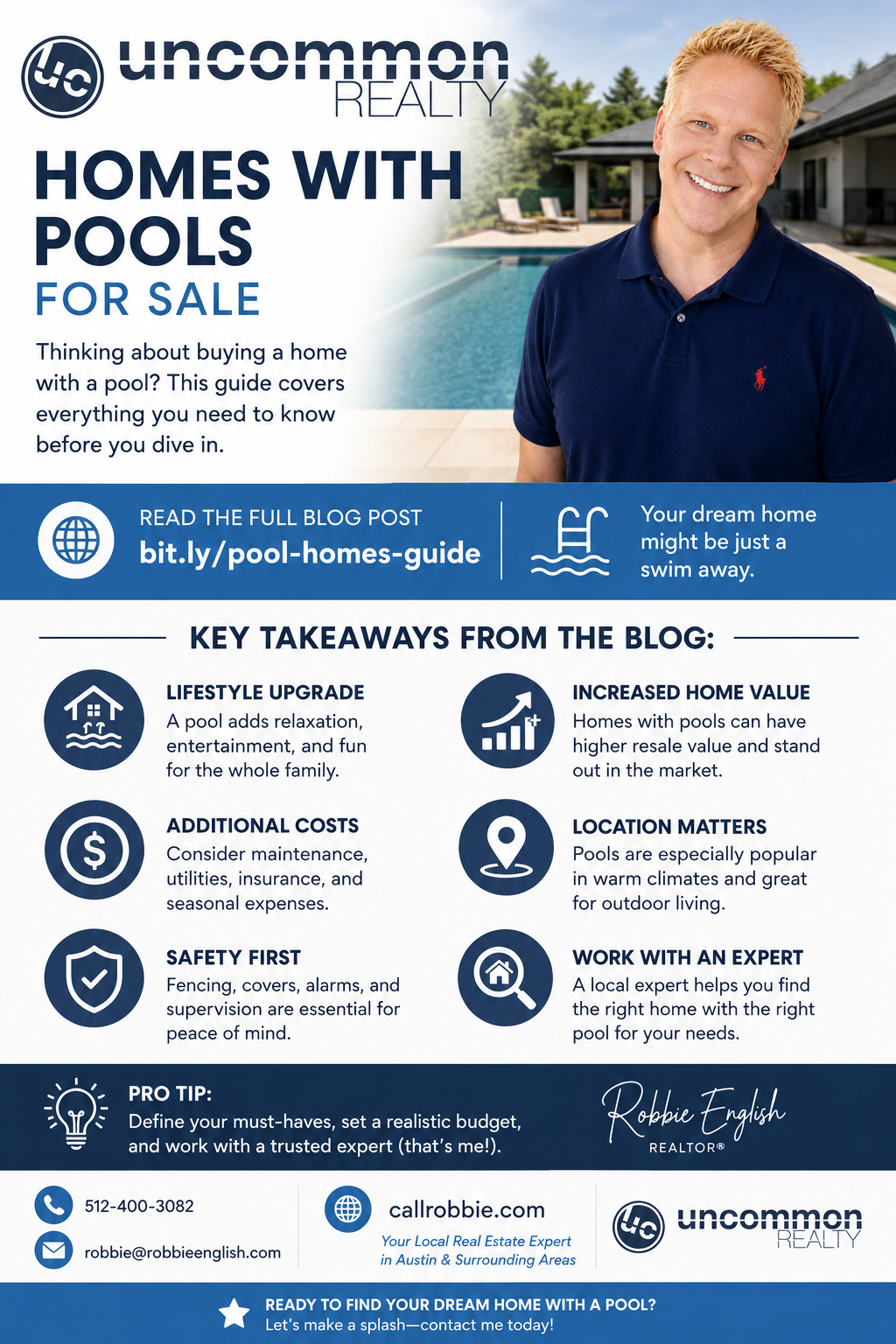
My name is Robbie English, Broker, REALTOR at Uncommon Realty. I help buyers weigh these decisions every day, and my goal here is to give you an honest picture of pool ownership so the backyard that sells you on a home is also one you are glad to own for years.

Why Pools Are So Popular In Central Texas
Central Texas has a long swim season. With hot summers stretching well beyond the calendar months most regions enjoy, a private pool is genuinely usable for a large part of the year, which makes it more than a luxury here. For many families, a pool becomes the center of summer life: a place to cool off, entertain, and spend weekends at home rather than fighting crowds elsewhere.
That demand keeps pool homes attractive on the market. But the practical realities of cost, upkeep, and resale matter just as much as the lifestyle appeal, so let's look at the numbers honestly before we get to the areas where you will find these homes.
There is also a comfort factor worth naming. Austin summers are hot enough that outdoor time is limited without a way to cool off, and a backyard pool turns the hottest months into the best ones. It changes how a family uses its home, encouraging people to stay in, host friends, and spend evenings outside. For buyers relocating from cooler climates, that shift in daily life is often the thing that makes a pool feel worth the cost once they experience a full Central Texas summer.
What A Pool Really Costs: Build Versus Buy
Building a pool in the Austin area is a significant investment. A new in-ground gunite pool typically runs in the range of roughly $57,000 to $100,000 or more, with an average around $76,000, and premium designs or difficult sites push higher. Fiberglass pools are less expensive, often averaging in the low-$30,000s, and permitting alone commonly adds $1,000 to $3,000. Central Texas limestone can also raise excavation costs when rock is encountered.
This is exactly why buying a home that already has a pool is usually the smarter financial move for pool-seekers. Because pools rarely return their full cost at resale, an existing, well-maintained pool is frequently priced into the home well below what it would cost you to build the same pool from scratch. If a pool is a must-have, shopping for homes that already have one often gets you more pool for your money than buying a poolless home and adding one later.
Do Pools Add Value In Texas?
Pools do add value in a hot market like Texas, but rarely dollar-for-dollar. On average a pool can add somewhere around $50,000 to a typical Austin-area home's value, yet the return on the construction cost generally lands in the 30 to 60 percent range. In other words, a $70,000 pool might recover a fraction of that at sale, even though it makes the home more marketable to the right buyer.
The type matters, too. In-ground gunite and fiberglass pools are the ones that reliably add appraised value; above-ground pools generally add little and can even deter some buyers. As a buyer, this works in your favor: you benefit from the seller's sunk cost. As a future seller, it means you should buy a pool because you want to use it, not purely as an investment play.
Pool Types And What Each Means For You
Not every pool is the same, and the type affects cost, maintenance, and longevity. Gunite (sprayed concrete) pools are the most common in Central Texas and the most customizable in shape and size; they are durable but need periodic resurfacing, typically every ten to fifteen years. Fiberglass pools are pre-formed, install faster, cost less, and are easier on chemicals and cleaning, but come in fixed shapes and sizes. Vinyl-liner pools are the least common here and require liner replacement over time.
Beyond the shell, look at how the pool is sanitized and heated. Saltwater systems have grown popular for gentler water and lower chemical handling, though the equipment costs more up front and salt can be hard on some surfaces and nearby stonework. A heater extends your season into the cooler months but adds to both purchase and operating costs. Automation, LED lighting, and features like spas or water features are wonderful to inherit on an existing home but expensive to add, another reason buying a home with the pool already built often makes sense.
The Ongoing Costs: Maintenance, Utilities, And Insurance
The purchase is only the beginning. All-in, owning a pool in Central Texas commonly runs somewhere in the range of $4,000 to $12,000 per year once you add up electricity for the pump, water for refilling and evaporation in the heat, chemicals, and periodic repairs. A weekly cleaning service typically costs $80 to $150 per visit, or you can handle maintenance yourself for less. Plan, too, for larger periodic expenses like resurfacing and equipment replacement over the pool's life.
Insurance is another factor buyers overlook. Pools are considered an "attractive nuisance," so insurers usually recommend raising your liability coverage, often to around $500,000, and many owners add an umbrella policy for roughly $200 to $300 a year per million in coverage. The premium bump for the pool itself is often modest, but the liability side is real, and Texas has pool barrier and fencing requirements you will need to meet. Build these ongoing costs into your budget before you fall for the backyard.
What To Check Before Buying A Home With A Pool
When you find a home with a pool you love, evaluate the pool as carefully as the house. A standard home inspection does not fully cover pool systems, so order a dedicated pool inspection. Have the equipment assessed for age and condition, the pump, filter, and any heater, since these are expensive to replace. Ask when the pool was last resurfaced, whether it holds water without leaking, and the condition of the decking, coping, and tile.
Also look at the practical fit: does the lot offer privacy and the right sun exposure, is there a safety fence or enclosure that meets code, and is the pool a type and size you actually want to maintain? Saltwater versus traditional chlorine, heating, and automation all affect both cost and enjoyment. Knowing what you are inheriting lets you negotiate on price or repairs from a position of information. For the broader home-evaluation picture, see my guide on what to look for when buying a home in Austin.
Pay particular attention to older pools. A pool that is fifteen or twenty years old may be perfectly sound, but it may also be approaching a resurfacing, a re-tile, or an equipment overhaul, each of which can run into the thousands. Cracks in the shell, persistent water-level loss, rust stains, dated or failing equipment, and decking that has heaved on Central Texas clay soil are all worth pricing out before you commit. None of these are automatic dealbreakers, but they are the difference between a turnkey backyard and a project, and you want to know which one you are buying. A qualified pool inspector can give you a realistic sense of the pool's remaining life and the repairs on the horizon, which is exactly the information that lets you make a confident offer.
Pool Homes By Area Across The Austin Metro
Pool homes are available across the region, and each area offers a different mix of price, lot size, and lifestyle. Here is where to look, with a search for each so you can browse current listings.
In the city core, Austin and Central Austin pool homes tend to command a premium for location and walkability, often on smaller lots. To the northwest, Northwest Austin balances established neighborhoods, good schools, and larger lots that suit backyard pools well.
In the fast-growing northern suburbs, Cedar Park, Leander, and Round Rock offer newer construction and strong value, where an $800,000 budget often buys a larger pool home than it would closer in. Continuing north and east, Georgetown, Hutto, Jarrell, and Pflugerville stretch a budget further, with more space for the money.
For a Hill Country and lake lifestyle, Lakeway, Bee Cave, Spicewood, Dripping Springs, and Jonestown deliver larger lots, views, and a more resort-like feel, which pairs naturally with a pool. Each of these areas has its own price points and tradeoffs, and the right one depends on your budget, commute, and how much land you want.
Who A Pool Home Is Right For
A pool home fits buyers who will genuinely use it: families who want summers at home, entertainers, and anyone who values a private retreat in a climate that rewards it. It suits buyers who are comfortable budgeting for the ongoing upkeep and who want the lifestyle now rather than taking on a year-long construction project.
It is a weaker fit for buyers on a tight monthly budget who would feel the maintenance costs, those who travel constantly and would rarely use it, or buyers focused purely on maximum resale return per dollar. Being honest about how you will actually use a pool is the fastest way to know whether to prioritize one in your search. If a pool is a nice-to-have rather than a must-have, keeping it as a preference rather than a hard filter will also open up more homes and give you more room to negotiate.
Bringing It All Together
Homes with pools are a genuine draw in Central Texas, where the long swim season makes them usable much of the year. The keys to buying well are understanding that buying an existing pool usually beats building one financially, that pools add marketability more than full dollar-for-dollar value, and that the ongoing costs and a proper pool inspection deserve real attention. Get those right, and a pool home is a purchase you will enjoy for years.
When you are ready to look, you can browse and save homes on my website or through my app, filtering for pools in the exact areas and price range that fit you. When you find a contender, I am glad to help you evaluate the pool and the home together and negotiate with confidence.
Written for buyers and sellers in the Greater Austin, Texas area by Robbie English, REALTOR, Broker at Uncommon Realty.
Categories
- All Blogs (898)
- !!! (59)
- !x (594)
- Austin Real Estate (100)
- Bee Cave Real Estate (1)
- Building A Home (14)
- Buying A Home (137)
- Buying Land (1)
- Cedar Park Real Estate (54)
- Central Austin Real Estate (71)
- Down Payment Assistance Programs (1)
- Downsizing (3)
- Downtown Austin Real Estate (5)
- Dripping Springs Real Estate (60)
- East Austin Real Estate (3)
- Financing and Mortgage (23)
- first-time homebuying (107)
- Georgetown Real Estate (9)
- Hill Country Real Estate (1)
- HOA (2)
- Home Appraisals (12)
- Home For Rent (1)
- Home Inspections (6)
- Home Pricing (5)
- Home Staging (1)
- Home Values (12)
- Homeownership (1)
- Homes For Rent (1)
- Homes For Sale (115)
- Hutto Real Estate (5)
- Investing (6)
- Investment Properties (4)
- Lakeway Real Estate (31)
- Leander Real Estate (58)
- LGBT+ Real Estate (8)
- Luxury Homes For Sale (4)
- Luxury Real Estate (19)
- Market Conditions (15)
- Moving to Austin (2)
- Moving to Texas (4)
- Negotiations (3)
- Neighborhoods (8)
- Northwest Austin Real Estate (93)
- Off Market Listings (7)
- Pflugerville Real Estate (10)
- Private Listings (2)
- Property Management (42)
- Property Tax (3)
- Real Estate (18)
- Reddit Question Answered (79)
- redwrite (62)
- Relocation (2)
- Renting (6)
- Representation (30)
- Round Rock Real Estate (56)
- Selling Your Home (60)
- South Austin Real Estate (1)
- Westlake Real Estate (2)
Recent Posts